Baby Gate for Stairs: The Definitive Buying Guide for 2026

About 93,000 children under 5 are treated in U.S. emergency rooms each year for stair-related injuries, which works out to roughly one child every six minutes, according to a Nationwide Children’s Hospital analysis of CPSC NEISS data. That number stopped me cold when I first read it. My older daughter was 14 months old, newly walking, and absolutely fearless about the stairs in our 1920s craftsman. We installed our first gate that same week. After installing, testing, and replacing gates in three different homes, I’ve learned that the difference between a gate that works and one that fails is almost never the price tag. It’s the details.
The Standard Every Gate Must Meet
Before you look at a single product listing, you need to know one thing: any gate marketed for use with children must comply with ASTM F1004, the federal safety standard for expansion gates and expandable enclosures, made mandatory under 16 CFR Part 1239 (effective 2021). This standard sets the floor, not the ceiling. It governs how much force a gate must withstand before failing, how the latch must function to resist a toddler’s attempts to open it, and how the gate must perform across repeated use cycles.
Look for the ASTM F1004 certification mark on the packaging. If it isn’t there, put the gate back. The JPMA (Juvenile Products Manufacturers Association) runs an independent certification program that tests gates against this standard, and their seal provides additional confidence, though ASTM compliance is the baseline requirement.
The standard also addresses spindle spacing. The gap between vertical bars or mesh openings must not exceed 4.25 inches to prevent head entrapment. Check this on the gate itself and on any extension panels you add. Extension panels are a common weak point. A gate body might pass, but a third-party or off-brand extension can introduce gaps that the original design never had.
Hardware-Mounted vs. Pressure-Mounted: This Is the Decision That Matters Most
Every other choice flows from this one.
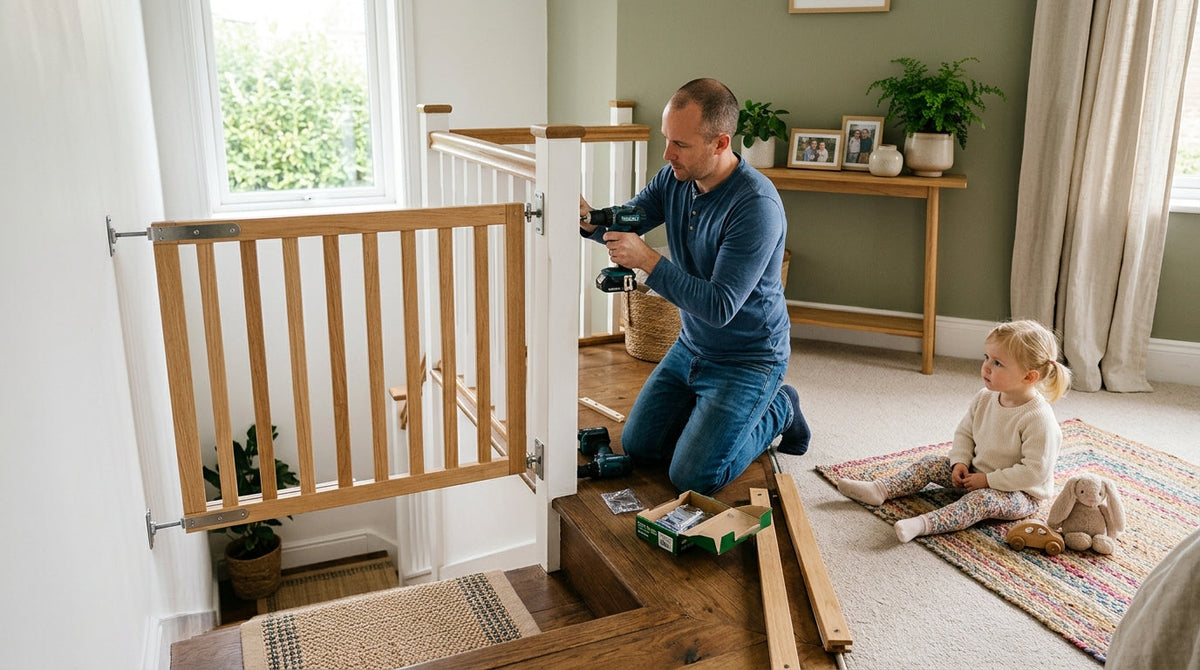
Hardware-mounted gates attach directly to the wall, door frame, or stair structure using screws and mounting brackets. They do not move when pushed, kicked, or leaned on. For top-of-stairs installation, hardware mounting is the only acceptable option. A pressure-mounted gate at the top of a staircase is a fall waiting to happen.
Pressure-mounted gates use a threaded spindle or spring mechanism to create tension against the surrounding surfaces. They are faster to install, leave no holes, and are easier to move between locations. They are appropriate at the bottom of stairs or in interior doorways where a fall risk is lower. They are not appropriate at the top of stairs, full stop.
In my experience, a pressure-mounted gate at a doorway can fail when a determined toddler applies sustained lateral pressure. One gate I installed held fine for weeks until a child figured out that pushing in one direction would walk the feet off the frame. That experience ended my use of pressure-mounted gates anywhere near a staircase.
If you rent and cannot drill into walls, verify that a pressure-mounted model meets your safety needs before you buy it. Some manufacturers sell "rental-friendly" hardware-mounted kits that use adhesive anchor plates or furniture-bolt systems. These are worth investigating if your lease prohibits wall penetration. But pressure-mounted at the top of stairs is not a compromise. It’s a hazard.
One practical note on pressure-mounted models: if you use one at the bottom of stairs or in a doorway, check the tension weekly. These gates loosen over time, especially in high-traffic areas or on textured surfaces. If the gate wobbles or shifts when you push it, tighten it immediately or replace it.
Top-of-Stairs Gates: Non-Negotiable Features
A gate installed at the top of a staircase needs to do two things a bottom-of-stairs gate does not: it must be hardware-mounted, and it must have a self-closing, self-latching mechanism.
Self-closing means the gate swings shut under its own weight or spring tension after you walk through. Self-latching means it locks automatically without you touching the latch. These two features exist because adults forget. The gate closes and locks itself so your child cannot follow you through an opening you didn’t realize you left.
Swing direction is a detail that trips up a lot of parents. A gate that swings into the stairwell creates a fall hazard because you could push it open and step into empty air. A top-of-stairs gate should swing away from the stairs, into the room. Measure the clearance on the room side before you buy. Some gates swing only one direction; others are configurable. Confirm which you’re getting.
Also measure the depth of your stair opening. Many staircases have a newel post on one side and a wall on the other, and the mounting surfaces are not parallel. Some gates include angled mounting hardware for exactly this situation. If yours doesn’t, you’ll need to add a spacer block or choose a different model.


Measuring Your Opening: Do This Before You Look at a Single Product
Standard interior doorways run 28–36 inches wide, but stair openings are frequently wider or irregular. Measure the width of your opening at three heights: near the floor, at mid-height, and near the top. If the measurements differ by more than half an inch, your walls are not parallel and you’ll need a gate with adjustable mounting hardware or an angled bracket kit.
Then check the manufacturer’s stated range. Most gates have a base width and an extension capability. A gate listed as "fits openings 29–44 inches" means the gate body plus included extensions covers that range. If your opening is 46 inches, you need either a wider model or an additional extension panel sold separately.
When you add extension panels, re-check the spindle spacing. I mentioned this above, but it bears repeating. Extensions can introduce wider gaps at the join points, and a 4.25-inch gap is the maximum, not a target.
Write down your exact measurement before you open a browser tab. It takes two minutes and it prevents a return trip to the hardware store.
Gate Material Comparison
| Material | Durability | Best Use | Key Risk |
|---|---|---|---|
| Steel / Aluminum | Highest | Top of stairs | None significant |
| Wood | Moderate | Interior doorways | Splinters over time |
| Mesh / Fabric | Moderate | Wide openings, bottom of stairs | Loose edges, entanglement |
| Plastic | Lowest | Temporary use only | Cracks under impact |
Latch Mechanisms: Dual-Action vs. Single-Release
The latch is the gate’s last line of defense. Toddlers are persistent and surprisingly dexterous. A single-button or single-lever release is faster for adults but easier for a motivated toddler to figure out. In my experience, children can defeat simple adhesive strap locks through sustained effort and coordination.
Dual-action latches require two simultaneous motions to open, typically a lift-and-push or squeeze-and-pull combination. They are meaningfully harder for young children to operate because the two motions require coordination that most toddlers under 3 haven’t developed. They are slightly slower for adults, which becomes relevant at 2 a.m. when you’re navigating a dark hallway.
If your household includes older children, frequent babysitters, or grandparents who may not remember to re-latch, a dual-action mechanism adds a real layer of protection. Older kids often leave gates open out of habit. A self-latching gate solves that problem entirely.
Some premium gates combine self-latching with a dual-action manual override. This is the configuration I’d recommend for top-of-stairs installations.
Installing a Hardware-Mounted Gate: Quick Reference
-
Read all instructions first
Read the full manufacturer instructions before picking up any tools. Confirm hinge side and swing direction. -
Locate studs or select anchors
Find wall studs at each mounting point. If none align, use anchors rated for your gate’s stated weight load. -
Mount brackets at correct height
Attach wall brackets using only the provided hardware. Do not substitute screws of a different length or gauge. -
Hang gate and check swing direction
Confirm the gate swings away from the stairwell into the room, with adequate clearance on the room side. -
Test before trusting
Push hard from both sides, try to lift the gate off brackets, and cycle the latch at least 10 times. -
Re-check after one week
Tighten all screws after the first week. Wall material settles around anchors and screws can back out slightly.
Retractable Gates: When They Work and When They Don’t
Retractable gates use a mesh panel that rolls into a wall-mounted housing when not in use. They are excellent for wide openings, open floor plans, and situations where a swinging gate would block traffic flow. When the mesh is extended and locked, a quality retractable gate is solid and difficult to push through.
They are not appropriate for top-of-stairs use. The cord or strap mechanism that guides the mesh creates an entanglement risk, and the mesh itself, while strong, does not provide the rigid frame that a stair gate requires. Use retractable gates at the bottom of stairs, in wide hallways, or in doorways where a traditional gate would be impractical.
Retractable gates also require more maintenance than rigid models. Inspect the cord and locking mechanism monthly. Look for fraying, kinking, or any resistance when extending or retracting the mesh. A mechanism that sticks is a mechanism that will eventually fail to lock.
Material Matters More Than It Looks
Metal gates, typically steel or aluminum, are the most durable option. They don’t warp, they don’t splinter, and they hold their shape under repeated impact. If you have a child who treats the gate as a climbing structure (and many do), metal is the right choice.
Wood gates are attractive and can blend into traditional home interiors, but wood can splinter over time, especially at joints and edges. If you choose a wood gate, inspect it every few months for cracks or rough edges.
Mesh and fabric panels are common on retractable gates and some pressure-mounted models. The mesh must be tightly secured to the frame with no loose edges. A loose edge is something a child can grab, chew, or catch a finger in. Run your hand around the entire perimeter of a mesh gate before you install it, and repeat that check every month.
Plastic gates are generally the least durable option for stair use. Plastic can crack under impact and may not hold its shape over years of use. For stair applications, metal is the better choice.
Budget, Certification, and Where to Shop
Basic pressure-mounted gates start around $30–50. Hardware-mounted gates for stair use typically run $80–150. Retractable models and wide-opening configurations can reach $150–200 or more. These are real ranges, not minimums.
The certification is not optional. A $35 gate with ASTM F1004 certification is safer than a $120 gate without it. When you’re shopping online, look for the certification mark in the product images or listed explicitly in the specifications. If the listing doesn’t mention ASTM F1004 or JPMA certification, contact the seller before buying. Uncertified gates exist on major retail platforms, and they look identical to certified ones in listing photos.
Buy from retailers that carry the original manufacturer’s extension panels. Using off-brand extensions voids most manufacturers’ safety certifications and, as noted above, can introduce spacing problems that the gate was never designed to have.
Pre-Purchase Gate Checklist
Installation: Where Gates Fail
The gate itself is rarely the problem. Installation is where things go wrong.
Read the manufacturer’s instructions before you pick up a drill. Mounting the hinge side incorrectly requires redoing the entire installation, which takes significantly longer than reading the instructions first.
Use all provided hardware. Manufacturers include specific screws, anchors, and spacers for a reason. Substituting a longer screw because you ran out of the provided ones can cause the bracket to crack the wall surface or fail to seat correctly.
If you’re mounting into drywall without a stud behind the mounting point, use the wall anchors specified for your gate’s weight rating. Most gate manufacturers specify a minimum stud or anchor rating. Drywall alone will not hold a gate under force.
After installation, test the gate before you trust it. Push on it hard from both sides. Try to lift it off the brackets. Operate the latch repeatedly. If anything feels loose or off, stop and troubleshoot before your child gets near it.
Check the installation again after the first week of use. Screws can back out slightly as the wall material settles around the anchor. A quick check with a screwdriver takes 30 seconds.
A Quick Checklist Before You Buy
Before you finalize any gate purchase, confirm the following:
The Bottom Line on Stair Gates
Stair gates are one of the few baby-proofing purchases where the consequences of getting it wrong are immediate and severe. About 93,000 children under 5 are treated in emergency rooms each year for stair-related injuries. A certified, correctly installed gate removes a significant portion of that risk during the years when children are most vulnerable.
The right gate for your home is the one that fits your specific opening, is mounted correctly for its location, carries ASTM F1004 certification, and gets checked regularly after installation. Spend what you need to spend to get those things right. The gate will last through your child’s stair-climbing years, and you’ll use it every single day.