Every skill your baby learns in the first year is a reason to celebrate. It is also, almost always, a reason to reassess your home.
That sounds alarming. It isn’t meant to. What it means is that development and danger are linked in a very specific, predictable way: each new physical ability opens a new category of risk that simply didn’t exist the week before. A baby who can’t roll can’t fall off a changing table. A baby who can’t pull to stand can’t tip a bookshelf. The skills arrive on a schedule, more or less. The hazards follow right behind them.
Rolling Over: The First Surprise (Around 2–4 Months)
Most parents aren’t ready for the first roll. It happens fast, often earlier than expected, and it tends to happen on a surface where a fall would matter: a changing table, a couch, a bed.
The safety implication is straightforward. Once your baby can roll, she can move off an elevated surface in seconds. Keep one hand on her during every diaper change, even when you’re reaching for a wipe that’s six inches away. Better yet, move diaper changes to a floor mat before you think you need to.
Rolling also changes the sleep equation. The AAP’s safe sleep guidance recommends placing babies on their backs to sleep. Once a baby can roll both ways independently, you don’t need to reposition them during the night. But until that point, a firm, flat sleep surface with no loose bedding, bumpers, or inclined inserts remains essential. According to CDC SUID data, about 3,500 infants die each year from sleep-related causes in the United States. Many of those deaths involve unsafe sleep environments that a mobile baby can shift into a dangerous position within.
Sitting Up: The World Gets Bigger (Around 4–7 Months)
Sitting up seems benign. It is, mostly. But it marks the moment your baby begins to interact with the environment in a new way: reaching, grabbing, pulling things toward her mouth.
Everything at arm’s reach is now a choking hazard. Get down on the floor and look at your space from a seated baby’s perspective. Coins, button batteries, small toy pieces from older siblings, pen caps. The rule of thumb is that anything that fits inside a toilet paper roll is a choking risk for a child under three. At this age, that means active floor supervision and a cleared play space.
Sitting also means your baby is now upright enough to be placed in a high chair, a bouncer, or a bath seat. Each of these carries its own hazard profile. Harnesses in high chairs must be buckled every single time, even for a meal that takes four minutes. Bath seats are not safety devices. The AAP is explicit: a bath seat is a bathing aid, not a substitute for adult supervision, and a child can drown in as little as one to two inches of water.


Crawling: The Radius Expands (Around 7–10 Months)
Crawling is the milestone that tends to catch parents most off guard, because it happens gradually and then suddenly. One week your baby is rocking on all fours. The next week she is across the room and under the coffee table.
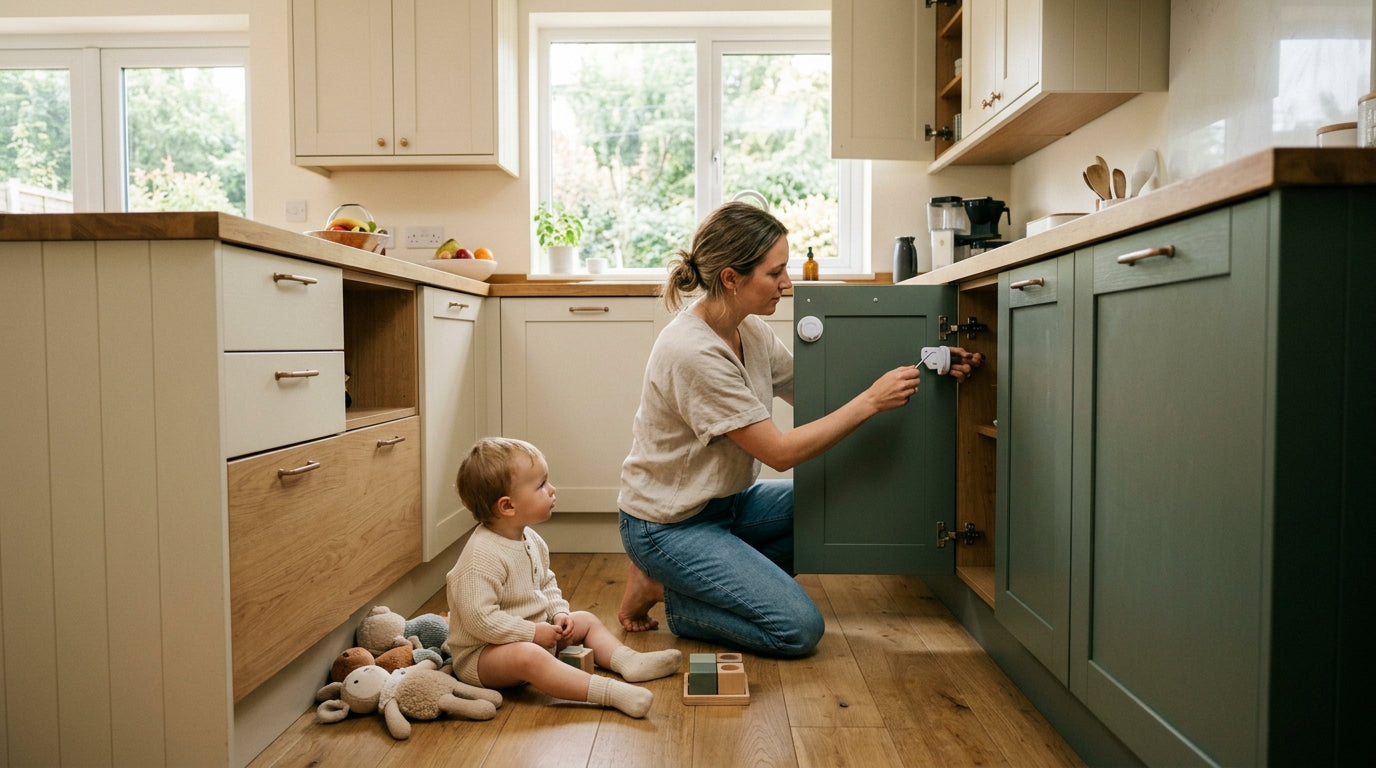
This is when outlet covers go in, if they aren’t already. This is when cabinet locks become urgent. Under the kitchen sink is the most common location for cleaning products in most homes, and it is exactly the height a crawling baby heads toward. ASTM F3492–21 is the voluntary consumer safety standard that applies to cabinet locks and latches in the U.S. Not all locks are equal. A 2012 CPSC recall pulled 900,000 Safety 1st Push 'N Snap cabinet locks after reports of children as young as 9 months opening them, with three children reaching toxic cleaning products before anyone intervened.
In my experience, a nine-month-old can empty the cabinet under the bathroom sink in the time it takes to answer the doorbell. The magnetic lock I hadn’t installed yet was still in its packaging on the counter above. After that, I installed locks before the skill arrived, not after.
Per CDC PROTECT data, unsupervised medication exposures send roughly 100 children under five to U.S. emergency departments every day. That number doesn’t shrink because a bottle has a child-resistant cap. Under 16 CFR 1700.15, packaging passes the "child-resistant" bar if at least 85% of tested children (ages 42–51 months) can’t open it within 10 minutes. That means roughly 15–20% of children in that age range can get in. Child-resistant packaging is a layer of protection, not a lock.
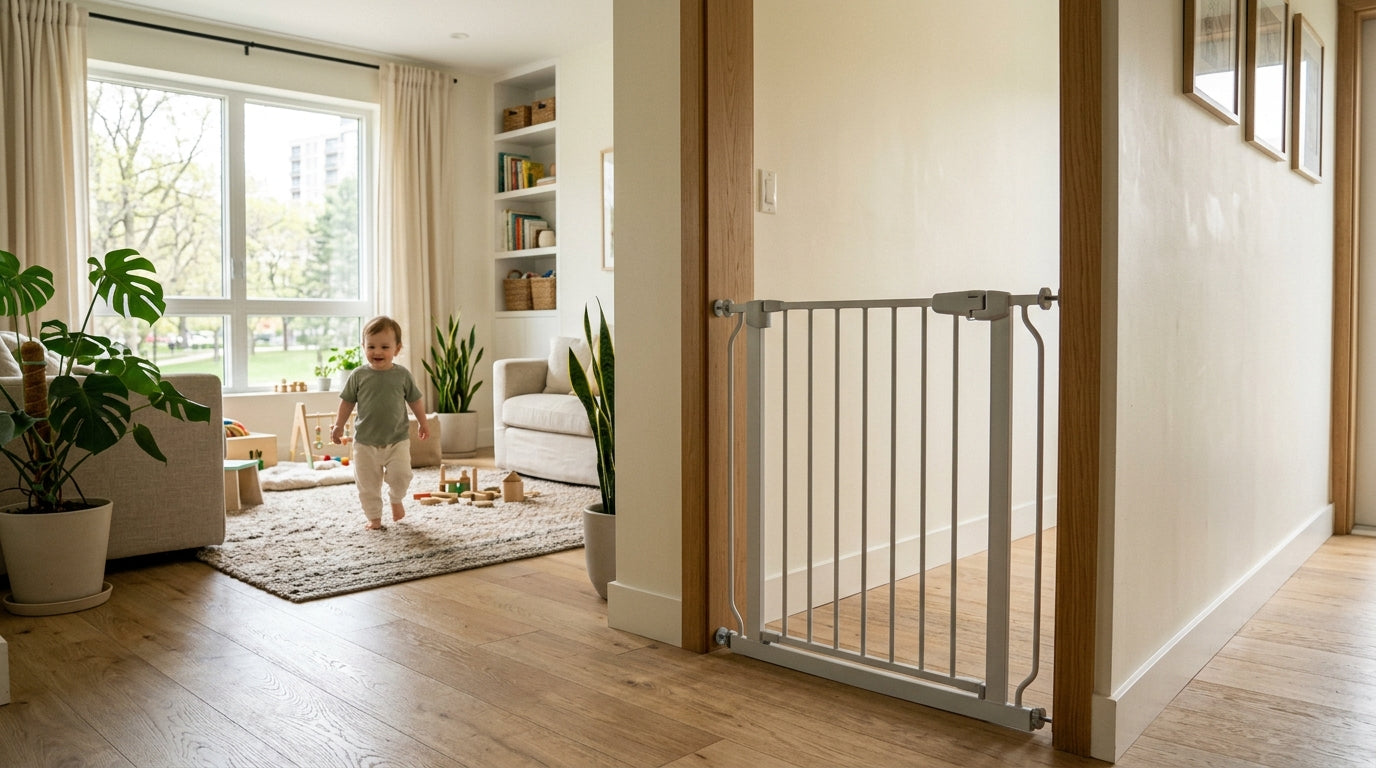
Crawling also means stairs. About 93,000 children under 5 are treated in U.S. emergency rooms each year for stair-related injuries (Nationwide Children’s analysis of CPSC NEISS data, 1999–2008). ASTM F1004 is the federal safety standard for expansion gates and expandable enclosures, made mandatory under 16 CFR Part 1239 (effective 2021). Hardware-mounted gates belong at the top of stairs. Pressure-mounted gates are acceptable at the bottom. Install them now, before your baby figures out the staircase is there.

- Under-sink cabinet: cleaning products within reach
- Uncovered outlet at baseboard height
- Stair entry: no hardware-mounted gate installed
- Low shelf: medications and small objects accessible
Pulling to Stand: The Tip-Over Window Opens (Around 8–11 Months)
Pulling to stand is the milestone that changes furniture safety from a background concern to an immediate one. Your baby will grab whatever is nearby: a bookshelf, a TV stand, a floor lamp, a dresser drawer she’s pulled open as a step. None of these were designed to bear a baby’s sudden lateral weight.
CPSC reports one child death every two weeks from tip-overs involving furniture, TVs, or appliances. The victims are overwhelmingly toddlers, but the hazard is established the moment a baby begins pulling up. Anchor your furniture now. Every tall bookshelf, every dresser, every TV stand. Anti-tip straps cost a few dollars and take twenty minutes to install. I know parents who put it off because the straps are visible or because the furniture is heavy and "probably fine." It isn’t probably fine. The weight of the furniture is part of the problem: when a child pulls on a drawer, the piece pivots forward at the base, and the top comes down fast.
In my experience, an adhesive furniture strap can be defeated by a 26-month-old. She didn’t tip the dresser, but she could have. After that, every piece in our house got hardware-mounted straps into studs.
Pulling to stand also means your baby is now at counter height in many rooms. Tablecloths become a hazard. Anything sitting on a low table or the edge of a counter is reachable. Hot liquids are a serious burn risk. Move mugs of coffee away from table edges, and keep your baby out of the kitchen when anything is on the stove.


Cruising: Speed and Pinch Points (Around 9–12 Months)
Cruising, where a baby moves along furniture while holding on, introduces two hazards that parents often overlook: speed and doors.
A cruising baby moves faster than a crawling one and is less stable. Falls are frequent. Corner protectors on coffee tables and hearths matter here. So does clearing the path between pieces of furniture your baby uses as a highway.
Doors become a pinch hazard the moment a baby can reach a door edge and pull. Roughly 4 in 10 pediatric door-injury emergency department visits happen to children age 4 or younger. Door pinch guards, the foam or silicone sleeves that wrap around the hinge side and the latch side of a door, are inexpensive and useful at this stage.
Cruising babies also start reaching up onto surfaces they couldn’t access before. This is when you reassess what’s on low shelves and end tables. It is also when blind cord safety becomes critical. Corded window blinds are a strangulation hazard for children, and a cruising baby who can reach a dangling cord is at risk. Cordless blinds or cord wind-ups are the standard recommendation.
First Steps: The Whole House Is Now the Hazard Zone (Around 10–14 Months)
Walking changes everything, mostly because it changes your child’s range and speed simultaneously. A walking baby can cover ground in any direction, open doors that were previously too heavy, and reach things that were previously too high.
This is the point where your whole-home safety audit needs to be complete, not in progress. Gates, locks, anchors, outlet covers, cord management. All of it.
Water becomes a more serious concern once a child is walking. Drowning is the leading cause of unintentional injury death in children ages 1–4 (CDC). A walking toddler can reach a toilet, a bucket of mop water, a dog bowl, a decorative fountain. Toilet locks are worth considering. Any standing water container should be emptied immediately after use.
Walking babies also start climbing. The transition from walking to climbing takes about two weeks in most children. Once your baby is climbing, the furniture anchor work you did in the pulling-to-stand phase becomes even more important, and you need to think about what your child can use as a step: laundry baskets, toy bins, couch cushions pulled to the floor.
Always-On Safety: Birth Through 12 Months
The Hazards That Don’t Change With Milestones
Some risks are present from birth and don’t shift with development. They belong in every conversation about first-year safety.
Carbon monoxide has no smell, no color, and no warning. According to the CDC, CO poisoning kills more than 400 people each year and sends more than 100,000 to U.S. emergency rooms. A CO detector on every floor of your home, tested monthly, is non-negotiable. According to the NFPA, three out of five home fire deaths occur in homes with no smoke alarms or non-functioning ones. Smoke alarms belong on every level, inside every bedroom, and outside every sleeping area.
According to the CDC, unintentional suffocation kills roughly 1,000 infants under age 1 each year in the United States. For the first twelve months, the sleep environment stays firm, flat, and clear of soft objects, regardless of what your baby can do developmentally.
In 2024, 99.2% of poison center cases involving children under 6 were accidental, according to America’s Poison Centers. Children don’t seek out dangerous substances. They find them because the substances are accessible. Locks, height, and child-resistant packaging together reduce that access. No single layer is enough on its own.
Staying Ahead of the Curve
The most useful thing I can tell you is this: install the safety measure for the next milestone before your baby reaches it. Not when she does. Not after she demonstrates she can do it. Before.
Development follows a rough timeline, and that timeline is knowable. If your baby is six months old and not yet crawling, the cabinet locks still need to go in now, because crawling is weeks away, not months. If she’s pulling to stand but not yet walking, the stair gates need to be installed this weekend.
Babies don’t announce their new skills. They just do them. The changing table fall, the emptied cabinet, the tipped bookshelf: these things happen in the seconds between one moment and the next. The window for prevention is the time before the skill arrives. Use it.