
Every baby goes through the same basic developmental arc, but the hazards that matter most shift significantly in the first year. What threatens a two-month-old is almost nothing like what threatens a ten-month-old. Most parents babyproof in one big sweep before the baby arrives, or after a scare, and both approaches miss the window.
This is a stage-by-stage guide. Do the work that matches where your baby is, then come back and add the next layer.


The Baseline: What Every Home Needs Before You Bring Baby Home
Some safety measures have nothing to do with what your baby can do. They’re about the home itself.
Start with smoke and carbon monoxide detectors. Three out of five home fire deaths occur in homes with no smoke alarms or non-functioning ones (NFPA). CO poisoning kills more than 400 people each year and sends more than 100,000 to U.S. emergency rooms (CDC). Test every detector before the baby comes home. Replace any that are more than ten years old. Put a CO detector on every floor, and make sure there’s one near the sleeping area.
Set your water heater to 120°F (49°C). Burns from tap water are entirely preventable and entirely common. Do it now, before you forget.
Lock up medications. About 36,000 children under five are treated in U.S. emergency departments each year for unsupervised medication exposures (CDC PROTECT / NEISS-CADES). That clock starts earlier than most parents expect. Medications belong in a locked cabinet or a high shelf with a latch, not in a purse on the floor or a nightstand drawer.
Set up a safe sleep environment and remove soft objects from the crib.
These are the non-negotiables. Everything else builds on top of them.
3 Months: Your Baby Can’t Move Yet, But You’re Out of Time to Prepare
At three months, your baby is lying where you put her. She can’t roll reliably, can’t grab, can’t crawl. The temptation is to think babyproofing can wait. It can’t, because the work takes time, and the next stage arrives faster than you think.
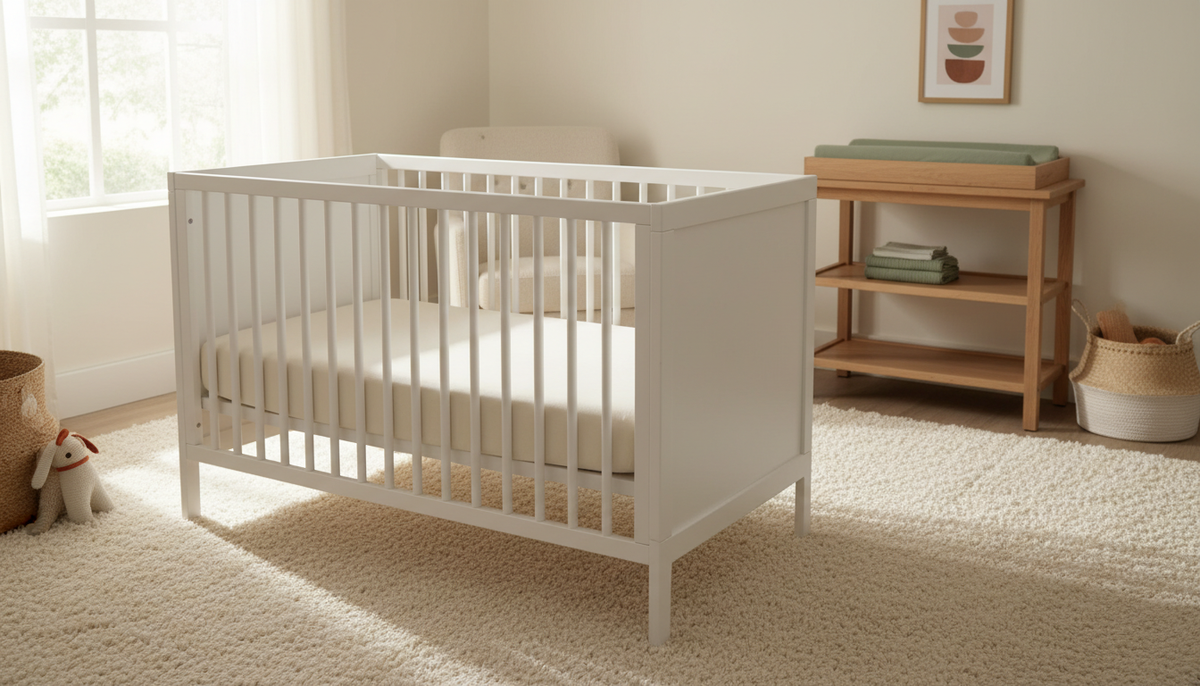
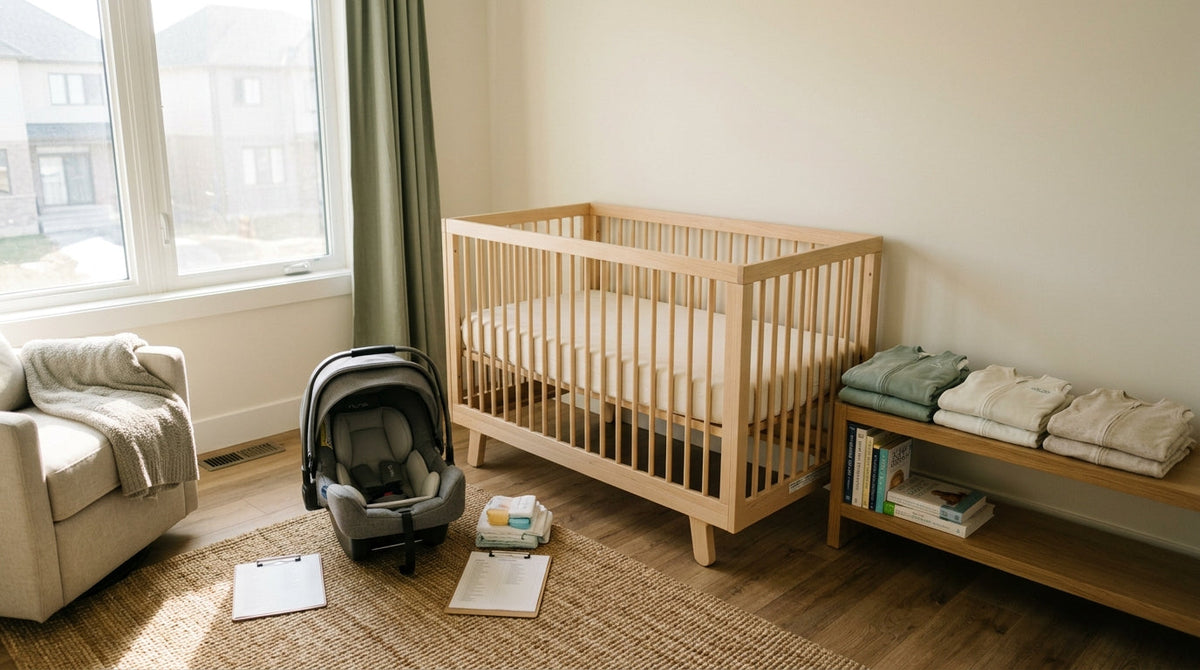
The most urgent issue at this age is sleep safety. About 3,500 infants die each year from sleep-related causes in the United States (CDC SUID data), including roughly 1,000 from unintentional suffocation (CDC). The AAP’s safe sleep guidance is specific: firm, flat surface, alone, on their back, in a crib or bassinet that meets current safety standards. No bumpers. No positioners. No soft bedding. The crib should be empty except for the baby.
Check your crib slats. They should be no more than 2 3/8 inches apart. If you’re using a hand-me-down crib, look it up on the CPSC recall database before you put your baby in it.
This is also the moment to anchor furniture. CPSC reports one child death every two weeks from tip-overs. Your baby can’t pull on a dresser yet, but the anchoring takes thirty minutes and you will not find thirty minutes once she’s mobile. Do it now. Bookshelves, dressers, TV stands, anything tall or heavy gets strapped to the wall.
What to do at 3 months:- Confirm every smoke and CO detector works
- Set water heater to 120°F (49°C)
- Lock up all medications and chemicals
- Anchor tall furniture to studs


6 Months: Rolling, Reaching, and Putting Everything in Her Mouth
Rolling typically appears between four and six months. Once your baby can roll, she can move off surfaces, reach objects nearby, and begin pulling things toward her mouth. The hazard profile changes fast.
Falls from elevated surfaces become real. A changing table, a couch, a bed. Keep one hand on the baby any time she’s on an elevated surface, or do everything at floor level.
Choking hazards need to go. Get down on the floor and look at your home from eight inches off the ground. Anything smaller than a toilet paper tube is a choking hazard. Coins, batteries, small toys belonging to older siblings, pen caps, anything. The floor needs to be clear.
Outlet covers are worth installing now, before the reaching and crawling starts. Tamper-resistant receptacles (TRRs) are built into most outlets in homes built or renovated after 2008, but older homes often don’t have them. Plug covers are a stopgap. If your outlets are older, TRRs are a better long-term fix.
Window safety matters more than most parents realize at this stage. A window screen is not a fall barrier. It will not hold a child’s weight. Window stops or guards that limit opening to four inches are the right solution for any window above the first floor.
What to add at 6 months:- Remove all small objects from floor-level reach
- Install outlet covers or tamper-resistant receptacles
- Add window stops to upper-floor windows
- Never leave baby unattended on elevated surfaces
- Begin identifying which cabinets need locks before crawling starts

- Outlet without tamper-resistant cover
- Small objects within floor-level reach
- Unsecured bookshelf, not wall-anchored
- Blind cord hanging within baby’s reach
9 Months: Crawling, Cruising, and Getting Into Everything
Nine months is when babyproofing becomes urgent in a way that is hard to overstate. Crawling babies cover ground fast. Cruising babies pull up on everything.
Cabinet locks are now essential. The products under your sink, in your bathroom vanity, and in your laundry area are dangerous. Many products parents store in cabinets, from acetaminophen to furniture polish, are required by 16 CFR 1700.14 to ship in child-resistant packaging. But child-resistant packaging is tested on children ages 42–51 months, and at least 15–20% of children in that age range can open it. Your nine-month-old is below that test range entirely.
When shopping for cabinet locks, look for products that meet ASTM F3492–21, the voluntary consumer safety standard that applies to cabinet locks and latches in the U.S. And check the CPSC recall database before you buy. A 2012 CPSC recall pulled 900,000 Safety 1st Push 'N Snap cabinet locks after reports of children as young as 9 months opening them. Three of those children reached toxic cleaning products.
Stair gates go up now. Children under 5 are treated in U.S. emergency rooms for stair-related injuries (Nationwide Children’s analysis of CPSC NEISS data, 1999–2008). At the top of stairs, use a hardware-mounted gate, not a pressure-mounted one. Pressure-mounted gates can be pushed out by a falling child. ASTM F1004 is the federal safety standard for expansion gates and expandable enclosures, made mandatory under 16 CFR Part 1239 (effective 2021). Look for that certification on any gate you buy.
Door pinch injuries spike at this age. Toddlers and preschoolers under 5 carry an outsized share of door-related ED visits. Pinch guards for door hinges and door stops that prevent full closure are cheap and worth installing on every interior door your baby can reach.
Toilet locks, if you don’t have them, go on now. A child can drown in as little as one to two inches of water (AAP). Keep bathroom doors closed and latched.
What to add at 9 months:- Cabinet locks on all under-sink and chemical storage cabinets
- Hardware-mounted stair gates at the top of every staircase
- Pressure-mounted gates at the bottom of stairs (acceptable there)
- Door pinch guards on hinge sides
- Toilet locks
- Bathroom door latch or hook-and-eye at adult height


12 Months: Walking, Climbing, and Testing Every Boundary
Twelve months brings walking, and walking brings a new set of reach heights and fall risks. Your baby is now upright, taller than she was three months ago, and interested in climbing anything she can get a foot onto.
Corner and edge guards matter now. Coffee tables, hearths, TV stands with sharp edges. A walking baby falls constantly. That’s normal. The goal is to make sure the falls don’t land on a sharp corner.
Revisit your furniture anchoring. A cruising baby pulls on furniture for support. A walking baby does the same thing, but with more force and more confidence. Check that every anchor is still secure and that the straps haven’t loosened.
The kitchen becomes a bigger hazard. Stove knob covers prevent your baby from turning on burners. Oven door locks prevent burns from a hot door surface. If you have a freestanding oven, an anti-tip bracket is worth adding, though this is more relevant as babies become toddlers who might climb the open oven door.
Cord management is important at this stage. Blind cords are a strangulation risk for infants and toddlers. Corded blinds manufactured after 2018 are required to meet a safer standard, but older blinds are still in millions of homes. Wrap cords high, use cord wind-ups, or replace with cordless blinds.
Revisit medication storage with fresh eyes. Unsupervised medication exposures send children under five to U.S. emergency departments (CDC PROTECT data). A one-year-old who can open drawers and cabinets needs more than a child-resistant cap between her and a bottle of ibuprofen. Locked storage is the right answer. Poison center cases involving children under 6 are typically accidental (America’s Poison Centers), reflecting normal toddler behavior meeting accessible hazards rather than carelessness.
What to add at 12 months:- Corner and edge guards on low furniture and hearths
- Stove knob covers and oven door lock
- Cord management for all window blinds
- Re-check all furniture anchors
- Move to locked storage for all medications and supplements
- Baby gate across any room with concentrated hazards (laundry room, home office)
Hazards That Don’t Fit Neatly Into a Stage
A few risks deserve mention outside the monthly framework because they depend on your specific home.
Water. Drowning is the leading cause of unintentional injury death in children ages 1–4 (CDC). If you have a backyard pool, the four-sided isolation fence with a self-closing, self-latching gate is the standard. It needs to be in place before your baby is mobile, not after. Kiddie pools should be emptied and stored after every use. Five-gallon buckets left with standing water are a hazard.
Garage and utility areas. These spaces often get overlooked in babyproofing sweeps. Pesticides, automotive fluids, and power tools all need locked storage. Children under 5 are exposed to poisonous substances regularly (AAP). Garages are a major source of those exposures.
Older siblings’ toys. Small parts, button batteries, magnets. If you have an older child, the hazards from their toys are real and ongoing. Establish a habit of keeping their space separated or elevated.
Keeping Up as Your Baby Grows
Babyproofing is not a project you finish. It’s a practice you maintain. Get down to your baby’s level every few months and look at the space with fresh eyes. New furniture, new developmental skills, and new hazards appear regularly.
Check recall lists every few months at CPSC.gov. Products get recalled after they’re in your home. The recall database is searchable by product category and takes five minutes to check.
The goal is not a perfectly locked-down home. It’s a home where the serious hazards are controlled and the minor ones are manageable. Layer the protections in the order your baby’s development demands them, and you’ll stay ahead of the risks that matter.