Baby Proofing for Autism: Sensory-Safe Home Modifications That Help

Every child deserves a home that keeps them safe. For autistic children, that bar is higher, and the work is more specific.
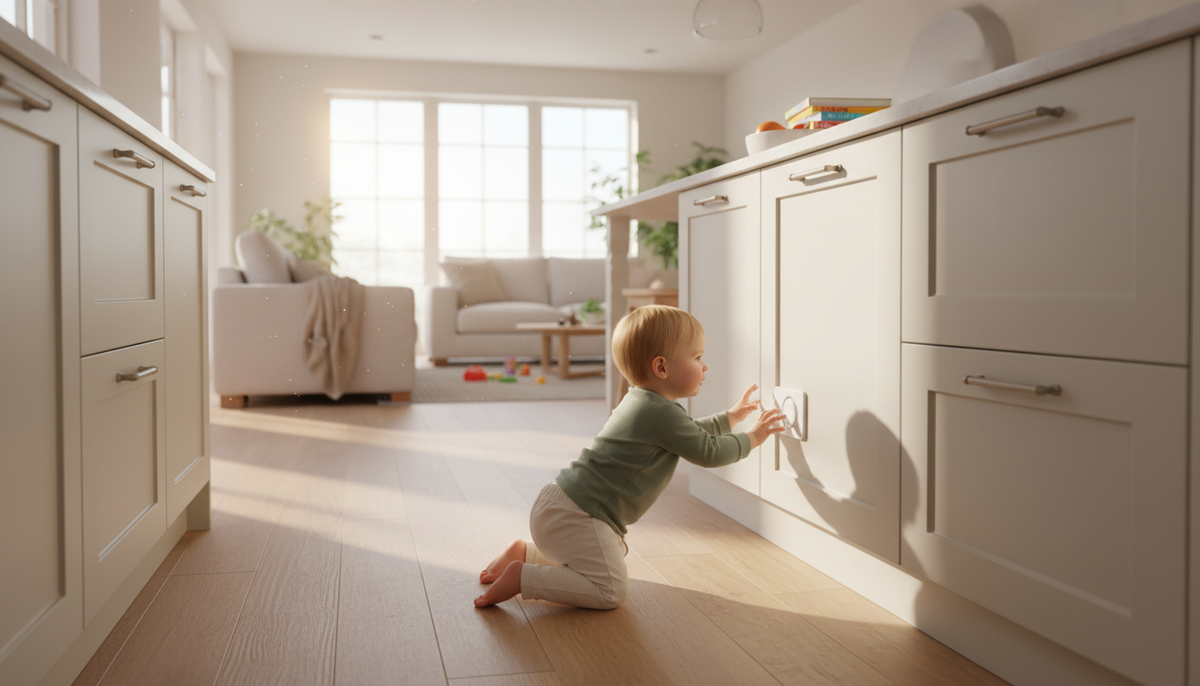
Standard baby proofing assumes a child who responds to danger the way most children do: flinching from sharp edges, stopping at a gate, crying when hurt. Many autistic children don’t follow that script. A child in sensory overload may run toward a door rather than away from a hazard. A child seeking proprioceptive input may climb a bookshelf not out of curiosity but out of physical need. A child with pica may mouth a cleaning tablet that a typical toddler would ignore. The modifications that protect neurotypical toddlers are a starting point here, not a finish line.
This guide is for parents, caregivers, and anyone setting up a home for an autistic child. It covers sensory-driven hazards that standard guides miss, elopement prevention, and the environmental changes that reduce meltdowns before they become safety crises.
Why Standard Baby Proofing Falls Short
Most baby proofing guides are built around physical hazards: stairs, sharp corners, cabinet contents, electrical outlets. Those hazards are real and relevant for autistic children too. But they leave out an entire category of risk, the sensory environment itself.
An autistic child experiencing auditory overload from a beeping door alarm may panic and bolt. A child overwhelmed by flickering overhead lights may have a meltdown near a glass coffee table. The hazard isn’t always the object. Sometimes it’s the sensory trigger that drives a child toward the object.
In my research, occupational therapists who work with autistic children consistently noted the same gap: parents had baby proofed thoroughly but hadn’t addressed what was causing their child to run, climb, or crash into things in the first place. Addressing the sensory environment reduces the frequency of those behaviors, which reduces injury risk.
Lighting: Reducing Visual Overload
Fluorescent and cool-white LED lighting can be distressing for children with visual sensory sensitivities. Flickering, high-contrast light, and sudden brightness changes are common triggers.
Install dimmer switches in bedrooms, living rooms, and any space where your child spends significant time. Choose warm-toned LED bulbs (look for a color temperature around 2700K–3000K) rather than daylight or cool-white bulbs. Blackout curtains in the bedroom serve double duty: they support sleep and eliminate the jarring transition when outdoor light changes suddenly.
That said, don’t make every room dim. Keep one clearly lit, consistent space in the home where your child can orient themselves during overwhelm. A predictable bright zone helps children self-locate when they’re dysregulated. Consistency matters more than any single lighting choice.


Sound Management Without Creating New Hazards
Here’s where a lot of well-meaning safety products backfire. Many door alarms, motion sensors, and cabinet alerts use loud, sudden beeps as their alert mechanism. For a child with auditory sensitivities, that sound can be more distressing than the underlying hazard it’s meant to flag.
Choose vibration-based or silent alerts wherever possible. Wearable door chime systems that alert a parent’s phone or wristband are available and work well for elopement monitoring without adding noise to the environment. If you’re using a door sensor, look for one with a silent or vibration mode.
For the broader sound environment, weatherstripping on doors and windows reduces the intrusion of outdoor noise. Soft furnishings, rugs, and upholstered furniture absorb sound and reduce echo in hard-floored rooms. If your child’s bedroom is near a street or noisy neighbor, a white noise machine (set at a consistent, low volume) can mask unpredictable sound spikes without adding new sensory complexity.
Avoid wind chimes, decorative bells on door handles, or anything that produces intermittent, unpredictable sound near areas your child frequents.
Elopement Prevention: Beyond the Baby Gate
Elopement, meaning a child leaving the home or a safe area without supervision, is one of the most serious safety risks for autistic children. Many autistic toddlers and preschoolers can defeat standard baby gates, either by climbing over them or figuring out the latch mechanism. My older daughter defeated an adhesive strap lock at 26 months, and she was neurotypical. A determined, physically capable autistic child can move through most standard barriers faster than parents expect.
Door locks placed outside typical hand reach are one of the most effective interventions. A deadbolt or chain lock positioned at the very top of a door (above 6 feet) or a keyed lock at the very bottom (below 18 inches) is harder to locate and operate for a young child, even one who has learned to manipulate standard handles. Use both if your child is a skilled problem-solver.
Door handle covers and door knob alarms are useful secondary layers, not primary ones. For sliding doors, a bar lock or pin lock in the track prevents opening even if the handle is manipulated.
Window locks are non-negotiable. Standard window stops that limit opening to 4 inches are widely available and easy to install. For second-floor rooms, this is critical. Check every window your child can reach, including those accessible from furniture.
Yard perimeter checks go beyond the fence gate latch. Walk the full perimeter and look for gaps at ground level, loose fence boards, and anything that could serve as a step up and over. A child seeking to leave an overwhelming environment is motivated in ways that surprise parents who haven’t seen it.
Tactile Hazards and Oral Safety
Tactile sensitivities cut both ways. Some autistic children avoid certain textures intensely, and contact with an unexpected texture (a rough edge, a scratchy furniture tag, a sticky surface) can trigger a sudden, sharp physical reaction, a fall, a head-bang, a bolt across the room. Others seek texture obsessively, mouthing, rubbing, or chewing objects for sensory input.
For texture avoiders, remove or cover rough edges on furniture, cut tags from cushions and soft furnishings, and replace scratchy area rugs with smoother alternatives. For texture seekers, the goal is redirection rather than removal. Provide designated chew tools and fidget tools that your child’s occupational therapist recommends, and supervise their use. Avoid chew necklaces and bracelets: the FDA warns that jewelry marketed for sensory chewing, including for children with autism or ADHD, can cause choking and strangulation. Your child’s occupational therapist can help you identify what type of input they’re seeking and match it to a safe alternative.
Pica, the ingestion of non-food items, is present in some autistic children and requires a higher level of storage security than standard cabinet locks provide. According to America’s Poison Centers, 2.1 million human poison exposures were reported in 2024. Medications, supplements, cleaning products, and small decorative objects need locked storage, not just latched storage. A 2012 CPSC recall pulled 900,000 Safety 1st Push 'N Snap cabinet locks after reports of children as young as 9 months opening them. Standard locks are not sufficient for a child with pica or strong oral-seeking behavior. Use keyed or combination locks on cabinets containing anything toxic or ingestible.
Furniture, Climbing, and Tip-Over Risk
Autistic children may climb for sensory reasons, seeking the proprioceptive input of pulling, lifting, and bearing weight, rather than out of simple curiosity. This makes tip-over risk particularly acute. A child climbing a bookshelf for the physical sensation of climbing is not going to stop because they’ve reached the top.
Anchor every piece of furniture that could tip: bookshelves, dressers, wardrobes, TV stands. Use furniture straps rated for the weight of the piece, and verify that the wall anchor hits a stud. For televisions, wall-mounting is safer than any TV stand arrangement. If wall-mounting isn’t possible, a low, wide TV console with a wall strap is the next best option.
Corner guards and edge bumpers are standard baby proofing, but they matter more here. During a meltdown or intense stimming episode, a child may move fast and unpredictably. Hard corners on coffee tables, hearths, and low shelving become higher-risk when a child is in motion and not tracking their environment. Use guards on every corner at head and shoulder height for your child’s current size.
Remove or secure low-hanging objects: pull cords on blinds, hanging decorations, cords from electronics. These are both strangulation risks and sensory targets.
Creating a Low-Sensory Retreat Space
One of the most effective safety modifications you can make is also the most overlooked: a dedicated quiet room or corner where your child can decompress safely.
This space should have soft, dim lighting (a salt lamp or a low-wattage warm bulb works well), minimal decor, familiar comfort items, and no access to hazards. No sharp edges, no climbing temptations, no unsecured furniture. A pop-up tent or canopy in the corner of a bedroom creates an enclosed, lower-stimulation zone within a larger room. Many children use these spaces proactively, retreating before they reach crisis level, which is exactly what you want.
Weighted blankets and compression items can support this space for older children. They provide deep pressure input that many autistic children find regulating. These are not safety devices in themselves, but they reduce the dysregulation that leads to unsafe behavior. Never use a weighted blanket with a baby: the AAP says weighted blankets and other weighted objects should not be used on or near an infant. For an older child, use one only while awake, choose one light enough for your child to remove on their own, and have your child’s OT or pediatrician confirm the weight and fit first.
The layout of the broader home matters too. Consistent, low-clutter placement of furniture and toys reduces sensory confusion and helps your child navigate safely. For an autistic child, unexpected environmental changes can trigger distress and the unsafe behaviors that follow. When you need to make changes, do it gradually and walk your child through the new layout.
Working With Your Child’s Therapeutic Team
No guide can tell you exactly what your child needs. Sensory profiles vary enormously across autistic children. One child is a climber. Another is a bolter. Another mouths everything. Another is devastated by unexpected sound.
Your child’s occupational therapist is the most valuable resource you have for translating a general sensory-safe framework into modifications that fit your specific child. Bring them into the conversation about your home layout. Ask about your child’s sensory profile in writing so you can share it with family members, babysitters, and anyone else who spends time in your home.
Your developmental pediatrician can help you assess elopement risk and connect you with resources specific to autism safety, including door alarm systems designed for families managing elopement and local programs that register children with first responders.
The CPSC, AAP, and CDC provide foundational safety guidance, and it applies here. But for autistic children, that foundation needs to be built on a thorough understanding of your child’s individual sensory and behavioral profile. Start with the universal hazards, then layer in the sensory modifications, and keep adjusting as your child grows and their needs change.