
Most parents think of babyproofing as a project they’ll get to eventually. Then their baby gets up on all fours and covers six feet of floor in about four seconds, and "eventually" becomes this afternoon.
Month seven is the deadline. Not a soft one. By the time your baby is crawling with any confidence, they can reach outlets, pull on cords, and navigate toward an open cabinet faster than you’d believe if you hadn’t seen it yourself. The window between "rolling occasionally" and "into everything" is shorter than it feels from the outside.
Here’s what to do before it closes.
Start With the Floor
Get down on your hands and knees. Literally. This is the single most useful thing you can do before any product purchase. You will immediately see things you’ve been walking past for months: a power strip with a loose cord trailing across the baseboard, a gap under the entertainment unit where small objects collect, a glass vase sitting on a low shelf that you’ve never once thought about.
Crawlers explore by grabbing and mouthing. Anything within 24 inches of the floor is fair game. Do a full room-by-room sweep at ground level, and make a list before you buy a single lock or cover.
Gates: The Non-Negotiable First Purchase
Stairs are the most immediate hazard once a baby starts moving. About 93,000 children under 5 are treated in U.S. emergency rooms each year for stair-related injuries, per a Nationwide Children’s Hospital analysis of CPSC NEISS data. That works out to roughly one child every six minutes.
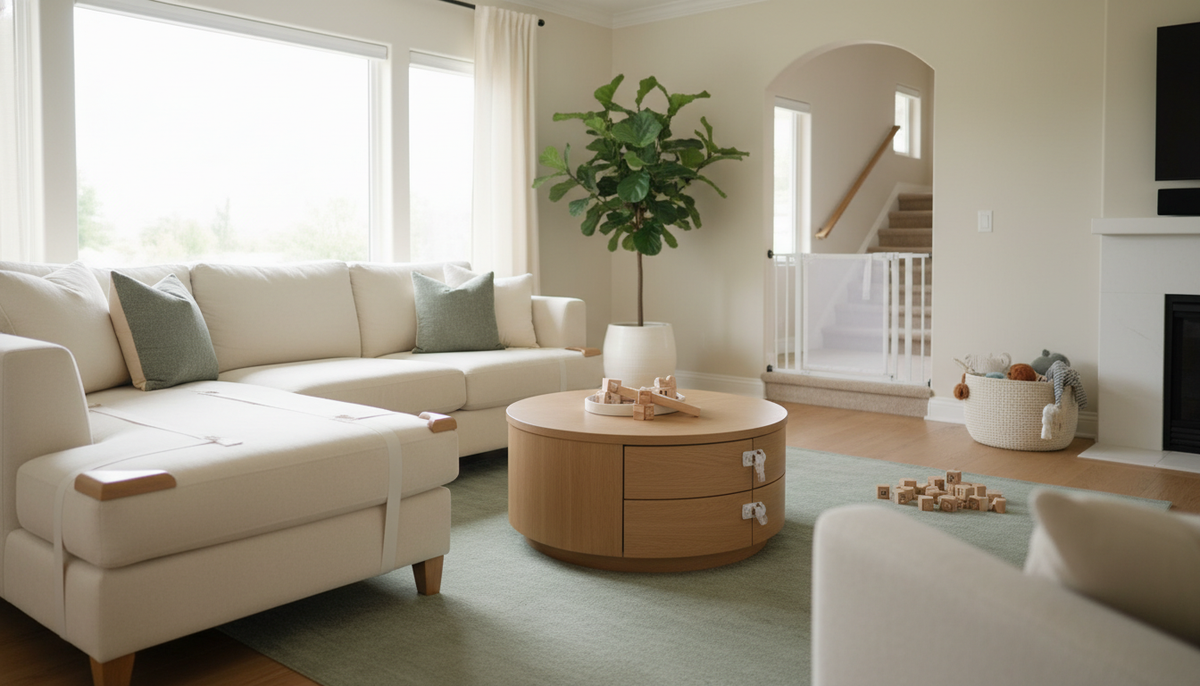
Hardware-mounted gates belong at the top of every staircase. Pressure-mounted gates are fine for doorways and room boundaries, but they can be pushed out, and the top of a staircase is not the place to find that out. ASTM F1004 is the federal safety standard for expansion gates and expandable enclosures, made mandatory under 16 CFR Part 1239 (effective 2021). When you’re shopping, look for that certification on the box.
Install the top-of-stair gate before your baby is mobile. Not the week they start crawling. Before.
Cabinet Locks: Layers Matter
The under-sink cabinet is where this gets urgent fast. In my experience, under-sink cabinets are emptied in seconds. A child can pull out dish soap, sponges, and cleaning products before a parent returns from answering the door.
Cabinet locks are your primary line of defense, but they are not infallible on their own. ASTM F3492–21 is the voluntary consumer safety standard that applies to cabinet locks and latches in the U.S. It’s a good baseline, but "meets a voluntary standard" is not the same as "your specific toddler cannot defeat it." A 2012 CPSC recall pulled 900,000 Safety 1st Push 'N Snap cabinet locks after reports of children as young as 9 months opening them, with three children reaching toxic cleaning products.
Pair cabinet locks with a second layer: move the most dangerous items to high shelves or a locked closet. Many of the products parents store in cabinets, from acetaminophen to furniture polish, are required by 16 CFR 1700.14 to ship in child-resistant packaging. But even federally child-resistant packaging only has to keep 80–85% of test-panel children (ages 42–51 months) out, meaning roughly 15–20% can still get in. Child-resistant is not childproof. Treat it as a backup, not a solution.
Per CDC PROTECT data, unsupervised medication exposures send roughly 100 children under five to U.S. emergency departments every day. Medications belong in a locked cabinet, not a bathroom drawer with a standard push-latch.

- Power strip with trailing cord
- Low shelf with breakable objects
- Coffee table corner at head height
- Blind cord hanging within reach
- Unsecured tall bookshelf
Furniture Anchoring: The Tip-Over Risk Is Real
CPSC reports one child death every two weeks from tip-overs involving furniture, TVs, or appliances. Crawlers pull up on anything they can reach, and a dresser that has stood in your bedroom for years becomes a climbing structure the moment your baby discovers it.
Anchor every tall piece of furniture to a wall stud. Dressers, bookshelves, TV stands, wardrobes. Use a stud finder, not just drywall anchors. The strap or bracket needs to be rated for a load well above the weight of the furniture itself. If you’re unsure, look for anti-tip straps rated for at least two to three times the weight of the piece.
Pull the TV back from the edge of any surface it sits on. Better still, wall-mount it. A TV on a low console is a tip-over risk and a crush hazard in one.


Outlet Covers and Cord Management
Standard plastic outlet plug covers are better than nothing, but tamper-resistant outlets are better than those. Many newer homes already have them built in. If yours doesn’t, a licensed electrician can replace standard outlets with tamper-resistant versions, which require simultaneous pressure on both slots to open. It’s worth the cost.
Cords are a separate problem. Loose window blind cords are a strangulation hazard for infants. Charging cables and appliance cords at baseboard level are chewing and pulling hazards. Secure cords to walls with cable clips, use cord shorteners on blinds, and route anything you can behind furniture.


The Bathroom: Two Separate Hazards
Drowning is the leading cause of unintentional injury death in children ages 1–4 (CDC). And a child can drown in as little as one to two inches of water (AAP). That means a bucket left on the floor, a toilet with the lid up, or a bathtub with standing water are all real risks, not hypothetical ones.
Install a toilet lock before your baby is pulling to stand. Empty the tub immediately after every bath. Never leave standing water in a bucket or basin at floor level.
The second bathroom hazard is the medicine cabinet and under-sink storage. Everything from the cabinet locks section above applies here, and then some. Bathrooms concentrate medications, cleaning products, and razors in a small space. Lock all of it.
Door Pinch Points
Toddlers and preschoolers under 5 carry an outsized share of door-related emergency visits. Hinged doors are the main culprit. Finger pinch guards that wrap around the door’s hinge side prevent the door from closing fully on small fingers. Door knob covers slow access to rooms you want to keep off-limits. Foam door stoppers prevent doors from slamming shut on a crawler who has followed you into a room.
In my experience, adhesive-only locks can be defeated by persistent toddlers over several days. Screw-mounted hardware holds longer on high-traffic cabinets.
Pre-Crawling Safety Sprint Checklist
Smoke Alarms, CO Detectors, and the Safety Layer You Can’t See
Three out of five home fire deaths occur in homes with no smoke alarms or non-functioning ones (NFPA). If you haven’t tested yours recently, do it now. The recommendation is one on every level of the home, inside each sleeping area, and outside each sleeping area.
CO poisoning kills more than 400 people each year and sends more than 100,000 to U.S. emergency rooms (CDC). Carbon monoxide detectors belong on every level of the home, and within 15 feet of every sleeping area. If yours are more than five years old, replace them. The sensors degrade.
This is the safety layer that requires no installation skill and no baby-specific product. It just requires doing it.
Soft Edges and Fall Zones
Once a baby starts pulling to stand, coffee table corners and fireplace hearths become head-level hazards. Foam edge and corner guards are inexpensive and widely available. They’re not permanent fixtures. You’ll take them down in a few years. But a crawler who pulls up on the coffee table and tips sideways is going to hit that corner, and the difference between a bruise and a laceration is whether you padded it.
Fireplace hearths are harder. A padded hearth gate that encloses the entire fireplace is more effective than corner pads alone. It also keeps small hands away from ash and any tools stored nearby.
Do It Before You Think You Need To
The standard advice is to babyproof "when your baby starts moving." The problem is that by the time you notice they’re moving, they’ve already been moving for a few days. Babies practice mobility in short bursts before parents clock it as a pattern.
Set month six as your hard deadline. Walk the floor, install the gates, anchor the furniture, lock the cabinets, test the smoke alarms. It takes a weekend. The hazards it removes are ones that don’t give you a second chance to address them.