Baby Proofing for Twins: Double the Trouble, Double the Safety

Parenting twins means you are always doing the math. Two crawlers. Two climbers. Two children who will, at some point, figure out that one of them can occupy your attention while the other gets into something they absolutely should not. That dynamic is not a parenting failure. It is physics. And it is the reason baby proofing for twins requires a different framework than proofing for a single child.
Most baby proofing advice assumes a solo mover and a caregiver with divided attention. Twin households break that assumption immediately. The hazard calculus changes when two children are mobile at the same time, when one can boost the other, when a gate that resists one determined toddler may not resist two. What follows is a room-by-room, risk-by-risk guide built around that reality.
Safe Sleep Comes First, and It Cannot Be Shared
The AAP is clear: each infant needs their own sleep surface. Separate cribs or bassinets, firm mattresses, no shared blankets, no bumpers, no soft objects in either space. The temptation to co-bed twins is understandable when you are running on four hours of sleep and the babies seem to comfort each other. But the AAP recommends the same room for at least the first six months, with each baby in their own space, and that guidance exists for a reason. About 3,500 infants die each year from sleep-related causes in the United States (CDC SUID data), and unintentional suffocation kills roughly 1,000 infants under age 1 each year in the United States (CDC). Shared sleep surfaces increase both risks.
For twins specifically, the room-sharing benefit is real. You can hear and respond to both babies from one location. But keep the cribs separated enough that a rolling infant cannot press against the other crib’s side, and check both spaces every time you check one. It becomes reflex quickly.
Stairs: Two Children, One Gate, One Problem
About 93,000 children under 5 are treated in U.S. emergency rooms each year for stair-related injuries (Nationwide Children’s Hospital analysis of CPSC NEISS data). That number was calculated before anyone factored in the twin variable: one child holding a gate open while the other walks through.
Gates for stairs need to be hardware-mounted, not pressure-mounted. Pressure-mounted gates are appropriate for doorways and room dividers, but at the top of stairs, a pressure-mounted gate can be dislodged by a child pushing against it. With twins, the force doubles. ASTM F1004 is the federal safety standard for expansion gates and expandable enclosures, made mandatory under 16 CFR Part 1239 (effective 2021). When you buy, look for that certification on the packaging.
Install gates at both the top and the bottom of every staircase. Yes, both. In my experience, a child can learn to open a pressure-mounted gate by 22 months, and a sibling will quickly discover how to assist in the process.
Check gate hardware monthly. Screws work loose. Hinges wear. A gate that held firm in September may have play in it by December.


Furniture Anchoring: The Weight Doubles, the Risk Multiplies
A single toddler pulling on an open dresser drawer can tip a piece of furniture. Two toddlers doing it simultaneously, or one climbing while the other pulls, can bring down something much heavier. Anchor every dresser, bookshelf, wardrobe, and television to the wall. Every single one. This is not optional in any home with young children, and in a twin home it is urgent.
Use anti-tip straps rated to hold several times the weight of the furniture piece itself. For televisions, wall-mount them when possible. If a TV sits on a stand, the stand needs to be anchored and the TV needs to be strapped to the stand. Twins climb. They use each other as ladders. Children as young as 18 months will use a sibling’s back as a step stool to reach higher shelves.
Pull out every drawer in every piece of furniture and check whether the piece tips forward without the anchor. If it does, that anchor is doing real work. Verify it quarterly.
Cabinet Locks and Chemical Storage
The under-sink cabinet is one of the most dangerous spaces in any home with young children. Cleaning products, dishwasher pods, drain cleaners. In a twin household, the risk is compounded because one child can draw your attention while the other opens a cabinet you thought was secured.
A 2012 CPSC recall pulled 900,000 Safety 1st Push 'N Snap cabinet locks after reports of children as young as 9 months opening them, with three children reaching toxic cleaning products. The lesson is not that cabinet locks are useless. It is that no single lock should be your only barrier. Use a lock and store the most dangerous products on a high shelf or in a locked cabinet above counter height. Redundancy is the principle.
Medications and supplements belong in locked storage, always. A child who can open a childproof cap is not unusual. Two children working on the same bottle, or one handing a bottle to the other, is a scenario that moves faster than you expect. Keep everything pharmaceutical in a locked box or a cabinet with a keyed lock, not just a magnetic push-lock.
Water Safety: The Margin Is Smaller Than You Think
Drowning is the leading cause of unintentional injury death in children ages 1–4 (CDC). A child can drown in as little as one to two inches of water (AAP). Those two facts together should reshape how you think about every water source in your home.
Bathing twins means you need a system, not just a routine. Never leave the tub to answer the door, grab a towel, or check on the other child. If you need to leave the bathroom, take both children with you. Non-slip mats belong in every tub and on the floor beside it. Toilet locks are not excessive. A toddler leaning over a toilet bowl can fall in headfirst. With twins, one child can be playing in the hall while the other is in the bathroom in the time it takes you to look away.
Empty all standing water after every use. Buckets, inflatable pools, pet water bowls. All of it.
Playpens and Play Yards: Containment Has a Purpose
A play yard is not a cage. It is a tool, and in a twin household it is one of the most useful tools you have. Use it during high-risk moments: when you are cooking, when you need to use the bathroom, when you are answering the door. Two mobile infants or toddlers in a space you cannot monitor for 90 seconds is a real hazard scenario.
ASTM F406 is the safety standard for non-full-size cribs and play yards, made mandatory under 16 CFR Part 1221. When you purchase, verify the model meets that standard. Check the mesh for tears or holes before every use. Gaps in mesh sides can trap limbs or heads. Never add a mattress, pillow, or extra padding not designed for that specific model.
Do not use a play yard as a long-term substitute for supervision. Use it as a bridge for the moments when you cannot have eyes on both children simultaneously.
Choking Hazards: Small Objects Travel Between Two Children
A single child’s small-object hazard is relatively contained. With twins, objects move. One child picks up a coin, a button, a small toy piece, and hands it to the sibling. Or drops it where the sibling is sitting. The floor sweep that worked for one child needs to happen more frequently and more thoroughly when two children are crawling or toddling through the same space.
Any toy appropriate for a 3-year-old may have small parts that are dangerous for an 18-month-old. If your twins are different ages or at different developmental stages, keep age-appropriate toys separated by space, not just by the honor system. A mesh bag or a closed bin in a different room is more reliable than "the big one knows not to share those."
Know infant and toddler CPR and choking relief for both children. Take a refresher course every year. Know it for two.
Twin Home Safety Checklist
Window Coverings, Outlets, and Cord Management
A cord on a window blind is a strangulation risk for any child. For twins, the risk is elevated because they play together, pull on things together, and can wrap a cord around each other in the time it takes you to cross the room. CPSC guidance calls for cordless window coverings or cords that are inaccessible. Retrofit kits exist for older blinds, but replacement is more reliable.
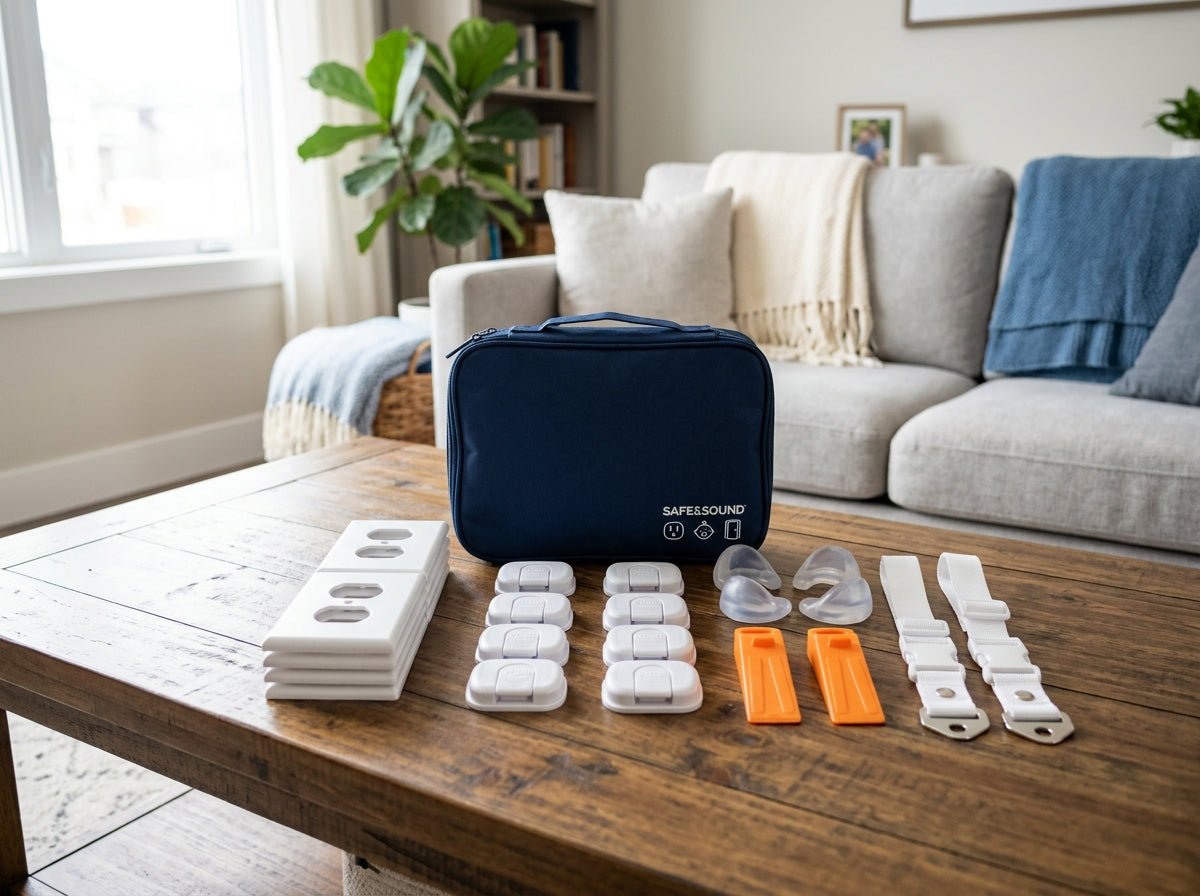
Outlets need tamper-resistant covers or, better, tamper-resistant receptacles built into the wall. Standard plug covers can be removed by a determined toddler and become choking hazards themselves. Tamper-resistant receptacles require simultaneous pressure on both slots to open, which is harder for small fingers to manage.
Appliance cords are a separate problem. A lamp cord, a phone charger, a baby monitor cable: all of these can be pulled, chewed, or used as a climbing aid. Route cords behind furniture or through cord covers. Remove extension cords from any space where both children play. Two children tripping over the same cord is twice the fall risk, and a cord is also a strangulation risk for infants.
Room-by-Room Audits and Caregiver Communication
A safety setup that works in October may not work in February. Children grow. They get taller, stronger, and more creative. Assign a weekly five-minute walkthrough of every room where your twins spend time. Look for locks that have loosened, anchors that have shifted, gates with worn hardware. Make it a habit, not a reaction to a near-miss.
Every caregiver who enters your home needs the same briefing. Partners, grandparents, babysitters. Which areas are off-limits. Where the play yard is and when to use it. Which cabinet locks require two steps to open. Which gate needs to be re-latched after use. Write it down if you need to. A laminated card on the refrigerator is not overkill. It is the difference between a consistent safety environment and one that degrades every time someone new is in the house.
Twin households are not just busier. They are structurally different in how hazards present and how quickly situations escalate. Build your safety plan around that reality, audit it regularly, and brief everyone who cares for your children on the specifics of your setup.