Baby Proofing on a Budget: Room-by-Room Under $100
Room-by-Room Under $100

Most babyproofing lists read like they were written by someone with an unlimited budget and a contractor on speed dial. The reality for most families is a Sunday afternoon, a trip to the hardware store, and maybe $80 to spend before the baby starts pulling up on furniture.
The good news: the fixes that matter most are not expensive. A few dollars of cabinet hardware, a $15 gate, some outlet covers. The dangerous gaps in most homes can be closed for well under $100 if you know where to spend and where to skip.
Here is a room-by-room plan that fits a real budget.
What to Buy Before You Buy Anything
Before you spend a single dollar, spend twenty minutes on the floor. Literally. Get down on your hands and knees in each room and look at the space from your child’s eye level. You will see things you have never noticed: the power strip tucked behind the couch, the gap under the bathroom vanity, the TV cable that loops low enough to grab.
In my experience, a crawl-through audit reveals hazards invisible from standing height. Before my younger daughter started crawling, I found three I had missed, including a decorative bowl on the bottom shelf of our bookcase that was full of small stones. She would have had those in her mouth in thirty seconds.
A crawl-through audit costs nothing and will tell you exactly where to focus your money.
The Kitchen: Spend About $25
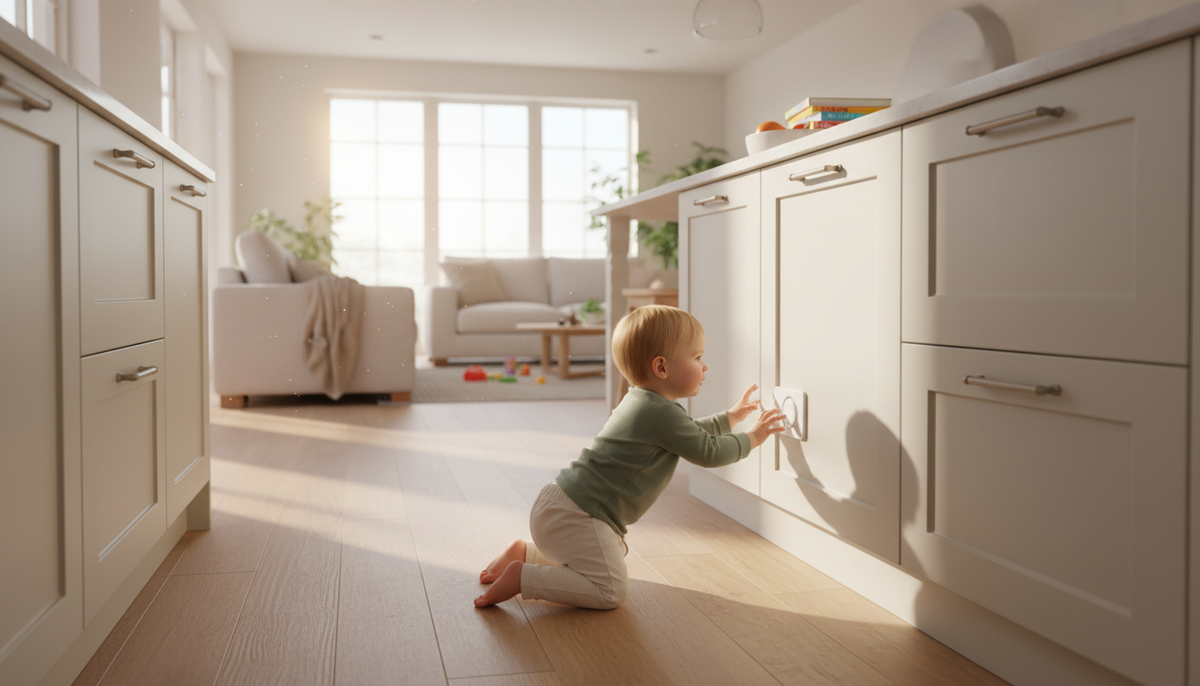
The kitchen is where most of the budget should go, because it concentrates the most hazards in one room.
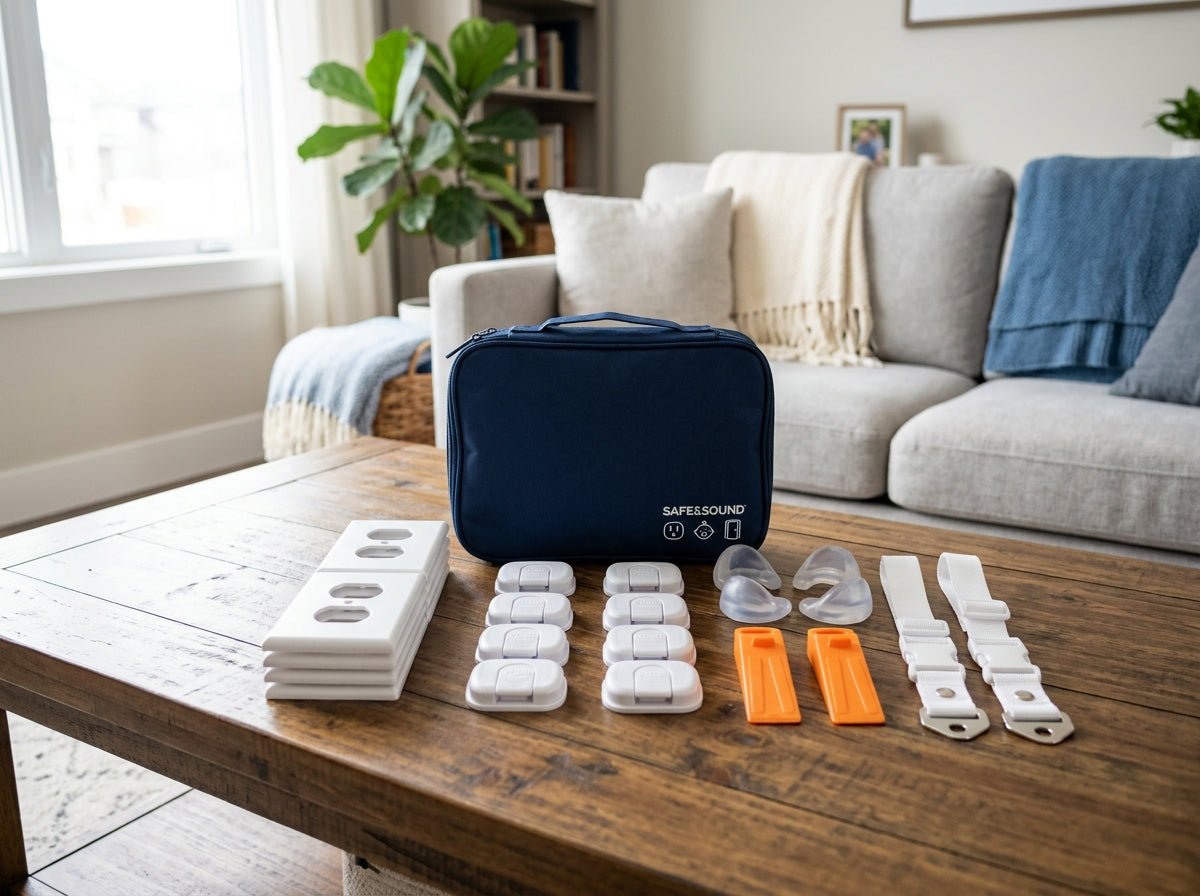
Cabinet locks are the single highest-value purchase in the house. The under-sink cabinet, wherever you store cleaning products, is the first priority. Magnetic locks run $20–$30 for a pack of eight and are the most defeat-resistant option. Adhesive strap locks are cheaper, around $10–$15 for a multipack, but test the adhesion on your cabinet finish before you trust them. In my experience, one of six strap locks I installed in my first kitchen failed on a painted cabinet within a month. My older daughter found it at 26 months.
For the stove, a knob cover set costs $10–$15 and takes five minutes. Skip the stove guard if budget is tight. It is useful but not essential if the knobs are covered and you are consistent about back-burner cooking.
The refrigerator and oven do not need locks at the crawling stage. Add them when your child starts pulling to stand, usually around 9–12 months.
What to skip in the kitchen: Drawer bumpers, appliance latches for things stored above counter height, and foam corner guards on the island. Put that money toward cabinet locks instead.

- Under-sink cabinet: cleaning products
- Stove knobs within toddler reach
- Low drawers with sharp utensils
The Living Room: Spend About $20
Two things matter most here: tip-over anchoring and outlet covers.
According to the CPSC, one child dies every two weeks from furniture, TV, or appliance tip-overs. Anti-tip straps for a TV or bookcase cost $8–$12 and take fifteen minutes to install. You need a stud finder (borrow one if you do not own one) and a drill. The strap anchors to a wall stud and to the back of the furniture piece. It is the most important $10 you will spend in this room.
For outlets, since the 2008 National Electrical Code, tamper-resistant receptacles are required in all new residential 125V outlets (NEC §406.12). If your home was built or renovated after 2008, you may already have them. Check for a small "TR" stamp inside the outlet slots. If you have them, you do not need covers. If you do not, basic sliding plate covers cost about $5 for a ten-pack.
Cord management is free. According to CPSC data, about 9 children under age 5 die each year from window-covering cord strangulation. Wrap blind cords around the cleats mounted high on the wall, or use a cord wind-up clip. Both options cost nothing if you already have the cleats. If you are buying new blinds, cordless options are now widely available at every price point. In 2022, the CPSC adopted federal safety rules requiring most new residential window coverings to be cordless or have inaccessible cords, with the standard (16 CFR 1260) taking effect May 30, 2023.
The coffee table is a real hazard for walkers and cruisers. Foam corner guards cost $8–$12 for a set. They are not glamorous, but a corner at toddler forehead height is a real risk. Buy them.


The Bathroom: Spend About $15
Three priorities: the toilet, the medicine cabinet, and the tub.
A toilet lock costs $10–$15. According to the CDC, drowning is the leading cause of unintentional injury death in children ages 1–4, and the AAP notes a child can drown in as little as one to two inches of water. The toilet is not the most likely drowning scenario, but it is a real one, and a toilet lock is cheap enough that there is no reason to skip it.
For medications, the lock on your medicine cabinet is your first line of defense. According to CDC data, unsupervised medication exposures send roughly 100 children under five to U.S. emergency departments every day. If your medicine cabinet does not lock, move all medications to a high shelf in a closet with a door handle cover, or buy a small lockbox for $15–$20. Under 16 CFR 1700.15, packaging passes the "child-resistant" bar if at least 85% of tested children (ages 42–51 months) cannot open it within 10 minutes. That means roughly 15–20% of children in that age range can still get in. Child-resistant packaging is not childproof. Locks matter.
A non-slip bath mat costs $8–$12 and prevents the most common bathroom injury: slipping on a wet tub floor. Buy one.
What to skip in the bathroom: Faucet covers are useful but not essential if you set your water heater to 120°F (49°C) or below, which the AAP recommends. Check your water heater setting first.


The Nursery and Bedroom: Spend About $10
If you have already handled the living room and kitchen, the nursery is relatively low-cost to address.
The crib itself is the main event. According to the CDC, unintentional suffocation kills roughly 1,000 infants under age 1 each year in the United States. Crib safety is about what you remove, not what you buy. No bumpers, no loose bedding, no pillows. A firm, flat mattress with a fitted sheet. That costs nothing.
Outlet covers for any outlets in reach of the crib or changing area: $5 for a pack. A door pinch guard for the nursery door costs $6–$8 and prevents fingers from getting caught.
If you have a dresser or bookcase in the room, anchor it. Use the same anti-tip strap approach as the living room. One strap per piece of furniture, $8–$12 each.
| Room | Key Purchases | Estimated Cost |
|---|---|---|
| Kitchen | Cabinet locks, knob covers | ~$25 |
| Living room | Anti-tip strap, outlet covers, corner guards | ~$20 |
| Bathroom | Toilet lock, bath mat | ~$15 |
| Nursery | Outlet covers, door pinch guard | ~$10 |
| Stairs and hallways | Hardware gate, door knob covers | ~$25 |
| Whole house | CO detector, furniture bumpers | ~$5 |
Hallways and Stairs: Spend About $25
A pressure-mounted gate works fine at the bottom of stairs to block access to a room, but at the top of stairs you need a hardware-mounted gate. This is the one place I will tell you not to go cheap on installation. A pressure gate at the top of the stairs can be pushed out by a falling child.
ASTM F1004 is the federal safety standard for expansion gates and expandable enclosures, made mandatory under 16 CFR Part 1239 (effective 2021). Look for that certification on any gate you buy. Basic hardware-mounted gates start around $30–$40. That is slightly over the per-room budget, but it is worth it. Buy a used one if needed, but verify the certification label is present and the gate has no recalls.
Door knob covers cost $3–$5 for a pack of four and keep toddlers out of rooms that are not babyproofed, like a home office or utility room. They are one of the most underrated purchases on this list.
The Whole-House Additions: Spend About $5
Two items that cover the whole house and cost almost nothing.
A carbon monoxide detector, if you do not already have one. According to the CDC, CO poisoning kills more than 400 people each year and sends more than 100,000 to U.S. emergency rooms. Basic CO detectors run $20–$25. If you already have one, check the battery. If you have a gas stove, gas furnace, or attached garage, this is not optional.
Furniture leg bumpers for low tables cost $4–$6 for a pack and take two minutes to apply. Not a life-safety item, but a real injury-prevention one for new walkers.
Tracking Your Spend
Here is how the budget breaks down across rooms:
- Kitchen (cabinet locks, knob covers): ~$25
- Living room (anti-tip strap, outlet covers, corner guards): ~$20
- Bathroom (toilet lock, bath mat): ~$15
- Nursery (outlet covers, door pinch guard): ~$10
- Stairs and hallways (gate, door knob covers): ~$25
- Whole-house additions (CO detector if needed, bumpers): ~$5
Total: approximately $100, and that assumes you need everything. Many homes already have CO detectors, tamper-resistant outlets, or cordless blinds. Your actual spend will likely be lower.
The goal is not a perfect catalog of every possible product. It is closing the gaps that cause the most serious injuries first, with the money you have available. Start with cabinet locks and the anti-tip strap. Everything else builds from there.