Baby Proofing Without Drilling: The Complete Renter-Friendly Product Guide
The Complete Renter-Friendly Product Guide

Every landlord has a version of the same speech. "No holes in the walls." "Any damage comes out of the deposit." "We’ll do a walk-through before you move out." You nod, sign the lease, and then six months later you have a crawler who has discovered the cabinet under the kitchen sink and a toddler who treats the bookshelf like a climbing wall.
Drilling is off the table. But doing nothing is not an option.
The good news: the baby-proofing industry has largely caught up with renters. Adhesive mounts, tension hardware, furniture anchors that use straps and floor pressure instead of studs, magnetic locks that need no drill at all. Most of what you need can be installed and fully removed without leaving a mark. Here is what works, what to skip, and how to think through each category.
Furniture Anchors Without Wall Studs
CPSC reports one child death every two weeks from tip-overs. That number covers furniture, TVs, and appliances, and it has not meaningfully declined in years. This is the category where renters feel the most stuck, because the standard advice is "bolt the strap into a wall stud." You can’t do that without drilling.
What you can do: use floor-anchor systems. Several brands now make anti-tip straps that secure to the floor rather than the wall, using a low-profile bracket and furniture feet. They work best on hard floors where the bracket can grip, and they do leave small marks on carpet if used long-term. Read the fine print on your lease before installing anything that contacts the floor.
A second option for dressers and bookshelves: furniture feet anchors that grip between the furniture leg and the floor, combined with a strap that loops around the furniture body and attaches to a heavy piece of furniture behind it. It sounds improvised. Done correctly, it is not.
What does not work: those foam corner guards people repurpose as "anti-tip" devices. They do nothing. And a single adhesive hook rated for a few pounds is not an anti-tip solution for a 60-pound dresser.
In my experience, an adhesive cabinet strap can fail, my older daughter defeated one at 26 months. A furniture anchor rated for several times the furniture’s weight and attached to a solid floor bracket held. Know the difference between decorative safety and structural safety.
Cabinet and Drawer Locks
This is where adhesive products shine. Magnetic cabinet locks are the gold standard for renters. You mount a small magnetic latch inside the cabinet door using adhesive or a single small screw (often into the cabinet interior, which most landlords don’t inspect), and you open it with a magnetic key. No visible hardware. No holes in the cabinet face.
Per CDC PROTECT data, unsupervised medication exposures send roughly 100 children under five to U.S. emergency departments every day. Bathroom and kitchen cabinets are the primary access points. A magnetic lock on the cabinet under your bathroom sink costs about $8 and takes ten minutes to install.
When evaluating adhesive cabinet locks, look for products that specify the surface prep requirements. Clean the surface with isopropyl alcohol, wait the full cure time (usually 24–72 hours before use), and test the bond before trusting it. In my experience, adhesive failures occur on particleboard and textured surfaces. On those, use a small screw into the interior cabinet wall instead.
Spring-loaded strap locks that loop through cabinet handles are a backup option. They require no adhesive at all. They are slower to open and some toddlers figure them out faster than you’d expect, but they leave zero marks and cost almost nothing.

Baby Gates: Pressure-Mount Realities
Pressure-mount gates are the renter’s default, and they work well in most locations. But there is one place they do not belong: the top of a staircase.
About 93,000 children under 5 are treated in U.S. emergency rooms each year for stair-related injuries, per a Nationwide Children’s Hospital analysis of CPSC NEISS data. A pressure-mount gate at the top of stairs can be pushed out by a falling child. It provides false security in exactly the situation where you need real security.
At the bottom of stairs, pressure-mount gates are fine. In doorways between rooms, pressure-mount gates are fine. At the top of stairs, you need a hardware-mount gate. If your landlord won’t allow it, have that conversation directly. Most landlords will permit a single gate installation with the agreement that you’ll patch and paint on the way out. A $150 deposit deduction is not worth a stair fall.
ASTM F1004 is the federal safety standard for expansion gates and expandable enclosures, made mandatory under 16 CFR Part 1239 (effective 2021). When you buy any gate, check that it meets this standard. It will be on the packaging.
For pressure-mount gates in approved locations, look for models with a wide base that distributes pressure across the door frame rather than concentrating it on two small rubber pads. The pads compress over time. Check the tension monthly.


Outlet Covers and Electrical Safety
Sliding outlet covers are the correct solution. They replace the existing outlet cover plate entirely, require a screwdriver but no drilling, and leave no damage when removed. The sliding mechanism requires simultaneous pressure and rotation to open, which most toddlers cannot coordinate.
Plug-in plastic outlet caps are the other option. They are cheap and widely available. They are also a choking hazard if a child removes them, and some children do remove them. If you use plug-in caps, use the larger two-piece style that covers the entire outlet face rather than the small individual prong caps.
Extension cords and power strips are a separate problem. A cord is a tripping hazard, and a strangulation risk for infants. Cord shorteners and cord clips that attach to baseboards with adhesive strips manage the length and route without any drilling. For power strips, get a cover box that encloses the strip entirely.


Door and Window Safety
Door pinch guards slip over the top of a door and prevent it from closing completely. No adhesive, no hardware. They protect small fingers from the hinge side and the latch side. In my experience, a pinch guard can eliminate door-slamming injuries quickly.
Door knob covers require no tools and leave no marks. They work well for interior doors to rooms you want to restrict. For sliding doors, a cut-down wooden dowel in the track is free and effective.
Window stops are the underappreciated renter tool. They are small devices that insert into the window track and limit how far the window can open, typically to 4 inches. No drilling required on most window types. Falls from windows are a serious hazard for children ages 1–5, and window screens do not prevent falls. A window stop costs $5–10 per window.

- Under-sink cabinet: medication and chemical access
- Stove knobs: reachable by standing toddlers
- Front burners: hot pots within arm’s reach
- Refrigerator: unsecured door and contents
- Power strips and cords: tripping and strangulation risk
Stove Knob Covers and Kitchen Safety
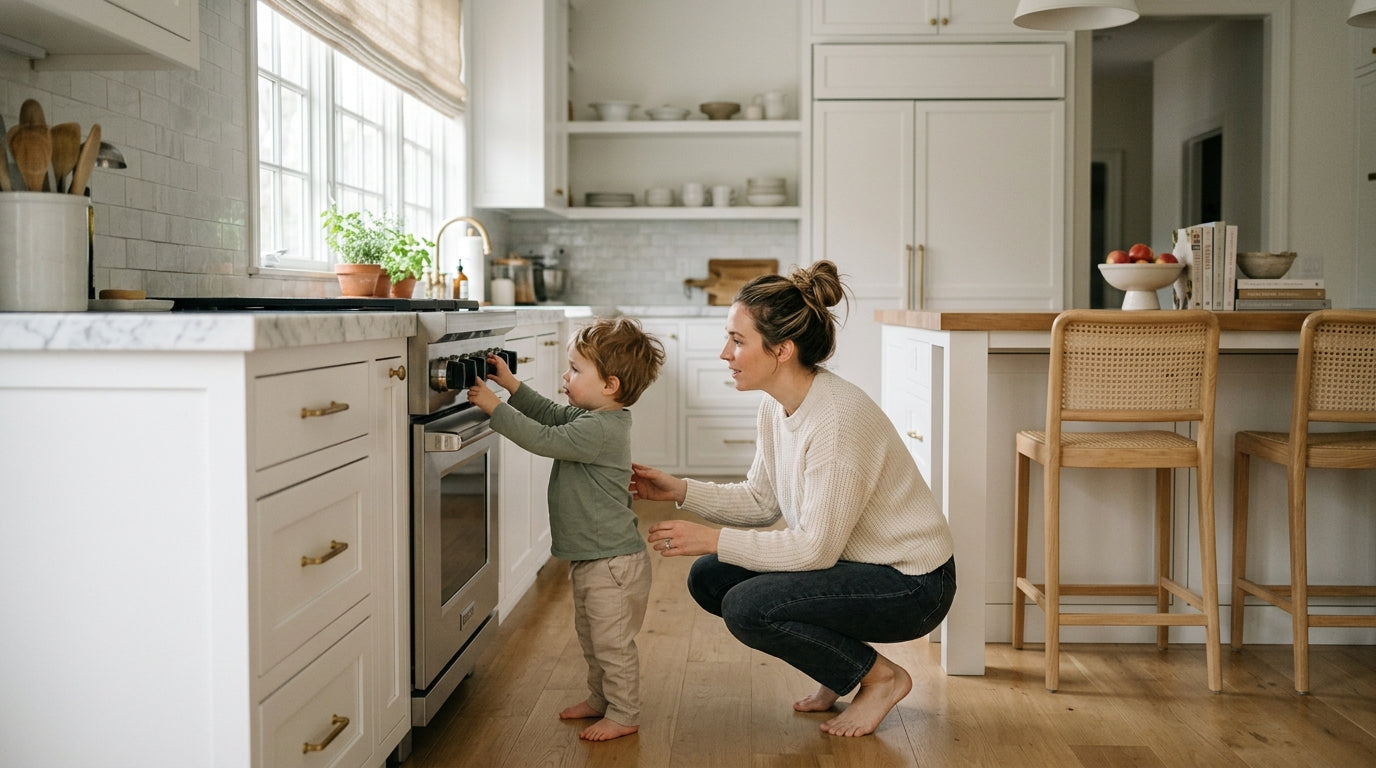
Stove knob covers slip over existing knobs and require a specific grip pattern to operate. They are universally compatible with standard round knobs and leave no marks. They are also one of the easiest products to forget to put back after you cook, which defeats the purpose. Build the habit. Stove shields that attach to the front of the range with heat-resistant adhesive strips keep small hands from reaching up to pots and pans on front burners. They are not a substitute for using back burners whenever possible, but they add a physical barrier for the moments you’re distracted. Refrigerator locks that use adhesive straps are reliable on most refrigerator surfaces, which tend to be smooth and non-porous. The adhesive bonds well to painted metal. Follow the cure time.
-
Lock Under-Sink Cabinets
Install magnetic cabinet locks on bathroom and kitchen under-sink cabinets. Clean surfaces with isopropyl alcohol first and wait the full cure time. -
Cover Every Outlet
Replace outlet cover plates with sliding covers throughout the home. No drilling required, and they remove cleanly when you move out. -
Gate the Bottom of Stairs
Install a pressure-mount gate at the base of any staircase. Check tension weekly and recheck monthly as the pads compress. -
Add a Toilet Lock
Fit a strap-style toilet lock on every toilet in the home. No tools needed, and it takes under five minutes per toilet. -
Install Window Stops
Insert window stops on every window above the first floor, limiting the opening to 4 inches. Screens alone will not prevent a fall.
Smoke and CO Detectors: The Renter’s Responsibility
Three out of five home fire deaths occur in homes with no smoke alarms or non-functioning ones (NFPA). Your landlord may be required by local code to provide them. They are not always required to maintain them, and they are not always functioning when you move in. Test every detector on move-in day.
CO poisoning kills more than 400 people each year and sends more than 100,000 to U.S. emergency rooms (CDC). If your unit has gas appliances or an attached garage, you need a CO detector. Plug-in combination smoke/CO detectors require no installation at all. Put one on every level of your home.
Battery-powered smoke detectors can be mounted with adhesive strips rated for the weight of the unit. They are not as reliable as hardwired detectors, but they are far better than nothing. Check the battery monthly.
Bathroom Safety Without Permanent Fixtures
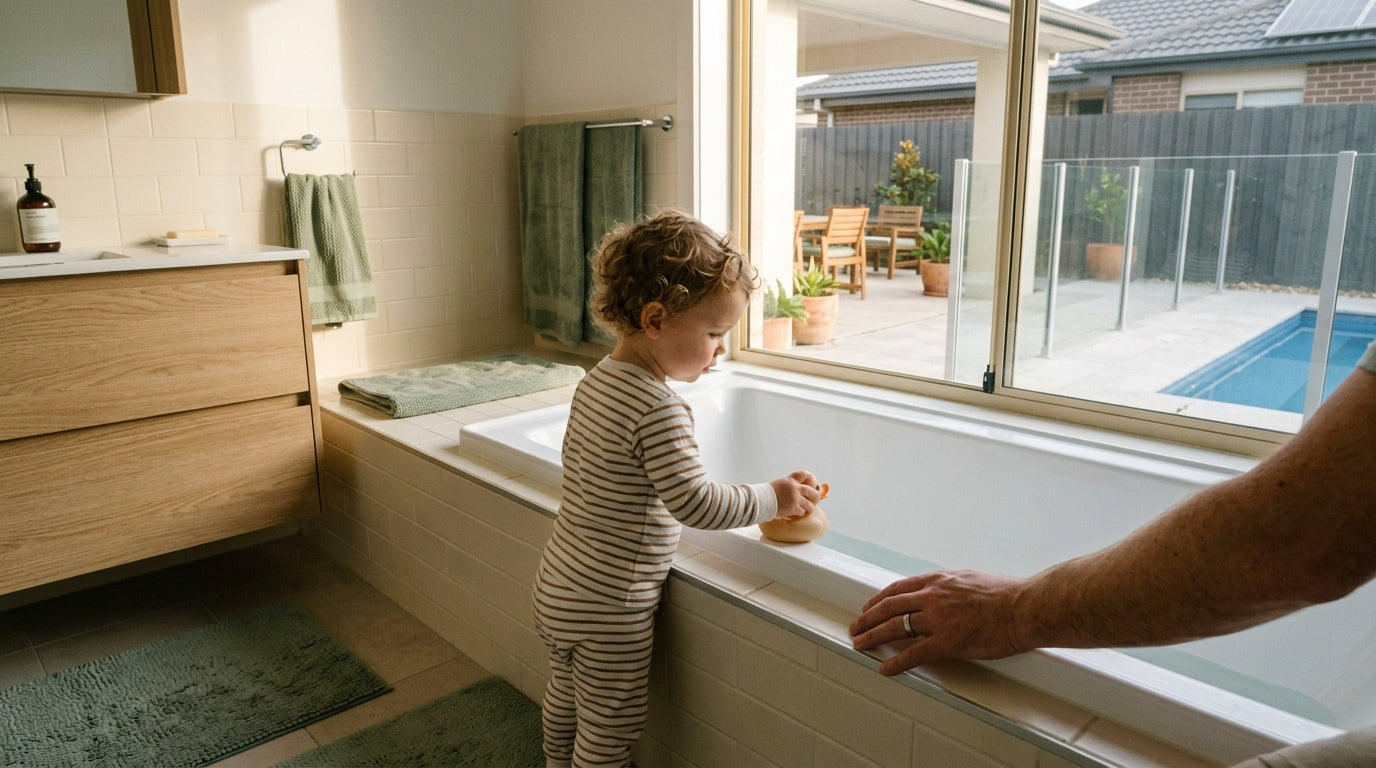
Drowning is the leading cause of unintentional injury death in children ages 1–4 (CDC). A child can drown in as little as one to two inches of water (AAP). The toilet, the bathtub, and even a bucket left with standing water are all hazards.
Toilet locks that use adhesive or a strap around the toilet tank require no tools and no drilling. They are not glamorous. They work. Bathtub spout covers slip over the existing spout and protect against head injuries during bath time. Non-slip bath mats with suction cups require no installation.
The most important bathroom safety measure is supervision, and the second most important is a door knob cover or door latch that keeps the child out of the bathroom entirely when you’re not in there. A $4 door knob cover is your first line of defense.
What to Prioritize When You Can’t Do Everything at Once
If you’re moving in and overwhelmed, do these five things first: magnetic cabinet locks on the under-sink cabinets, outlet covers throughout, a pressure-mount gate at the bottom of any stairs, a toilet lock, and window stops on any window above the first floor. That covers the highest-frequency hazards without a single hole in the wall.
Add furniture anchors for any tall piece of furniture your child could pull on, a stove knob cover, and door pinch guards as a second pass. Most of this can be done in a single weekend for under $150 total.
Renter-friendly does not mean second-rate. The products in this category have improved significantly. What matters is reading the installation requirements carefully, prepping surfaces correctly, and checking hardware monthly. A loose anchor is worse than no anchor because it creates false confidence.