Best Baby Gates for Stairs 2026: Top 10 Reviewed and Ranked

About 93,000 children under 5 are treated in U.S. emergency rooms each year for stair-related injuries, according to a Nationwide Children’s Hospital analysis of CPSC NEISS data. That’s roughly one child every six minutes. A baby gate is one of the simplest interventions you can make in your home, and also one of the most frequently installed incorrectly.
I’ve tested gates across three different staircase configurations over the past seven years: a standard wood banister, a half-wall with drywall on one side, and an open metal railing we inherited when we moved into our current house. My older daughter defeated a pressure-mounted gate at 26 months by leaning into it repeatedly until the tension gave. My younger one, at 18 months, figured out a single-step latch in about four days. Neither incident ended in injury, but both taught me more about gate failure modes than any spec sheet ever could.
Here’s what matters when you’re choosing a gate for stairs.
Hardware-Mounted vs. Pressure-Mounted: The Non-Negotiable Rule
This is the one rule you cannot bend. Pressure-mounted gates use tension against two walls or surfaces to stay in place. They’re convenient, tool-free, and fine for doorways between rooms. They are not safe at the top of stairs.
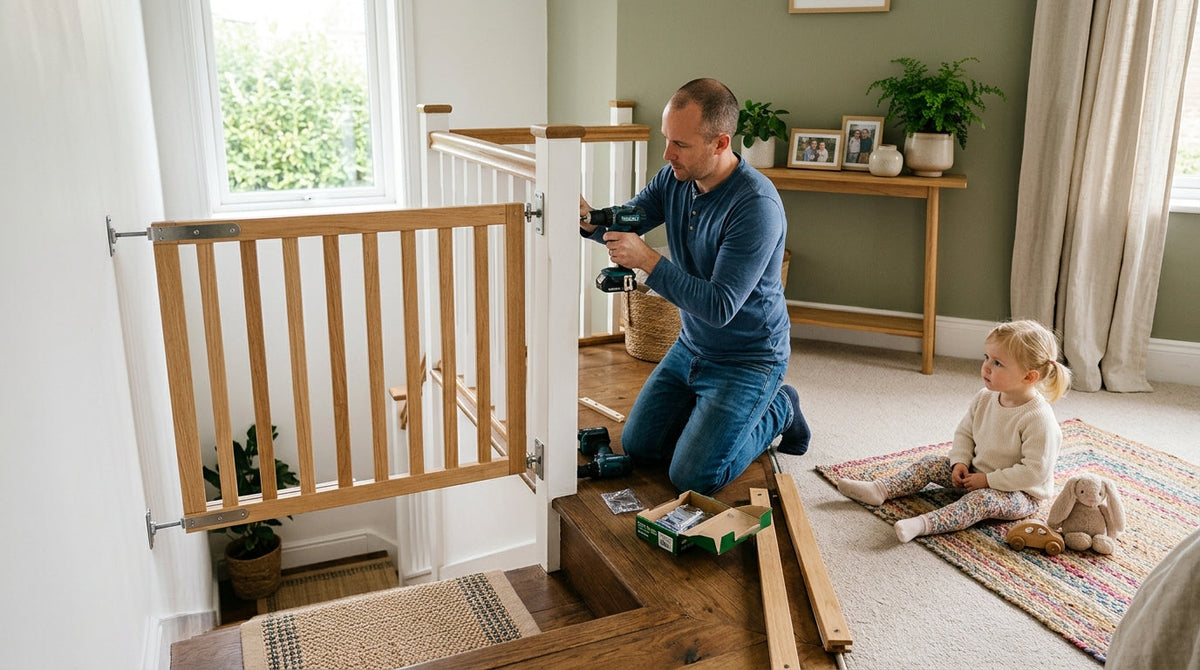
The CPSC is explicit on this point: at the top of a staircase, only hardware-mounted gates bolted directly into wall studs or a solid banister should be used. A pressure-mounted gate can dislodge under the weight of a falling or leaning child. At the top of stairs, that means a fall. The gate at the bottom of stairs can be pressure-mounted if you prefer, though hardware-mounted is always more secure.
Every gate on this list that’s rated for stair use is hardware-mounted. If a product listing says "no tools required" and you’re planning to use it at the top of your stairs, keep scrolling.
What the Safety Standards Require
ASTM F1004 is the federal safety standard for expansion gates and expandable enclosures, made mandatory under 16 CFR Part 1239, effective 2021. For full-size baby gates used at stairs, the relevant standard is ASTM F2050, which governs hardware-mounted and pressure-mounted gates for home use. Any gate sold in the U.S. should meet these standards. Any gate you’re considering secondhand may not.
Slat spacing is one of the most critical dimensions. Crib slats must be no more than 2 3/8 inches (6 cm) apart under the CPSC standard (16 CFR 1219), and this same threshold is widely applied to baby gates because the entrapment risk is identical. A child’s head can fit through gaps that their body cannot, and they can become trapped. Measure any gate you’re considering. Do not assume compliance.
The JPMA certification program is worth checking. JPMA-certified gates have been independently tested against the relevant ASTM standard. It’s not a guarantee, but it’s a meaningful data point, especially when you’re comparing similar-looking products at different price points.
Avoid accordion-style or expandable gates with large diamond-shaped openings. These are a head and neck entrapment hazard. Modern rigid-frame gates with small vertical slats are the appropriate design for stair use.


The 10 Best Baby Gates for Stairs
1. Regalo Easy Step Extra Tall Walk-Through Gate
A reliable hardware-mounted option at a reasonable price. The 41-inch height makes it difficult for most toddlers to climb, and the walk-through door swings in both directions. The one-handed latch requires you to lift and push simultaneously, which is manageable with a baby on your hip. I’ve installed this model in two different homes. The hardware kit includes banister adapters, which saves you from a separate purchase.
2. Evenflo Position and Lock Tall Gate
This gate earns its place on the list because of its adjustable width (38–42 inches) and the fact that it comes with four wall cups and two banister cups in the box. Most competitors charge extra for banister hardware. The latch is a two-step action: you press down and pull simultaneously. My younger daughter spent about a week trying to crack it and gave up. The steel frame is sturdy and shows no flex after two years of daily use.
3. Munchkin Pressure Mount and Hardware Mount Easy Close Gate
One of the few gates that works well in both pressure-mount and hardware-mount configurations. For bottom-of-stairs use, the pressure mount is solid. For top-of-stairs, switch to hardware mount. The auto-close feature is reliable. The gate swings shut and latches on its own within about two seconds of release. Test this mechanism monthly. Springs can weaken over time, and a gate that closes but doesn’t latch is worse than one that stays open because it creates a false sense of security.
4. Cardinal Gates Stairway Special
Designed specifically for top-of-stairs installation, this gate swings open in one direction only, toward you, away from the stairs. That’s a deliberate safety feature. A gate that could swing out over a staircase is a fall risk in itself. The latch requires deliberate pressure that toddlers cannot easily replicate. Width adjusts from 27 to 42 inches with extension panels sold separately. The hardware is heavy-gauge and the mounting plate is wider than most competitors, which distributes load better on drywall installations.
5. Summer Infant Multi-Use Deco Extra Tall Walk-Through Gate
The clear acrylic panel on this gate is the reason it makes the list. Visibility through the gate reduces the temptation to crack it open for monitoring. Before I had a see-through gate, I would crack the gate open to check on my older daughter on the other side, and she learned very quickly that a cracked gate was an invitation. The acrylic panel eliminated that habit entirely. The frame is wood with a metal latch mechanism, and it fits openings from 28 to 48 inches with extensions.
6. Dreambaby Chelsea Auto-Close Security Gate
Strong auto-close spring, reliable auto-latch, and a one-handed release that still requires deliberate pressure. The gate comes in a wide range of widths and has a low step-over bar (about 1 inch), which matters when you’re carrying laundry at 6 a.m. The steel construction feels heavier than similarly priced competitors. One note: the included wall cups are plastic. If you’re mounting into drywall without a stud, use the provided anchors carefully and test the installation before relying on it.
7. North States Easy Swing and Lock Metal Gate
This gate uses a swing-and-lock mechanism that I find more intuitive than lift-and-push designs. You swing the door open, and it locks automatically when it returns to the closed position. The latch can be operated with one hand but requires a deliberate pinch-and-lift that toddlers find difficult. The all-metal construction is the most durable on this list. It fits openings from 28 to 38.5 inches without extensions, and extensions are available up to 72 inches.
8. KidCo Safeway Top of Stairs Gate
Built for top-of-stairs use, this gate has a one-directional swing and a latch that requires two distinct motions to open. The mounting hardware is the most comprehensive I’ve seen in this category: it includes adapters for round banisters, square posts, and angled walls. If you have a non-standard staircase configuration, this gate is worth the premium. The mesh panel is tightly woven and gives you visibility without the weight of an acrylic panel.
9. Regalo 2-in-1 Stairway and Hallway Walk-Through Gate
A versatile option if you need a gate that works at the bottom of stairs and also in a doorway. The hardware-mount configuration is solid for stair use. The frame is steel with a baked-on enamel finish that holds up to repeated contact better than powder coat. The latch is a single-step lift mechanism, which is easier to operate one-handed but also slightly easier for a persistent toddler to learn. I’d recommend this gate for bottom-of-stairs use over top-of-stairs for that reason.
10. Perma Child Safety Extra Tall Safety Gate
At 36 inches tall, this is the tallest gate on the list. If you have a climber, height matters. My older daughter cleared a 30-inch gate at 28 months by using the horizontal bar as a step. The Perma gate has no horizontal bars below the top rail, which removes that climbing assist. The vertical slats are spaced well within the 2 3/8-inch requirement. Hardware-mount only. The installation is more involved than most, but the result is a gate with essentially no flex when you push on it.
How to Match the Gate to Your Staircase
The gate itself is only as good as its installation. Standard wood banisters are the easiest surface: the included hardware cups or banister adapters wrap around the post and tighten with a bolt. Metal railings require specific adapters, and not all gates include them. Check before you buy.
Drywall-only walls, where there’s no stud where you need to mount, are the most common installation problem I hear about. You have two options: use toggle anchors rated for the load, or install a mounting block (a horizontal piece of wood spanning two studs) and mount into that. The second option is more work but significantly more secure. A gate mounted into a single drywall anchor with no stud backing will eventually pull free under repeated lateral pressure.
Angled walls at the top of some staircases require angled mounting cups. KidCo and Cardinal Gates both include these. Most other brands do not.
After installation, test the gate before you trust it. Apply firm downward pressure on the top rail. Apply outward pressure toward the stairs. Push the door panel sideways. If anything shifts, wobbles, or creates a gap, reinstall before using the gate. A gate that moves is not doing its job.
Height, Climb-Resistance, and Planning for Growth
The standard minimum gate height is 22 inches, but most quality stair gates are 28–36 inches. For a child approaching 2 years old, 28 inches is borderline. For a child approaching 3, it’s likely insufficient.
Measure your child’s chest height while they’re standing. A gate should clear that measurement by a meaningful margin. Beyond height, look at the gate’s design for climbing assists: horizontal bars, wide frame edges, or mesh with large openings can all function as footholds. The gates I’d recommend for climbers are the Perma, the Cardinal, and the KidCo, all of which have minimal horizontal structure below the top rail.
Plan for the full span of use. A gate installed when your child is 9 months old needs to work until they’re old enough to understand stairs, which is typically closer to 3 years. Buy for the 2.5-year-old version of your child, not the infant version.
Auto-Close and Auto-Latch Features
Auto-close is useful. The risk of a forgotten open gate is real, especially in the first few months when the habit isn’t formed yet. Auto-latch is equally important: a gate that swings shut but doesn’t engage the latch is just a prop.
Test these mechanisms monthly. Press the door open, release it, and confirm it closes fully and the latch engages. Springs weaken with use and temperature changes. If the auto-close slows down or the latch starts missing, service or replace the gate. These are not cosmetic issues.
Installation Safety Checklist
Secondhand Gates and Older Models
Don’t use a gate you can’t verify. Older gates may predate current ASTM standards, may have missing hardware, or may have weakened components from years of use. A gate with a cracked frame, a worn latch, or missing mounting hardware is not a safe gate regardless of its original quality.
If you’re offered a secondhand gate, check the model number against the CPSC recall database before accepting it. Several gate models have been recalled over the past decade for latch failures and structural issues. The search takes two minutes and could prevent a serious injury.
The Bottom Line
The right gate for your stairs is hardware-mounted, ASTM-compliant, tall enough for your specific child, and installed into solid structure. Slat spacing should stay within the 2 3/8-inch limit. The latch should require deliberate action to open. And the whole assembly should feel immovable when you push on it.
Buy for the child your toddler is becoming, not the infant they are right now.