Sliding doors are one of those hazards that blend right into the background. They look harmless. They’re just a door. And then you watch a toddler figure out how to heave one open, and suddenly the patio, the pool, or the street is one enthusiastic sprint away.
In my experience, the hardware is simple, but the details matter. Wrong placement, wrong product type, and you’ve got a false sense of security.
Why Sliding Doors Need Specific Hardware
Standard interior doors close with a latch. Sliding doors don’t. They rely on a track and a latch mechanism that most toddlers can defeat by 18 months, sometimes earlier.
The two distinct risks require different products. First, there’s the opening risk: a child who can slide the door open gains access to whatever is on the other side. Second, there’s the pinch and crush risk: sliding doors move along a track with real force, and small fingers caught in the door edge or the frame gap can sustain serious injuries. You need to address both.
Track Locks: Your First Line of Defense
A track lock (also called a door bar or patio door lock) sits in the lower track and physically blocks the door from sliding past a set point. Most are adjustable. Some are removable. All of them are better than nothing.
There are three main types.
Bar-style locks drop into the track and brace against the door frame. They’re the most common, the cheapest, and the easiest to use. A length of wooden dowel works in a pinch, but purpose-built bars have rubber tips that grip the track without scratching it.
Foot-pedal locks attach to the track and engage with a press of your foot. These are faster for adults to use repeatedly, which matters if you’re going in and out to the patio constantly. They’re harder for a toddler to disengage because the release mechanism requires downward pressure at a specific angle.
Secondary latch locks mount on the door frame or door itself and add a second latch point above the factory latch. These are excellent for older toddlers who have already learned to flip the factory lever. Mounting height matters here: install these at least 48 inches from the floor.
For any track lock to work, it needs to fit your specific track width. Measure the interior width of your track before ordering. Most standard patio door tracks run between 3/4 inch and 1 inch wide, but older doors and non-standard installations vary.


Installing a Track Bar Lock
This is a five-minute job that most people overcomplicate.
- Measure the interior of the track from the door edge to the frame when the door is in your preferred "maximum open" position. If you want the door to open 6 inches for ventilation but no more, measure that 6-inch gap.
- Cut or adjust your bar to that length. Most adjustable bars telescope and lock with a thumbscrew.
- Drop it in the track. Test it by pushing the door firmly. It should not move.
- Test again with more force. A determined toddler can generate more push than you’d expect.
One thing I learned the hard way: check whether your track has a center divider. Some older aluminum-frame sliding doors have a ridge running down the middle of the track that a flat bar will sit on top of rather than inside. If that’s your situation, you need a bar with a notched or angled base, or a different lock type entirely.
-
Measure the track gap
With the door at your preferred maximum-open position, measure the interior track from door edge to frame. -
Adjust the bar length
Telescope the bar to your measured length and tighten the thumbscrew so it holds firmly. -
Drop it in the track
Set the bar in the track with rubber tips seated against the door and frame. -
Test with firm pressure
Push the door hard from both standing height and crouching toddler height. The door must not move. -
Check for a center divider
If the bar sits on a ridge rather than inside the track, switch to a notched-base bar or different lock type.
Finger Guards: The Overlooked Half of the Job
Track locks stop the door from opening. Finger guards stop the door from crushing fingers in the gap between the door edge and the frame, or between the door and the stationary panel. That gap closes fast and with real force. A sliding door on a well-maintained track moves easily, which is exactly what makes it dangerous. A child who reaches into the gap while someone else closes the door has no warning and no time to pull back.
Foam finger guards are the most common option. They’re U-shaped foam strips that slide over the door edge and create a compressible buffer. They work, but they compress under enough force, so they reduce injury severity rather than eliminate the pinch entirely. They’re also the easiest to install: no tools, no adhesive, just slide them on.
Rigid pinch guards are plastic or rubber guards that mount to the door edge and extend slightly past it, physically preventing the gap from closing completely. These offer better protection but require adhesive or screw mounting. On glass-panel sliding doors, screw mounting isn’t an option, so you’re relying on adhesive, which means surface prep matters.
Full-length door frame guards cover the entire vertical edge of the door frame rather than the door itself. These are worth considering if your child is in the habit of pressing against the frame while the door moves, which is more common than you’d think.
For the stationary panel gap, specifically the gap between the sliding door and the fixed panel, a foam strip adhesive guard works well. Clean the surface with isopropyl alcohol first. Let it dry fully before pressing the adhesive down. In my experience, skipping that step caused a guard to peel off within a week.


Choosing the Right Products for Your Door Type
Not all sliding doors are the same, and the hardware that works on a standard aluminum-frame patio door may not work on a barn-style interior door or a floor-to-ceiling glass panel.
Aluminum-frame patio doors accept most standard track locks and foam guards. The track is usually accessible and a consistent width.
Vinyl-frame doors are similar but sometimes have a raised track lip that interferes with flat-bottom bar locks. Check the product specs against your track profile.
Barn doors don’t have a lower track in the traditional sense. They hang from an overhead rail. Track locks don’t apply. For barn doors, you need a door stopper that mounts to the wall or floor, plus a latch-style lock if the door has one. Finger guards still apply to the edge gap.
Interior glass panel doors are common in newer construction. The gap between panels is often narrower, which is good, but the glass weight means the door moves with more momentum. Prioritize rigid pinch guards over foam on these.
Testing What You’ve Installed
Installation is only half the job. Testing is the other half.
Push the door hard from the inside. Then try it from a low angle, crouching down to toddler height, because the force distribution is different. Try to lift the door slightly while pushing: some track locks can be defeated if the door is lifted off the track first. If yours can, add a top-track pin lock, which is a small bolt that drops into a hole drilled in the upper track and prevents lifting.
Check the finger guards by pressing them with moderate force and watching whether they compress enough to allow a pinch. If a foam guard compresses more than halfway under hand pressure, it’s not offering meaningful protection for a door moving at speed.
Re-test every few months. Track locks can shift. Adhesive guards can loosen.
Sliding Door Safety Checklist
A Note on Doors Leading to Water
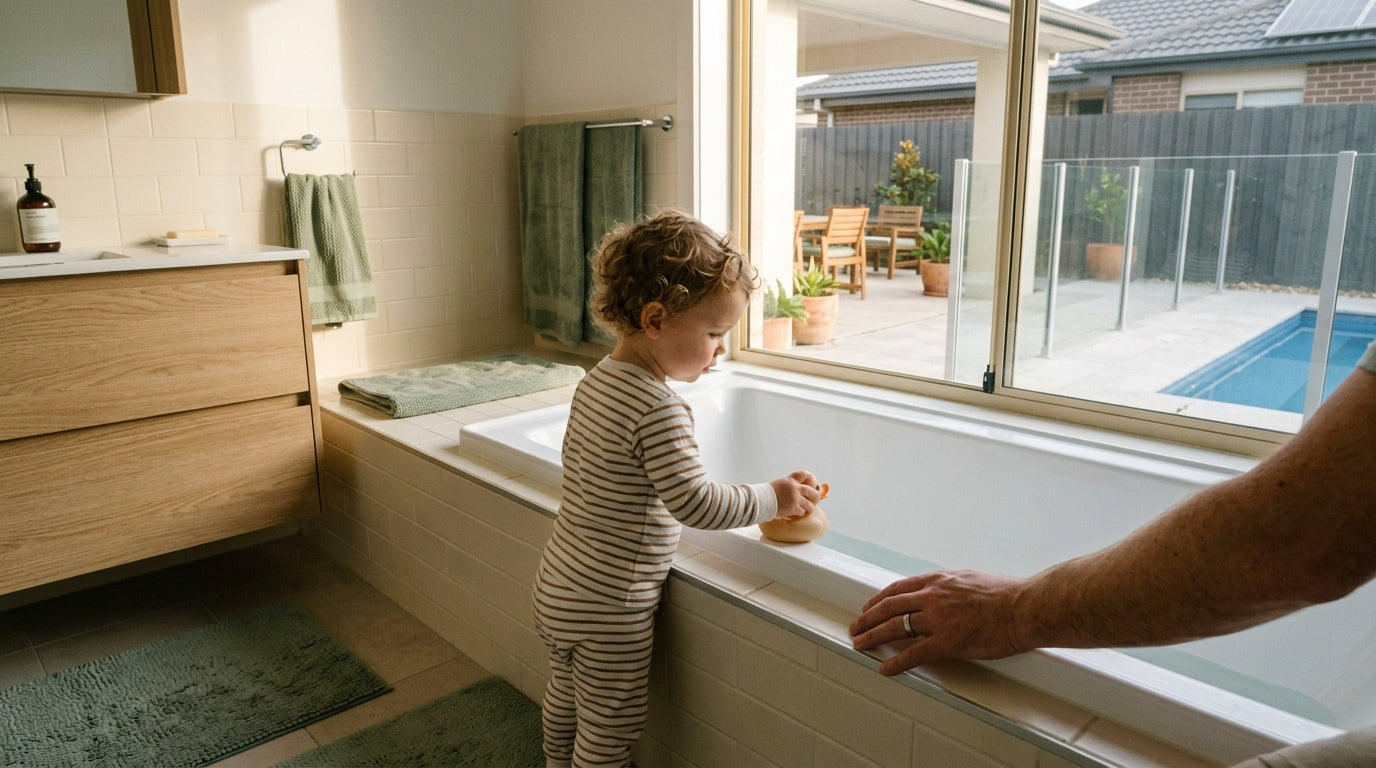
If your sliding door opens to a pool area, this is urgent. Drowning is the leading cause of unintentional injury death in children ages 1–4 (CDC). A track lock on that door is not optional. It’s a layer in a system that should also include pool fencing, a self-latching gate, and supervision. No single barrier is enough. The track lock buys you seconds. Seconds matter.
Keeping the Hardware Working
Check the track itself every few months. Debris in the track can prevent a bar lock from seating properly, and it can cause the door to jump the track, which defeats every guard you’ve installed. Vacuum the track, wipe it down, and make sure the door rolls smoothly.
Replace foam guards when they show compression set, the permanent squish that happens after repeated use. A guard that’s already compressed offers less protection than a fresh one.
If you move or rearrange furniture near a sliding door, re-evaluate your setup. A couch pushed close to a patio door gives a toddler a step up to reach a higher-mounted latch. These things interact in ways that aren’t obvious until they are.