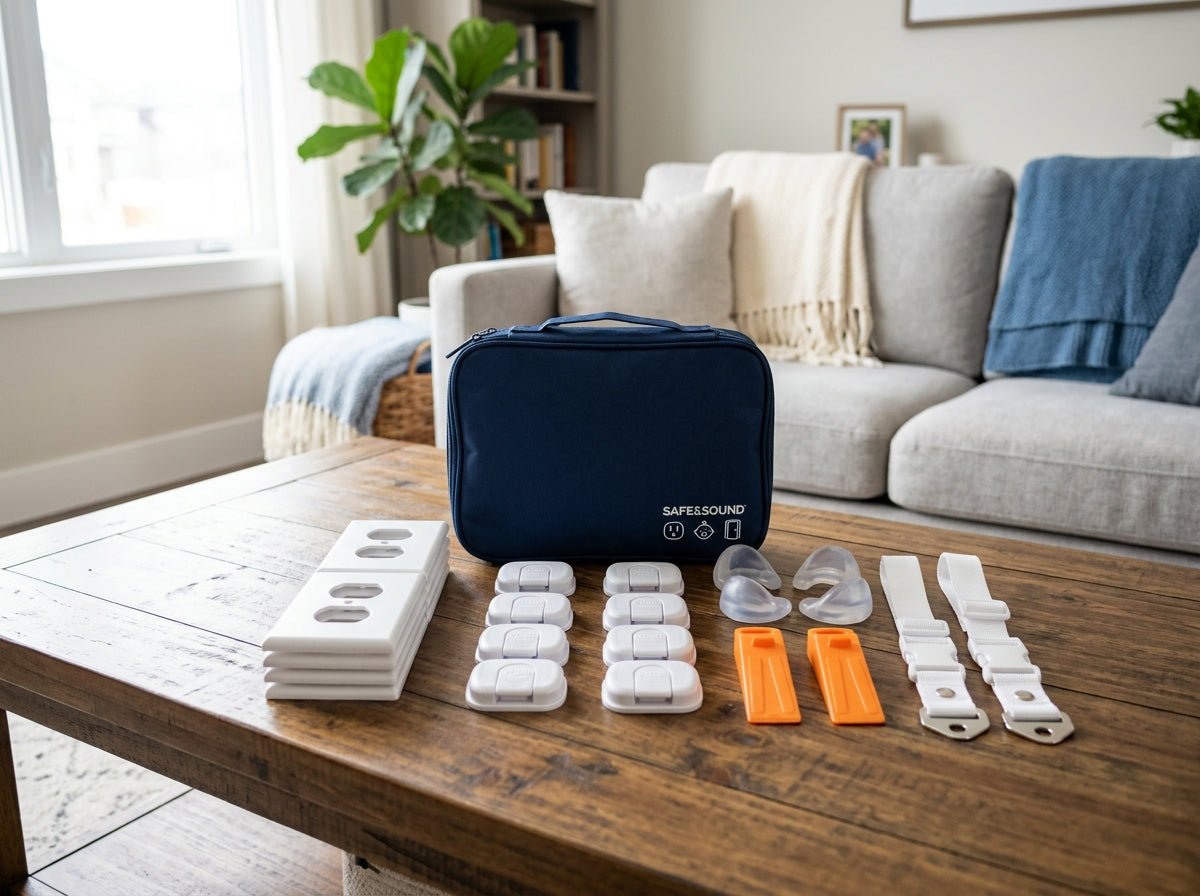
Every year I do a full walkthrough of our house. Not because I enjoy crouching behind toilets or yanking on furniture straps, but because my kids keep changing, and a house that was safe for a six-month-old is a different house for a fourteen-month-old who has just figured out how to climb.
Baby proofing is not a one-time event. It’s a practice. And it’s room-specific, because the risks in a kitchen are not the risks in a nursery, and the risks for a cruising ten-month-old are not the risks for a running two-year-old. This walkthrough goes room by room, tells you what to prioritize first, and gives you the specific products and installation details that work, based on years of living with this stuff.
Before You Start: Think Like Your Child
Get on your hands and knees. Seriously. Do it in every room before you buy a single product. The view from floor level is different from standing height. You will see cords you forgot existed, gaps behind appliances, outlets at eye level, and the underside of furniture that wobbles when you tap it.
I do this every time I start a new room assessment. It feels ridiculous. It is also the single most useful thing you can do before spending money on hardware.
While you’re down there, think in developmental stages. A newborn needs a safe sleep environment and not much else. A crawler needs cabinet locks and outlet covers. A walker needs gate hardware, furniture anchoring, and window guards. A toddler who can climb needs a different threat assessment. Build your checklist around where your child is now, and plan one stage ahead.
The Nursery: Start Here
About 3,500 infants die each year from sleep-related causes in the United States, according to CDC SUID data. Most of those deaths are preventable. The nursery is where you begin, and safe sleep is the foundation.
The crib should be empty. No bumpers, no pillows, no positioners, no stuffed animals. A fitted sheet on a firm, flat mattress. That’s the whole setup. The AAP has been consistent on this for years.
Beyond sleep, the nursery has other hazards that are easy to overlook. Cords from baby monitors, sound machines, and lamps should be routed out of reach and secured. A cord dangling into or near the crib is a strangulation hazard. Mount the monitor on the wall rather than clipping it to the crib rail, and keep the cord at least three feet from the sleeping area.
Dresser drawers are a climbing hazard as soon as your child can pull to stand. Anchor every piece of furniture in the nursery to the wall. According to the CPSC, one child dies every two weeks from tip-overs, and dressers are among the most common culprits. Use a two-point wall anchor strap, not the furniture’s own hardware alone. I test mine by gripping the top of the dresser and pulling hard toward me. If it moves more than an inch, the anchor needs to be redone.
Changing tables need a safety strap, and you need to use it every single time. Every time. The one time you don’t is the time the baby rolls.
The Kitchen: The Highest-Concentration Hazard Zone
More dangerous items are within reach in a kitchen than in any other room in the house. Knives, heavy pots, cleaning products, the stove, the oven, the refrigerator, small appliances with cords. The goal is not to make the kitchen inaccessible to your child. The goal is to eliminate the specific hazards while keeping the room functional for you.
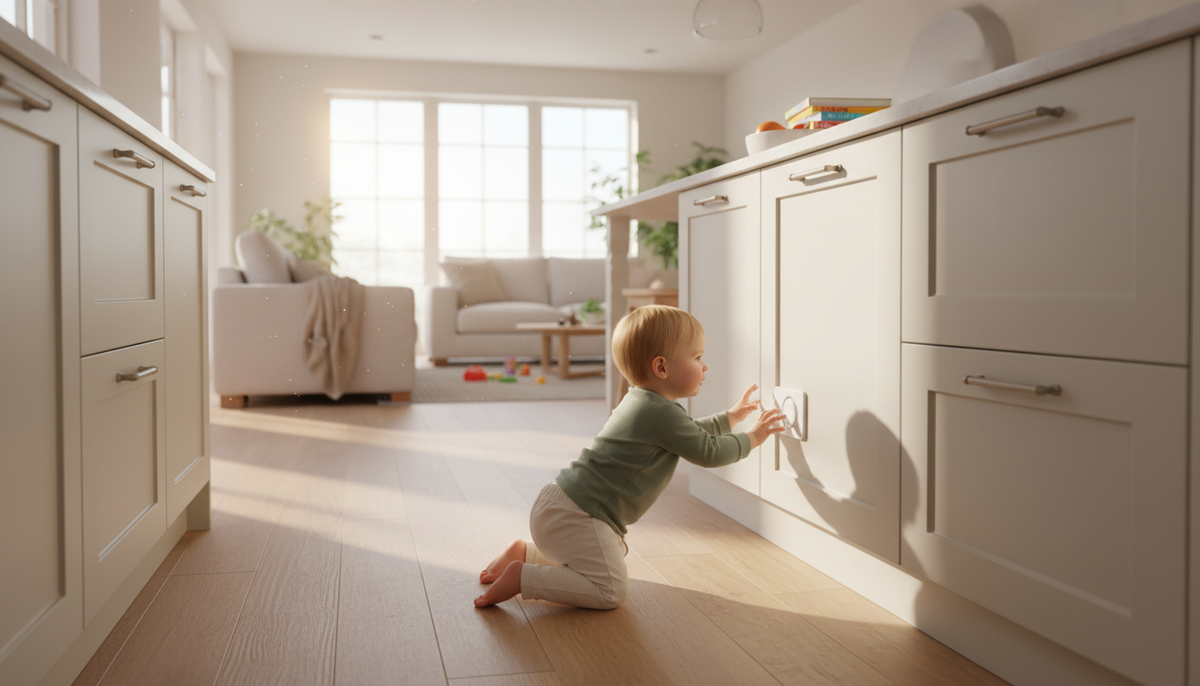
Cabinet locks are your first purchase. For lower cabinets, magnetic locks are the most reliable option. They require a magnetic key to open, which means no fumbling with a mechanism while holding a baby, and no visible hardware on the outside of the cabinet. I’ve installed both adhesive and screw-mounted versions across two kitchens. The screw-mounted ones hold reliably. The adhesive ones are unreliable depending on your cabinet material.
The cabinet directly under the sink needs a lock regardless of what else you decide. Cleaning products, dishwasher pods, and drain chemicals are all there. My younger daughter emptied that cabinet in the time it took me to answer the front door. She was fourteen months old and very fast. The cabinet has had a magnetic lock ever since.
Stove knob covers prevent a child from turning on a burner. They’re inexpensive and worth installing as soon as your child can reach the stove. A stove guard or oven shield adds a physical barrier between little hands and the cooktop surface. Use the back burners when possible, and turn pot handles toward the back of the stove.
For the refrigerator and oven, strap locks work well. The same applies to the dishwasher, which contains sharp utensils and, when running, very hot steam from the vent.
Keep the trash can inside a locked cabinet or use a can with a foot-pedal lid that requires adult weight to open. Trash is a constant source of curiosity and contains everything from broken glass to medication packaging.

- Monitor cord within 3 feet of crib
- Unsecured dresser, tip-over risk
- Changing table without safety strap
- Outlet at crawling eye level
Living Areas and Common Rooms: Furniture and Fall Hazards
Furniture tip-overs are not a fringe risk. According to the CPSC 2023 Annual Tip-Over Report, an average of 22 deaths per year result from furniture, TV, and appliance tip-overs. Anchor every bookcase, every TV stand, every wardrobe, every tall dresser. Use anti-tip straps rated for the weight of the piece plus the weight of a climbing child. I anchor to wall studs wherever possible. When that’s not possible, I use a toggle bolt rated for the load and check it every few months.
Flat-screen TVs should be wall-mounted or secured to the stand with an anti-tip strap that connects to the wall. A TV on a stand that is not anchored is an extremely heavy object waiting to fall on a child who grabs the stand for support while learning to walk.
Coffee tables with sharp corners are a real hazard for walkers and early runners. Corner and edge guards are a low-cost fix. Clear silicone guards are less obtrusive and hold well on most surfaces. I keep them on our coffee table until kids are past the unsteady running phase, which for my older daughter was around age three.
Fireplaces need a hearth gate or a padded hearth guard. The raised brick or stone edge is exactly the height of a toddler’s head. A freestanding gate that encloses the entire fireplace area is more effective than a hearth pad alone, because a pad doesn’t prevent a child from getting close to the firebox.
Outlets: use tamper-resistant outlet covers or, better, replace standard outlets with tamper-resistant receptacles (TRR outlets), which have built-in shutters that require simultaneous pressure from a plug to open. These are more effective than plastic plug covers, which children can remove.


Stairs: Gates That Hold
According to a Nationwide Children’s analysis of CPSC NEISS data (1999–2008), about 93,000 children under 5 are treated in U.S. emergency rooms each year for stair-related injuries. Gates are the primary intervention, and gate quality matters.
For the top of stairs, use only a hardware-mounted gate. Pressure-mounted gates are not safe at the top of a staircase. They can be pushed out by a falling child. Hardware-mounted gates bolt into the wall or banister and will not give under impact.
Look for gates certified to ASTM F1004, the federal safety standard for expansion gates and expandable enclosures, made mandatory under 16 CFR Part 1239 (effective 2021). Look for that certification on any gate you buy. The gate should have a one-hand adult operation mechanism and should swing away from the stairs, not toward them.
At the bottom of stairs, a pressure-mounted gate is acceptable. It’s less convenient to install hardware at the bottom, and a fall from the bottom landing is far less dangerous than a fall from the top.
Check your gate hardware every month. Screws work loose. My older daughter figured out how to rock a gate back and forth to loosen the wall anchors, which is how I learned to use longer screws and check them weekly.


Bathrooms: Water, Medications, and Chemicals
According to the CDC, drowning is the leading cause of unintentional injury death in children ages 1–4. According to the AAP, a child can drown in as little as one to two inches of water. That means a bucket, a toilet, a bathtub with standing water, all of these are hazards.
Install a toilet lock. They look unnecessary until you think about what happens when a toddler leans over a toilet bowl. Use a non-slip mat inside the tub and a bath spout cover to protect against head injuries. Never leave standing water in the tub when bath time is over.
Set your water heater to 120°F (49°C). According to the CPSC, at 140°F (60°C), a third-degree burn can occur in just five seconds. At 120°F (49°C), a serious scald takes about five minutes of exposure. Most water heaters come from the factory set higher than 120°F. Check yours with a thermometer at the tap. It takes about two minutes of running hot water to get an accurate reading.
Medications are a serious and underappreciated hazard. According to CDC PROTECT data, unsupervised medication exposures send roughly 100 children under five to U.S. emergency departments every day. Every medication in your house, including vitamins, supplements, and over-the-counter products, should be stored in a locked cabinet or on a high shelf with a child-resistant closure. This includes medications in purses and bags. Grandparents’ purses are a frequent source of exposure. Have that conversation before visits.
All cleaning products under the sink need a magnetic cabinet lock. The bathroom is also where you’re most likely to have a hair dryer or other appliance near water. Unplug and store these after every use.


Windows: Falls and Cords
According to the CPSC, about 3,300 children age 5 and younger are treated in U.S. emergency rooms each year for window fall injuries. Windows in homes with young children should not open more than 4 inches (CPSC and AAP). Window stops and window guards enforce this limit. Window screens are not fall protection. They are designed to keep insects out, not to support a child’s weight.
In New York City, NYC Health Code Section 131.15 (1976) requires window guards in apartments where children age 10 or younger reside. If you’re outside NYC, window guards are still worth considering for any window above the ground floor that a child could access.
Corded window coverings are a separate hazard. According to CPSC GoCordless data, about 9 children under age 5 die each year from window-covering cord strangulation. In 2022 the CPSC adopted federal safety rules requiring most new residential window coverings to be cordless or have inaccessible cords (16 CFR 1260, effective May 30, 2023). If you have older corded blinds, replace them with cordless versions, or use a cord wind-up device and wall anchor to keep cords out of reach. Wrapping cords around a cleat is not sufficient.
Laundry Room, Garage, and Utility Spaces: Lock Them Out
The simplest strategy for the laundry room and garage is to keep children out entirely. A door handle cover or a keyed lock on the door is more effective than trying to make the space itself safe.
If your child does have access to the laundry room, laundry pod locks are essential. Pods are brightly colored and look like toys. They cause severe chemical burns to the mouth and esophagus on contact.
In the garage, lock up all tools, chemicals, and sharp objects. Garage door sensors should be tested monthly: place a two-by-four flat on the ground under the door and trigger the close. The door should reverse on contact. If it doesn’t, the sensor needs adjustment or replacement.
Carbon monoxide is an invisible hazard in any home with gas appliances, an attached garage, or a fuel-burning furnace. According to the CDC, CO poisoning kills more than 400 people each year and sends more than 100,000 to U.S. emergency rooms. Install a CO detector on every level of your home, including inside or directly outside every sleeping area. Combination smoke and CO detectors are fine. According to the NFPA, three out of five home fire deaths occur in homes with no smoke alarms or non-functioning ones. Test all detectors monthly and replace batteries annually.
Small Objects, Button Batteries, and Miscellaneous Hazards
Small objects are a choking hazard for any child under three. The tube test is the standard: if an object fits inside a toilet paper tube, it’s a choking hazard. This applies to toy parts, coins, button batteries, refrigerator magnets, and anything else that ends up on the floor.
Button batteries deserve special attention. According to Poison Control and the AAP, an ingested button battery can cause severe internal burns in as little as two hours. They’re found in remote controls, key fobs, small toys, greeting cards, and hearing aids. Secure any device that uses them with a screw-fastened battery compartment. If the compartment opens easily, tape it shut or remove the battery when not in use.
High-powered magnet sets are not for children under 14. If older siblings have them, they need to be stored out of reach.
Keeping It Current
Baby proofing degrades over time. Adhesive fails. Screws loosen. Kids grow and discover new capabilities. My older daughter defeated an adhesive strap lock at 26 months, which is how I learned to use only screw-mounted hardware on anything important.
Do a full walkthrough every three to four months, or immediately after a developmental leap. When a child starts pulling to stand, do a walkthrough. When they start climbing, do another one. When a younger sibling starts moving, do it again, because what’s safe for a four-year-old is not safe for a crawling infant.
Keep a running list of what you’ve installed and when. Check every anchor, every lock, every gate. Replace anything that shows wear. The hardware is only as good as the last time you verified it was working.