Living Room Baby Proofing Checklist: Every Corner Every Hazard

Every living room looks different. But the hazards inside them are remarkably consistent, and the window of time you have before a crawling baby becomes a cruising toddler becomes a full-sprint preschooler is shorter than it feels.
I’ve been through this twice. My older daughter started pulling up on the coffee table at nine months and had a split lip from its corner by eleven. My younger one was mobile earlier and faster, and the living room was the room I thought I’d already handled. I hadn’t. This checklist is what I wish I’d had the first time.
Work through it room by room, item by item. Check things off. Then check again in three months, because what’s safe for a crawler isn’t safe for a climber.
Anchor Every Tall Piece of Furniture
Start here. Furniture tip-overs kill children every year in the United States. The CPSC reports that 22% of fatal child tip-overs happen in living and family rooms, behind only bedrooms at 50%.
Every bookcase, entertainment center, media console, and tall shelving unit in your living room needs to be anchored to a wall stud. Not drywall anchors. Studs. Use anti-tip straps or L-brackets rated to hold at least several times the weight of the furniture itself, and follow the manufacturer’s load specifications. If you rent, ask your landlord about installing anti-tip anchors; the holes are small and easy to patch. The CPSC’s advice is to anchor furniture and TVs to the wall; furniture-to-furniture straps and weighted bases are not a substitute.
Test every piece after installation. Push on it. Pull on it. Simulate what a 30-pound toddler with a full head of steam would do.
Address Coffee Tables and Sharp Corners
The coffee table is the single most dangerous piece of furniture in most living rooms for children between eight months and two years old. It’s exactly face height for a new walker. The corners are hard. Falls happen fast.
Corner guards and edge bumpers are the standard fix. Clear foam or silicone options adhere to the table edge and absorb impact. Corner guards with industrial-grade adhesive tape hold significantly better than those with basic foam backing. Press them firmly and let them cure for 24 hours before you consider the table safe.
If your coffee table has a glass top or particularly sharp metal corners, consider removing it from the room entirely during the active toddler phase. A floor cushion or an ottoman with rounded edges does the same job without the injury risk.
Outlets, Cords, and Electrical Safety
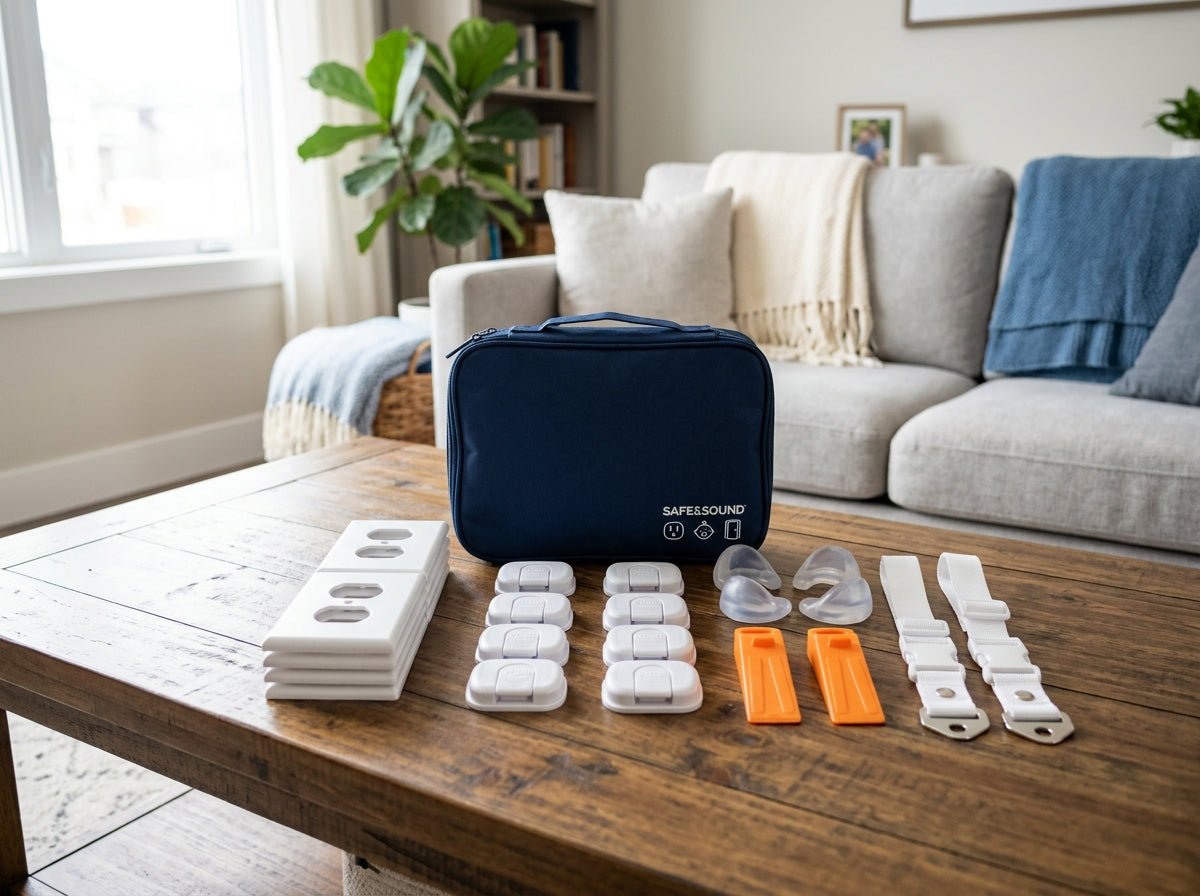
Unused electrical outlets need tamper-resistant covers. Full stop. The plug-in plastic caps are a choking hazard themselves if a child removes one, so sliding plate covers are a better option. They’re inexpensive, install in minutes, and require two simultaneous actions to open.
Cords are a separate problem. A power cord running along the baseboard is a tripping hazard and a strangulation risk for infants. Route cords behind furniture wherever possible. For cords that have to cross open floor space, use cord management boxes or cable raceways to keep them flat against the wall and out of reach. Extension cords should never be a permanent solution. If you need a cord to reach, you need a different outlet or a power strip mounted at height.
Lamp cords deserve specific attention. In my experience, floor lamps can be pulled over by a toddler tugging the cord alone. Weight the base, secure the cord, or move the lamp.


Window Coverings and Cord Strangulation
Corded blinds and shades have been responsible for children’s deaths from strangulation for decades. The CPSC has pushed hard on this issue, and the safest solution is replacing corded window treatments with cordless roller shades, cordless cellular shades, or motorized options.
If replacement isn’t immediately possible, the CPSC says to keep all window cords well out of children’s reach, eliminate dangling cords, permanently anchor continuous-loop cords to the floor or wall, and move furniture away from windows. Even cords tied high can still strangle a child, so treat this as a stopgap until you go cordless. Check every window in the room, including ones you rarely open.
Decorative curtain ties and tassels fall into the same category. If they hang low enough for a toddler to reach, they’re a risk.
Small Objects and Choking Hazards
Living rooms collect small objects the way dryers collect socks. Remote controls. Coins. Pen caps. Decorative stones in a vase. Button batteries.
Button batteries deserve their own sentence because they’re particularly dangerous. They’re flat, shiny, and exactly the size a toddler will put in their mouth. They can burn through a child’s esophagus in as little as two hours if swallowed. If you think your child swallowed one, go to the emergency room right away; do not wait for symptoms. Check every remote control in the room and make sure the battery compartment is secured with a screw.
Everything else that’s small enough to fit through a toilet paper roll is a choking hazard. Move decorative objects, loose change, and small accessories to high shelves or closed drawers. Do a floor-level survey: get down on your hands and knees and look at the room from your child’s height. You’ll find things you didn’t know were there.
Lamps, Vases, and Unstable Decorative Items
Floor lamps tip. Tall vases tip. Anything on a low shelf that a toddler can reach will eventually be pulled off that shelf.
Move breakables up. If something would shatter and create sharp fragments, it doesn’t belong at toddler height. Secure any lamp that could be pulled over by its cord or base. Museum putty or non-slip furniture pads can help stabilize items on shelves, but the better answer for the active toddler phase is simply to remove anything fragile from the lower two feet of the room.
Heavy decorative items on high shelves create a different problem. A child who climbs will pull things down. Keep heavier objects on lower shelves where a fall won’t generate as much force, and reserve high shelves for lightweight items only.
Fireplaces, Hearths, and Space Heaters
A fireplace hearth is a hard, raised surface at exactly the height a falling toddler will hit with their head. Hearth guards, which are padded bumpers that attach to the hearth edge, are the minimum protection. A freestanding safety gate around the entire fireplace is better, especially if the fireplace is in use.
Space heaters should not be accessible to children. Keep them behind a barrier or remove them from the room when children are present. The same applies to wood stoves. Any exposed heating surface that can cause a burn needs a physical barrier between it and your child.
When you’re buying a gate to enclose a hearth or heating area, look for products that meet ASTM F1004, the safety standard for expansion gates and expandable enclosures.
Living Room Safety Checklist
Houseplants and Toxic Greenery
Many common houseplants are toxic if ingested. Pothos, philodendron, peace lily, and dieffenbachia are all popular living room plants and all problematic if a child chews on a leaf. Snake plants and ZZ plants are also toxic.
Move all plants to high shelves or hanging planters where a toddler can’t reach them. Before you do, find out the name of every plant in your home. The ASPCA database covers pets, not children, so if you can’t identify a plant or your child has chewed one, call Poison Help at 1-800-222-1222. Some plants cause mild irritation. Others cause more serious reactions. Know which ones you have.
If you’re not sure what a plant is, treat it as toxic until you can identify it.
Rugs, Throw Rugs, and Tripping Hazards
A throw rug without a non-slip pad underneath it is a fall waiting to happen, both for your child and for you carrying your child. Put non-slip rug pads under every area rug in the room. Check the edges for curl or lift, and secure loose edges with rug tape.
For new walkers, even low-pile rugs can catch a foot. Watch how your child moves across different floor surfaces and adjust accordingly. If a rug is consistently causing trips, remove it.
Cabinets, Drawers, and Low Storage
Any cabinet or drawer that a toddler can reach needs a child-resistant lock or latch. In the living room, this often means media consoles with drawers, built-in shelving with doors, and side tables with storage.
The quality of the lock matters. In 2012, the CPSC recalled 900,000 Safety 1st Push 'N Snap cabinet locks after 140 children defeated them, and three of those children reached toxic cleaning products. Read reviews before you buy, test the lock yourself with your non-dominant hand to approximate toddler-level force, and check periodically that the lock hasn’t loosened over time.
Prioritize any storage that contains batteries, medications, cleaning products, or small objects. Even if you don’t think of the living room as a place where those items live, check. Medications migrate. Cleaning supplies get set down. Button batteries from a broken remote end up in a junk drawer.
A Final Walk-Through
Once you’ve worked through the list, do a slow circuit of the room at floor level. Look for anything that hangs, dangles, tips, or falls. Open every cabinet and drawer to confirm the locks hold. Push on every anchored piece of furniture. Check every outlet.
Then do it again in three months. Children change fast. A room that was safe for a crawler needs reassessment when that same child is pulling up on furniture, and again when they’re climbing. Baby proofing isn’t a one-time task. It’s a habit you build until your child has the judgment to navigate the space safely on their own.