Living Room Outlet and Cord Safety: Hiding Hazards in Plain Sight

The living room looks safe. Soft couch, low coffee table, maybe a basket of toys in the corner. But the outlets clustered behind the entertainment center, the lamp cord snaking across the baseboard, the window blind cord looped over its hook at adult height, these are the hazards hiding in the room you spend the most time in together.
What the Numbers Tell You
From 1991 to 2001, more than 24,000 children under 10 were treated in U.S. emergency rooms for electrical outlet injuries, about 7 a day (Electrical Safety Foundation International, citing CPSC data). That figure covers only outlet-specific incidents, not cord entanglement, appliance burns, or strangulation events. The actual scope of living room electrical hazards is broader.
Cord strangulation data is more severe. About 9 children under age 5 die each year from window-covering cord strangulation (CPSC GoCordless data). Per CPSC, nearly half of more than 200 corded-window-covering incidents involving children up to age 8 (2009–2021) resulted in a death. These are not freak accidents. They are predictable outcomes of accessible loops at child height.
The good news is that most of these hazards respond directly to physical intervention. You can fix them this weekend.
The Outlet Cover Problem Most Parents Don’t Know About
The plastic plug-in outlet caps sold in multipacks at every big-box store are a false sense of security. A 1997 Temple University study (Ridenour, Perceptual and Motor Skills) found that none of three outlet protector styles kept every 2- and 4-year-old in the study from reaching the outlet openings, and one style was much easier for the children to get past than the other two. The Electrical Safety Foundation International (ESFI), citing a Temple University study, reports that 100% of 2- to 4-year-olds removed one type of plastic outlet cap within 10 seconds.
In my experience, a 26-month-old pulled a sliding outlet cap off a power strip and had it out before I crossed the room.
The correct solution is a tamper-resistant receptacle (TRR). These have internal spring-loaded shutters that only open when equal pressure is applied to both slots simultaneously, the way a plug works. A child pressing a key or a hairpin into one slot gets nothing. Since the 2008 National Electrical Code, tamper-resistant receptacles are required in all new residential 125V outlets (NEC §406.12). If your home was built or rewired after 2008, you may already have them. If not, retrofitting is straightforward. An electrician can replace standard outlets with TRRs in an afternoon, or a confident DIYer can do it with the breaker off.
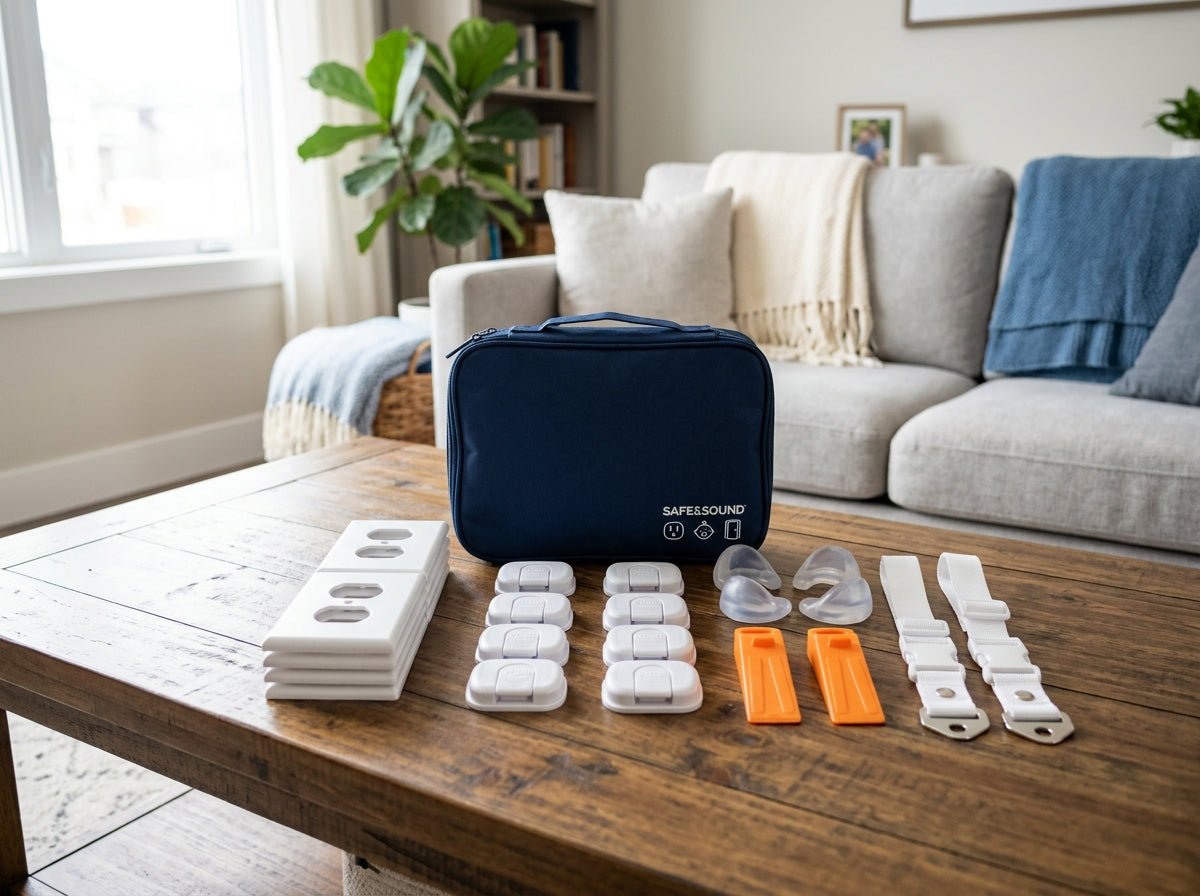
For renters or anyone who can’t replace outlets, the best alternative is a sliding plate cover that replaces the entire outlet faceplate rather than inserting into the slots. These are harder for small fingers to manipulate than plug-in caps, though they are not equivalent to a TRR.


Cord Strangulation: The Hazard at Eye Level
Window blind cords are the most dangerous cord in the living room. A looped cord at the right height, roughly 12–24 inches off the floor for a standing toddler, can form a noose in seconds. The CPSC data on this is not ambiguous.
In 2022 the CPSC adopted federal safety rules requiring most new residential window coverings to be cordless or have inaccessible cords (16 CFR 1260, effective May 30, 2023). That rule applies to new products. It does not remove the corded blinds already installed in millions of homes.
Audit every window in your living room right now. If you have corded blinds, either replace them with cordless versions or use a cord wind-up device and mount the cord wrap bracket high on the window frame, well above a child’s reach. Wrapping the cord around a hook at adult height is not sufficient. Children climb. They pull furniture over to reach things. The cord needs to be inaccessible, not just elevated.
Lamp cords, fan cords, and charging cables present a different but related risk. A cord that runs across open floor or hangs loosely from a table can wrap around a child’s neck or limb during play. Route every appliance cord behind furniture or along the baseboard using adhesive cable clips. Keep slack minimal. A cord with two feet of extra length coiled behind a lamp is a loop a child can pull free and put over their head.
Furniture Placement as a Safety Tool
Your furniture is doing safety work whether you’ve planned it that way or not. A couch pushed close to the wall blocks the outlet behind it. An entertainment unit that sits flush against the baseboard covers the cords running to it. Intentional placement costs nothing.
Walk the perimeter of your living room at floor level. Literally get down on your hands and knees. From that vantage point you will see which outlets are exposed, which cords are accessible, and which gaps between furniture a toddler can squeeze through to reach what’s behind.
The secondary concern with furniture is tip-over risk. CPSC 22% of fatal child tip-overs occur in living and family rooms. A child reaching for a cord behind a bookcase or entertainment unit may pull the unit forward. Anchor heavy furniture to wall studs using anti-tip straps. This is especially important for any unit that a child might use as a ladder to reach cords or outlets at a higher level.
Extension Cords Are Temporary. Treat Them That Way.
Extension cords are one of the most misused products in American homes. They are designed for temporary use. Leaving one plugged in permanently, running under a rug, or strung along a baseboard where children crawl creates compounding hazards: shock from exposed prongs, fire from heat buildup under carpet, and a long accessible cord a child can pull.
If you need more outlets in a specific area, the right fix is adding an outlet. If that’s not immediately possible, use a power strip with an on/off switch and mount it to the back of furniture or secure it to the baseboard so it cannot be pulled free. Choose a strip with individual outlet covers or a sliding safety cover. Keep the cord run as short as possible and route it where it is not a pull hazard.
Never use a standard extension cord as a permanent solution in a room where children play.
Damaged Cords Are Not a "Fix It Later" Problem
In my experience, parents wrap frayed lamp cords with electrical tape and call it handled. It is not. A cord with cracked insulation, exposed copper, or a loose connection at the plug is an electrocution and fire hazard. Tape does not restore the insulation rating of the cord. It creates a false sense of repair while the underlying fault continues.
Replace damaged cords. If the cord is attached to a lamp and the lamp itself is inexpensive, replace the lamp. If it’s a quality appliance with a replaceable cord, order the manufacturer’s replacement part. The repair cost is always less than the alternative.
Inspect every cord in your living room for soft spots, stiffness, discoloration, or visible wire. Check where cords meet plugs, where they exit appliances, and anywhere they’ve been bent repeatedly against a wall or furniture edge. Those flex points fail first.
Living Room Safety Checklist
Reducing Cord Exposure at the Source
The most effective cord safety strategy is having fewer cords. Battery-operated lamps, rechargeable fans, and wireless charging pads eliminate permanent cord exposure in the areas of the room where children spend the most time on the floor.
In my experience, a floor lamp next to a reading chair was pulled taut by a child at about 18 months while a caregiver was answering the door. The lamp didn’t fall, but it could have. The rechargeable lamp charges overnight, lasts through an evening, and has no cord at floor level during the hours it’s in use.
This is not always practical for every appliance. But for lamps, small fans, and decorative lighting, battery or rechargeable options have become viable and the tradeoff is worth it.
Auditing Your Room and Keeping It Current
Do a structured outlet audit when you first childproof. Identify every outlet in the living room, note which are within a child’s reach (roughly floor level to 36 inches), and prioritize those for TRR replacement or plate covers. Secondary outlets behind large furniture can be addressed after the primary ones.
Then build inspection into your routine. Every few months, check that outlet covers are intact and seated correctly, that cord clips haven’t pulled loose from the baseboard, and that no new cords have been routed in ways that create loops or pull hazards. Children grow and gain reach. A cord that was safely behind a couch at 14 months is accessible to a 24-month-old who has learned to move furniture.
Brief older siblings and regular caregivers on the specific rules in your home: which outlets have covers, where cords are routed, and what to do if they see a cover missing or a cord pulled loose. Consistent reinforcement across everyone who spends time in the room with your child is what makes the physical fixes hold.
The living room is fixable. Outlets, cords, and furniture placement are all within your control. Start with the outlets in reach, address the window blind cords today, and work outward from there.