Nursery Window Safety: Blinds Guards and Lock Solutions

The nursery feels safe when you’ve painted the walls, assembled the crib, and folded every tiny onesie into the dresser. But the windows in that room deserve the same deliberate attention you gave to the crib mattress or the baby monitor. They’re a source of light, airflow, and fresh air. They’re also where two of the most preventable hazards in a child’s bedroom live: cord strangulation and falls.
Both are serious. Both are fixable.
The Cord Hazard Is Worse Than Most Parents Realize
About 9 children under age 5 die each year from window-covering cord strangulation, per CPSC GoCordless data. Per CPSC, nearly half of more than 200 corded-window-covering incidents involving children up to age 8 between 2009 and 2021 resulted in a death. These are not freak accidents. They happen in ordinary bedrooms, during naps, in the time it takes a parent to step out for a moment.
The mechanism is straightforward and brutal. A looped cord, a dangling chain, an inner cord that pulls free when a shade is raised: any of these can form a noose around a small neck in seconds. Infants and toddlers lack the motor control and strength to free themselves. By the time a parent returns, it can be too late.
In 2022, the CPSC adopted federal safety rules requiring most new residential window coverings to be cordless or have inaccessible cords, with the custom standard (16 CFR 1260) taking effect May 30, 2023. That rule covers new products. It does not reach the millions of corded blinds already installed in homes across the country.
If your nursery has them, that’s where you start.
Cordless and Motorized Shades: What to Replace With
The safest window covering for a nursery is one with no exposed cord at all. Motorized roller shades and cordless cellular shades are the two best options. Both eliminate the need for manual cord operation near a child’s sleep area. Cordless cellular shades are available at most price points and are easy to retrofit into existing window frames. Motorized options cost more upfront but offer remote or app-based control, meaning you never need to reach past the crib to adjust the light.
In my experience, corded mini-blinds that look fine are still a hazard worth replacing before a newborn arrives.
Look for products labeled "best for children" under the Window Covering Safety Council’s program, or verify that the product is cordless or has fully inaccessible cords per the updated CPSC standard. If a shade has any cord that hangs below the bottom rail or forms a loop when raised, it does not belong in a nursery.


When You Can’t Replace the Blinds Right Now
Rental homes, budget constraints, and landlord timelines are real. If you cannot replace corded blinds immediately, the CPSC recommends removing all accessible cords, loops, and chains from the crib zone as a first step. Beyond that, three interim measures reduce risk without requiring full replacement.
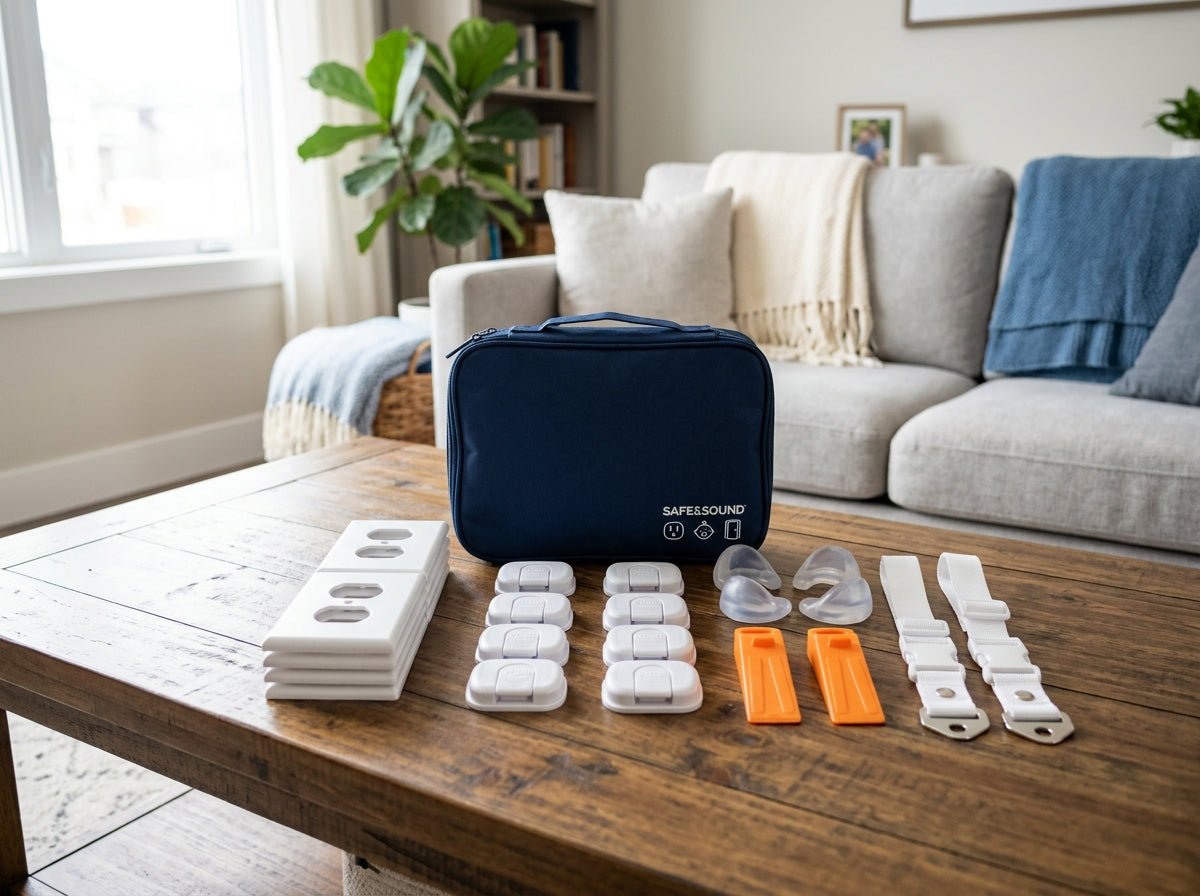
Cord shorteners wind excess cord length into a compact holder mounted high on the wall, keeping the cord out of a child’s reach. Break-away connectors replace the standard connector that holds a looped cord together; they’re designed to separate under a child’s weight before a dangerous tension builds. Winding devices approved by the Window Covering Safety Council secure the cord at a fixed high point.
None of these is as safe as removing the cord entirely. They are harm-reduction tools, not permanent solutions. Use them while you work toward replacement.
One more point for renters: if your rental has corded blinds or unsafe windows in a child’s bedroom, document the hazard in writing to your landlord and request modifications in compliance with local housing codes. Many jurisdictions require landlords to provide safe window coverings in children’s bedrooms. New York City, for example, has had NYC Health Code Section 131.15 since 1976, requiring window guards in apartments where children age 10 or younger reside. Your city may have similar protections. Check before assuming you have no leverage.
Window Falls: Guards, Locks, and the 4-Inch Rule
About 3,300 children age 5 and younger are treated in U.S. emergency rooms each year for window fall injuries, per CPSC data. Screens are not a barrier. A child leaning against a window screen will push it out. This is not a design flaw you can work around with a sticker or a verbal warning to a two-year-old.
Windows in homes with young children should not open more than 4 inches, per CPSC and AAP guidance. That’s the standard. Two categories of hardware enforce it.
Window guards that meet ASTM F2090 standards are rigid barriers installed inside the window frame. They allow airflow through the gaps while physically preventing a child from pushing through. Critically, they must include a quick-release mechanism that allows an adult to open the window fully in a fire or other emergency. A guard without egress capability is a fire hazard. Check the product specification before you buy.
Window stops and childproof locks limit how far a window can open. Tension-rod style stops wedge into the window track. Keyed or dual-action locks mount to the frame and require simultaneous button and lever pressure to disengage, which is beyond most toddlers’ coordination. Install these at 54 inches or higher from the floor, above a toddler’s reach, and test them monthly. A lock that has shifted or loosened is not doing its job.
In my experience, single-action window stops can be defeated by toddlers around 30 months. A dual-action model requiring simultaneous button and lever pressure is more effective.
Crib Placement and the 36-Inch Rule
Where you put the crib relative to the window matters as much as what hardware you install. Position the crib at least 36 inches away from windows, blinds, and cords. This serves two purposes. First, it keeps a sleeping infant away from dangling materials that could shift or fall. Second, it removes the crib from the cold draft zone near the glass, which can disturb sleep and, in very cold climates, create a temperature differential that affects an infant’s thermoregulation.
A crib pushed against a window wall for aesthetic reasons is a common setup I see in nursery photos shared online. It looks tidy. It’s also one of the configurations the CPSC specifically flags as a strangulation risk if any cord is within reach of a child who can pull to stand.
Measure before you finalize the room layout. If 36 inches isn’t achievable given the room dimensions, prioritize the window treatment change over the crib placement. Cordless shades plus a crib closer than ideal is safer than corded blinds plus a crib at the right distance.
Quarterly Inspection: What to Check and When
Hardware degrades. Adhesive weakens. Screws loosen in drywall. A window guard or lock that was installed correctly six months ago may not be performing correctly today.
Inspect all window hardware, blind mechanisms, and guards every three months. Here’s what to check:
- Window guards: grip the guard and apply outward pressure. It should not shift, flex, or pull away from the frame. Check the mounting screws for rust or loosening. Verify the quick-release mechanism still operates smoothly.
- Window locks and stops: test the lock under hand pressure, not just a light touch. If it moves or disengages more easily than it should, replace or reinstall it.
- Cordless shade mechanisms: raise and lower the shade fully. The mechanism should engage cleanly at every position. A shade that won’t stay up at a set height is a maintenance issue, but also a sign the internal spring is wearing out.
- Any cord management hardware: check that cord shorteners and winding devices are still holding the cord at the correct height. Cords slip down over time.
A guard that has shifted even slightly may no longer meet the 4-inch opening standard and should be reinstalled or replaced before the next use.
Quarterly Window Safety Checklist
Teaching Older Children Without Relying on It
Physical barriers carry the load for infants and young toddlers. But as children move into the preschool years, age-appropriate conversation becomes part of the safety system.
Keep it simple and concrete. Windows are for looking through, not leaning on. Blinds and cords are not toys. If something falls near the window, a grown-up gets it. These rules work best when they’re consistent and when the physical environment backs them up. A child who has never been able to reach a cord is less likely to be curious about one.
Don’t rely on teaching alone. A four-year-old who understands the rule will still test it. The hardware is the primary layer. The conversation is a secondary one.
Emergency Egress Is Not Optional
Every safety measure assumes that an adult can exit through the nursery window in an emergency. That assumption has to hold.
Window guards must have functioning quick-release mechanisms. Window locks must be operable by an adult under stress, in the dark, possibly with smoke in the room. Keep the path from the door to the window clear of furniture, baskets, and clutter. Know how your specific window guard releases before you need to find out under pressure.
The goal is a room that keeps a child safe from the hazards inside it while remaining accessible in a crisis. Those two requirements are not in conflict. They’re both part of the same design.
Cordless shades, a properly placed crib, ASTM-compliant window guards, and dual-action locks make the nursery window what it should be: a source of light and air, nothing more.