Toddler Kitchen Helper: Safe Standing Solutions for Little Chefs
Safe Standing Solutions for Little Chefs

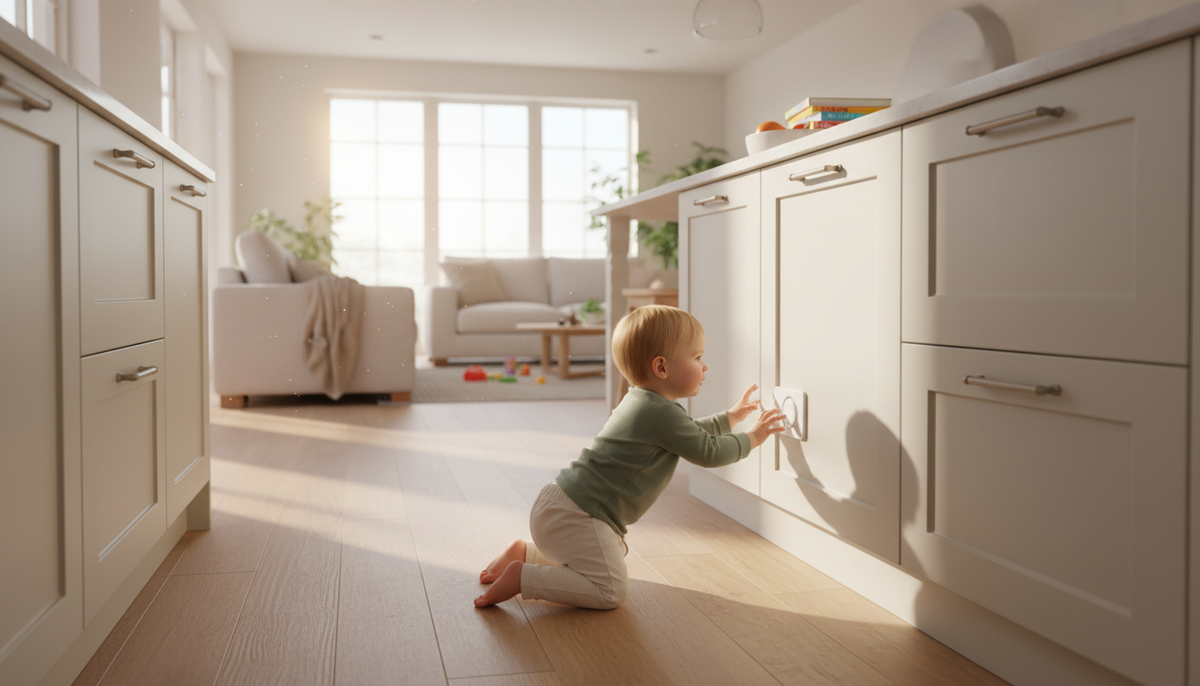
Every year, the CPSC receives reports of children falling from chairs, step stools, and improvised climbing solutions in the kitchen. Most of those falls happen when a parent is right there, watching, distracted for two seconds by a boiling pot or a ringing phone. The kitchen is where toddlers most want to be, and where the gap between "I’ve got this" and "call 911" is smallest.
A learning tower, or kitchen helper stool, is designed to close that gap. It puts your toddler at counter height with four walls around them instead of nothing. But not all of them are built the same way, and the wrong one can create exactly the hazard it claims to solve.
Here is what to look for, what to skip, and what I have learned from testing these with two kids who both, at different ages, decided the kitchen counter was their personal stage.
Why a Learning Tower Beats a Step Stool
A standard step stool gives a toddler height. That is it. There is no rail, no enclosure, no margin for the moment they spin around to show you something exciting and forget they are two feet off the ground.
My older daughter was 28 months old when she took a step stool tumble reaching for the pepper grinder. She was fine. But the speed of it, the way she just vanished from standing to floor, was enough for me to spend the next weekend researching enclosed platforms. The physics are simple: a railing that comes to mid-torso on a 24-to-36-month-old changes the fall risk entirely. The child has to actively climb over something to exit, rather than simply step off.
Learning towers work because they add a containment layer. The platform is wide enough to stand and shift weight. The rails are high enough to catch a lean. And the base is wide enough that a toddler throwing a small tantrum about the wrong color bowl does not tip the whole thing over.
The Safety Specs That Matter
Platform height adjustability is the first thing to check. A fixed-height tower that works at 24 months may put your child’s chin at counter level by 36 months, which means they are leaning over the rail to see anything. Look for at least two height settings, ideally three. The working position should put your child’s waist roughly at counter height, not their armpits.
Rail height matters more than most listings tell you. The AAP recommends that safety barriers for young children be high enough to prevent climbing over, which in practice means the top rail should reach at least chest height on your child at their current age. For a 2-year-old, that is roughly 18–20 inches above the platform. Measure before you buy if you can.
Base width and weight rating are where cheap towers fail. The base should extend beyond the footprint of the platform on all four sides. If the base is the same width as the platform, a child leaning hard to one side can shift the center of gravity past the edge. Most quality towers list a weight rating of 130–150 lbs, which sounds like overkill for a toddler but matters because it tells you about structural integrity, not just the child’s weight.
Hardware quality is worth examining in photos before purchase. Look for metal bolts and inserts, not just wood screws into wood. Wood-to-wood joints loosen with the repeated weight shifts and vibrations of daily use. Metal hardware holds.
Non-slip feet should be standard, but check. Kitchen floors, especially tile and hardwood, are unforgiving. Rubber feet on all four corners of the base are non-negotiable.


What to Look For in Materials and Finish
Most learning towers are solid wood, birch plywood, or a combination. Solid birch is the most durable and handles moisture better than MDF or particleboard. This matters in a kitchen where hands are wet, steam is real, and spills happen constantly.
Finish matters for two reasons: safety and longevity. Look for non-toxic, food-safe finishes, particularly if your toddler is in the phase of licking every surface they touch (mine was, at 22 months, enthusiastically). Water-based paints and natural oil finishes are the standard for reputable brands. Avoid anything with a strong chemical smell out of the box.
Some towers come unfinished or with a natural oil only, which lets you paint or stain to match your kitchen. That is a reasonable option if you are comfortable applying a child-safe finish yourself. If you are not, buy one that arrives finished and certified.


The Enclosure Style Question
There are two main enclosure designs: three-sided open-back towers and fully enclosed four-sided towers.
Open-back towers are easier to get a child in and out of, which matters when you are doing it 15 times a day. They are also lighter and often less expensive. The trade-off is that a child can exit backward without thinking about it, and at counter height, that is a real fall.
Fully enclosed towers with a door or latch on the front are safer for younger toddlers, specifically the 18–30 month range where impulse control is essentially nonexistent. The latch keeps them in until you lift them out. My younger daughter, at around 20 months, would have absolutely launched herself backward out of an open-back design. The enclosed version bought me the three minutes I needed to finish chopping without a hand on her at all times.
By age 3, most kids can understand "stay in the tower" well enough that an open-back design works fine. But for the younger end of the toddler range, the enclosed latch design is worth the extra cost and the slightly more complicated entry.

- Active stove: keep tower well away
- Knives and peelers: store out of reach
- Hot liquids: never handle near tower
- Tower base: must clear all traffic paths
Size, Weight, and Kitchen Reality
A learning tower is a large object. Before you buy, measure your kitchen. The average tower footprint is roughly 20 by 24 inches, and they are typically 35–42 inches tall. In a galley kitchen, that is significant. Some families keep the tower in a corner and pull it to the counter when needed. Others keep it at the island permanently.
Weight varies from about 18 lbs for lighter plywood models to 35 lbs for solid hardwood towers. If you are moving it frequently, lighter matters. If it lives in one spot, heavier is fine and often sturdier.
Foldable towers exist and solve the storage problem neatly. The fold mechanism adds a joint, though, and joints are potential failure points. If you go foldable, check that the locking mechanism is tool-free to engage but cannot be accidentally released by a child pushing on the frame. Test it yourself before your toddler uses it.

How to Evaluate a Specific Product
When I am looking at a tower I have not tested personally, I run through a short checklist:
- Does the listing give specific rail height measurements? If not, ask. Vague descriptions like "tall rails" are useless.
- Is there a weight rating listed? Anything under 100 lbs is a red flag for structural confidence.
- Are the joinery details shown in photos? You want to see hardware, not just finished wood.
- What is the return window? A 30-day return policy matters because some towers wobble in ways that only become obvious once a real child is standing in them.
- Are there verified reviews from parents of toddlers under 2? Older kids are more stable. Reviews from parents of 18–24 month olds tell you more about real-world safety.
- Does the brand respond to safety questions? I have emailed three different tower brands with specific questions about rail height and hardware specs. The ones that answered quickly and with actual numbers are the ones I trust.
One thing I check in person when possible: put the tower on your actual kitchen floor and push on the top rail from the side with moderate force. It should not rock. If it moves more than a quarter inch, the base is too narrow or the hardware is loose.
Quick Product Evaluation Checklist
Setting Up for Success
The tower solves the height problem. It does not solve the reaching-over-the-edge problem, the hot-surface problem, or the sharp-object problem.
Keep the tower away from the stove. This sounds obvious, but in a small kitchen it requires deliberate planning. The AAP is clear that children under 5 should not be near active burners, and a learning tower puts a toddler at exactly the height where steam, splatter, and handles are accessible. Use the tower at the island, a prep area, or a section of counter away from heat sources.
Knives, peelers, and graters go out of reach before the child goes in the tower. Not to the back of the counter. Out of reach. My rule is that anything with an edge lives in a drawer or on a magnetic strip above toddler arm-reach height. The tower raises their reach by 12–18 inches depending on the child. Adjust your knife storage accordingly.
Teach the entry and exit routine from day one. In our house, the rule is that my daughter asks to get in and asks to get out. She does not climb in herself. She does not jump out. This took about two weeks of consistent reinforcement at around 22 months and has held ever since. The tower is a tool with a protocol, not a piece of playground equipment.
Hot liquids are the biggest kitchen hazard for young children, according to the CDC, which reports that scalds account for a significant portion of pediatric burn injuries. Never pour boiling water, drain pasta, or handle a full pot of hot liquid while your toddler is in the tower. Step away, set them down, complete the hot task, then bring them back.
What This Buys You
A good learning tower is not a babysitting device. It is a participation device. It lets your toddler stir the pancake batter, tear the lettuce, press the cookie cutters, and feel useful in a space that otherwise tells them they are too small for everything.
That participation has real developmental value. In my experience as an educator and parent, hands-on food preparation correlates with better food acceptance in young children. My older daughter eats almost everything she has helped make. My younger one is following the same pattern.
The safety investment is real. A quality enclosed tower runs $150–$350 depending on materials and brand. That is not nothing. But it replaces the step stool that nearly put my older daughter on the floor, and it replaced my constant hovering with a structure that does the safety work for me. In a kitchen where the margin for error is small, that structure is worth the price.