
Most parents think they have more time than they do. The baby isn’t moving yet, the living room looks fine, and the cabinet under the sink is just cleaning supplies. Then one day you look up and your eight-month-old has pulled herself to standing against the coffee table, and the corner of that table is exactly at eye level.
That’s when the panic sets in. And that’s exactly when you don’t want to be starting from scratch.
The truth is, babyproofing isn’t a single weekend project. It’s a rolling process that tracks your child’s development, and it starts earlier than most parents expect. Here’s how to think about it, month by month and milestone by milestone.
Start Before the Baby Arrives: The Third Trimester Window
You will not have time after. I don’t say that to scare you. I say it because I remember sitting on my kitchen floor at 36 weeks pregnant, trying to figure out how to anchor a bookshelf to a plaster wall, and thinking: I should have done this two months ago.
The third trimester is your window for the heavy-lifting tasks. These are the things that require tools, research, or professional installation.
Anchor your furniture now. CPSC reports one child death every two weeks from furniture, TV, or appliance tip-overs. Dressers, bookshelves, and TV stands are the most common culprits. Anti-tip straps are inexpensive and take about 20 minutes to install. Do it before the baby comes, because you will not have 20 uninterrupted minutes for a while after.
Install smoke and CO alarms on every level. Three out of five home fire deaths occur in homes with no smoke alarms or non-functioning ones (NFPA). Carbon monoxide is a separate risk. CO poisoning kills more than 400 people each year and sends more than 100,000 to U.S. emergency rooms (CDC). Both detectors should be in place and tested before you bring a newborn home.
Check your water heater temperature. Set it to 120°F (49°C) or lower. Infant skin burns faster than adult skin, and the time between "warm bath" and "scald" is shorter than you think.
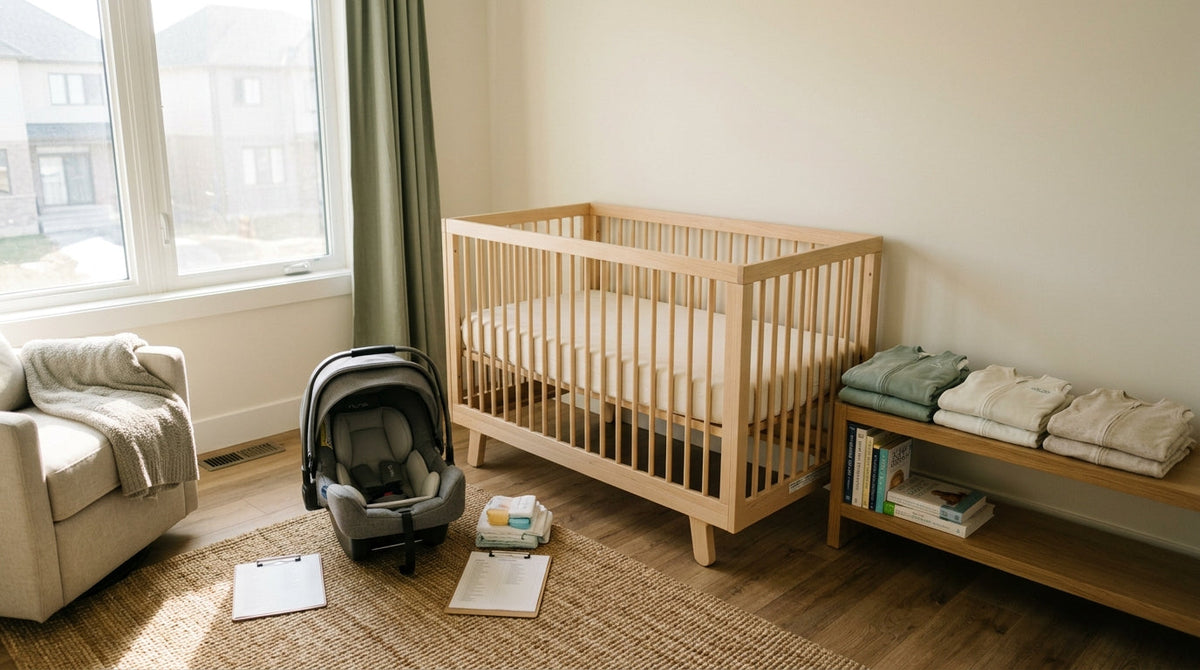
This phase is also when you should start thinking about your nursery layout. Keep the crib away from windows, blinds cords, and any furniture the baby could eventually climb to reach a window. The room needs to be safe not just at birth, but at 18 months when your child can climb.
Newborn to 3 Months: The Sleep Safety Phase
A newborn can’t go anywhere. But the risks at this stage are real, and they’re almost entirely about the sleep environment.
About 3,500 infants die each year from sleep-related causes in the United States (CDC SUID data). Unintentional suffocation kills roughly 1,000 infants under age 1 each year in the United States (CDC). These numbers are why the AAP’s safe sleep guidelines exist, and why following them is the most important thing you can do right now.
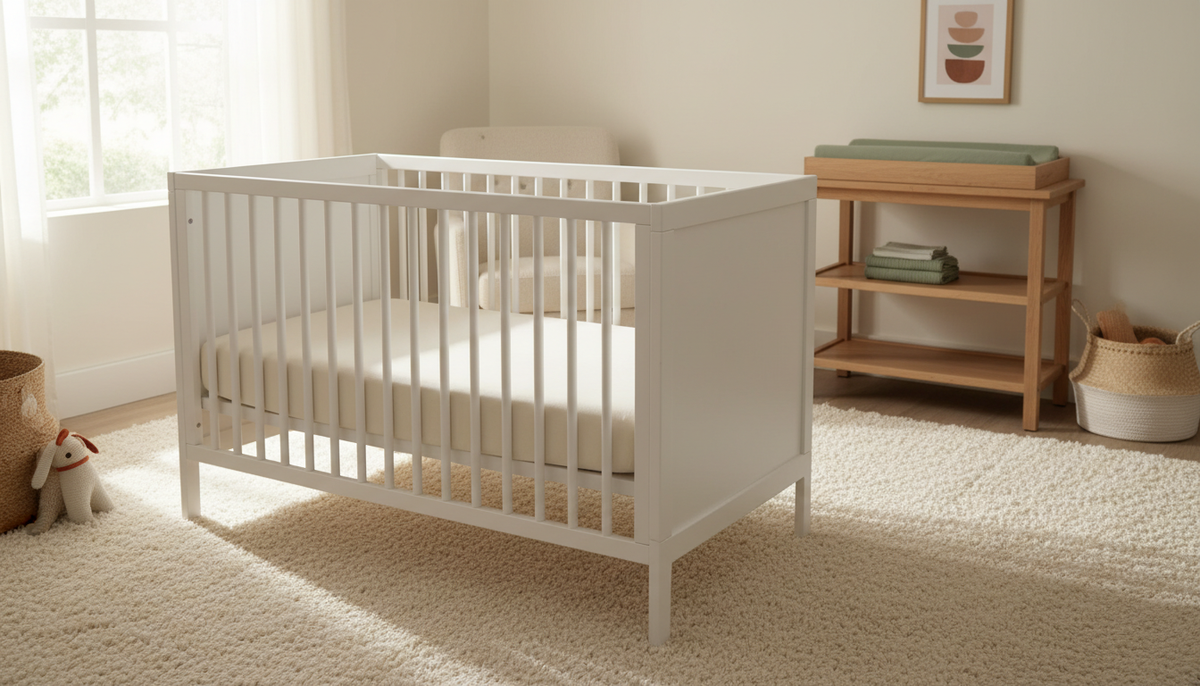
The basics: firm, flat sleep surface. No loose bedding, no bumpers, no pillows. Baby on their back, every time, for every sleep. No bed-sharing. A bare crib is a safe crib.
Beyond sleep, this phase is about blind cord safety. Loop-and-tassel cords should be cut and converted to cordless. Any cord within reach of a crib, bassinet, or changing table is a strangulation hazard. Infants don’t need to be mobile for this to be dangerous. They just need to be placed near one.


Babyproofing by Developmental Stage
Anchor furniture, install alarms, set water heater to 120°F (49°C), move all medicines and vitamins to locked storage
Safe sleep setup, remove all blind cords near crib
Scan floors for choking hazards, secure button battery compartments
Install stair gates, cabinet locks, outlet covers, and corner padding
Remove tablecloths, add window stops and toilet locks, recheck stair gates
Recheck medicine storage, upgrade adhesive latches to screw-mounted
Reassess reach every few months, pair barriers with verbal safety instruction
3 to 6 Months: Rolling and Reaching
Somewhere around four months, babies figure out how to roll. And then they figure out that rolling is a way to get somewhere. This is when falls from elevated surfaces become a real risk.
Never leave a baby unattended on a changing table, bed, or couch. I know you’ve heard this. I also know that the doorbell rings and you think "just one second." I’ve done it. The rule exists because babies move faster than your estimate of how fast they move.
This is also a good time to start scanning your home at floor level. Get down on your hands and knees and look. Small objects, loose cords, anything that could go in a mouth. Choking is a persistent hazard from this age forward. Anything that fits through a standard toilet paper tube is too small to be on the floor.
Button batteries deserve specific attention. An ingested button battery can cause severe internal burns in as little as two hours (Poison Control, AAP). Remote controls, key fobs, small electronics: check that battery compartments are secured. If the cover can be opened without a tool or significant effort, it’s a problem.

- Under-sink cabinet with caustic cleaners
- Electrical outlet at floor level
- Sharp corner on low cabinet door
- Stove knobs within toddler reach
6 to 9 Months: Crawling Changes Everything
This is the phase that catches parents off guard. Crawling babies cover ground fast, and they are motivated by curiosity in a way that is impressive and terrifying.
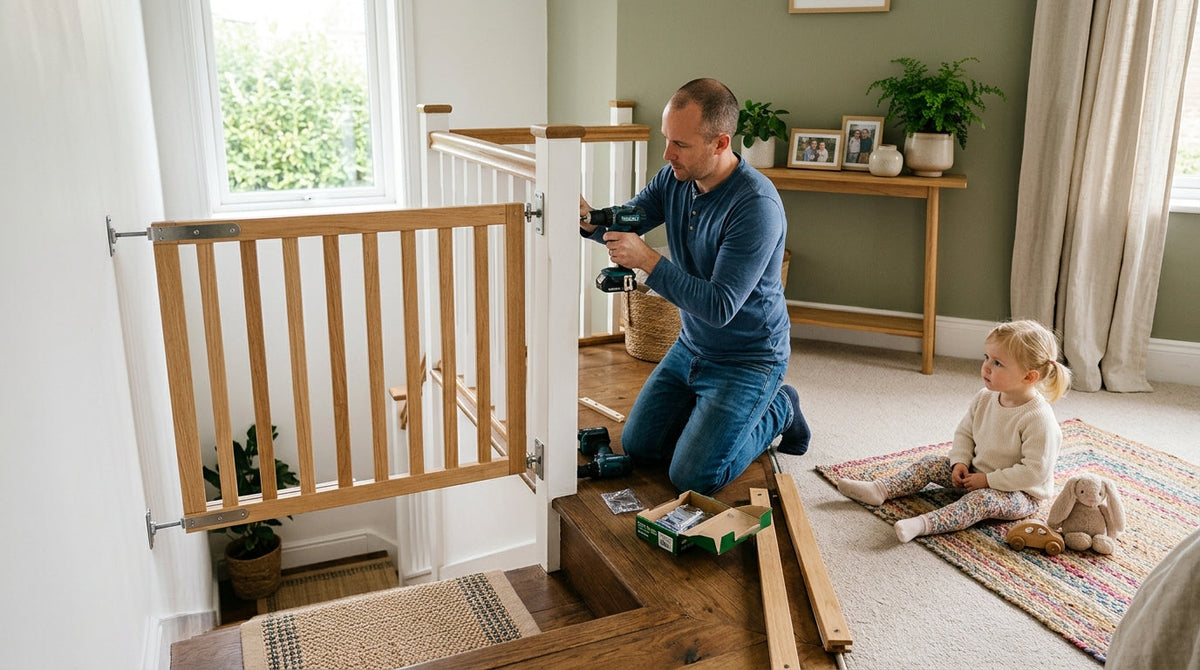
Stairs need gates at both the top and bottom. About 93,000 children under 5 are treated in U.S. emergency rooms each year for stair-related injuries (CPSC). A pressure-mounted gate is fine at the bottom of stairs, but the top requires a hardware-mounted gate. Look for gates certified to ASTM F1004, the federal safety standard for expansion gates.
Lock the cabinets. Under the sink first. Cleaning products, dishwasher pods, anything caustic. My younger daughter once emptied the under-sink cabinet in the time it took me to answer the front door. The cabinet was unlocked because I’d been meaning to get to it. After that, I installed magnetic locks on every lower cabinet in the kitchen and bathrooms the same afternoon.
Cover electrical outlets. Tamper-resistant outlets are now required in new construction, but if your home is older, sliding plate covers are more effective than the plug-in caps, which can themselves become choking hazards if a toddler pulls them out.
Pad sharp corners. Coffee tables, hearths, TV consoles. A crawling baby’s head is at exactly the wrong height for most of these.


9 to 12 Months: Pulling Up and Cruising
Once a baby can pull to standing, the risk profile shifts upward. Literally. They can now reach things on low tables, pull on tablecloths, and grab whatever is at the edge of a counter.
Tablecloths are a specific hazard here. A baby who grabs and pulls will bring down everything on the table. Hot liquids, heavy objects. Remove them or switch to placemats.
This is also when window safety becomes urgent. About 3,300 children age 5 and younger are treated in U.S. emergency rooms each year for window fall injuries (CPSC). Windows in homes with young children should not open more than 4 inches. Window stops and guards are inexpensive. Install them on any window above the ground floor, and move furniture away from windows so babies can’t use it as a climbing assist.
Check your stair gates. A baby who can pull to standing will test a gate differently than a crawling baby. Make sure hardware-mounted gates are still secure at the top of stairs.
12 to 18 Months: Walking, Climbing, and Getting Into Everything
Walking babies become climbing toddlers faster than you expect. My older daughter defeated an adhesive strap lock on a kitchen drawer at 26 months. She’d been working on it for weeks. I didn’t know. The point is that locks and latches are not permanent solutions. They’re friction, and toddlers are persistent.
At this stage, revisit every lock and latch you installed earlier. Test them. Replace adhesive-backed hardware with screw-mounted versions where possible. Adhesive fails on certain surfaces and with repeated use.
Medications need to be locked up, not just out of reach. Per CDC PROTECT data, unsupervised medication exposures send roughly 100 children under five to U.S. emergency departments every day. "Out of reach" stops working the moment your toddler figures out how to drag a step stool across the kitchen. A locked box or high cabinet with a latch is the standard.
Toilet locks. A child can drown in as little as one to two inches of water (AAP). Drowning is the leading cause of unintentional injury death in children ages 1–4 (CDC). Toilets, buckets, and even dog water bowls are hazards. Toilet seat locks are cheap and easy to install.
Stove knob covers. Toddlers at counter height can reach stove knobs. Covers that require adult hand size or a specific motion to operate are worth adding now.
18 Months and Beyond: The Moving Target
Babyproofing doesn’t end at 18 months. It evolves. Your toddler is now a problem-solver who will figure out your solutions and work around them.
The shift at this age is toward supervision and teaching alongside physical barriers. You can’t lock everything forever. But you can start explaining why the stove is off-limits, why we don’t touch the cleaning cabinet, why we hold the railing on stairs. Physical barriers and verbal instruction work together.
Keep reassessing. A toddler who couldn’t reach the bathroom counter at 14 months can reach it at 22 months. A child who couldn’t open a door at 18 months can open it at 26 months. Walk through your home every few months and ask: what can they reach now that they couldn’t reach before?
The Babyproofing Mindset
The goal isn’t a perfectly locked-down house. The goal is a home where the most serious hazards are addressed, where you have enough friction in the right places to give yourself time to intervene, and where you’re not spending every moment in a state of high alert.
Start early. Revisit often. And when your child defeats a lock you installed, which they will, replace it with something better rather than assuming they’ve learned their lesson. They haven’t. They’re just getting started.