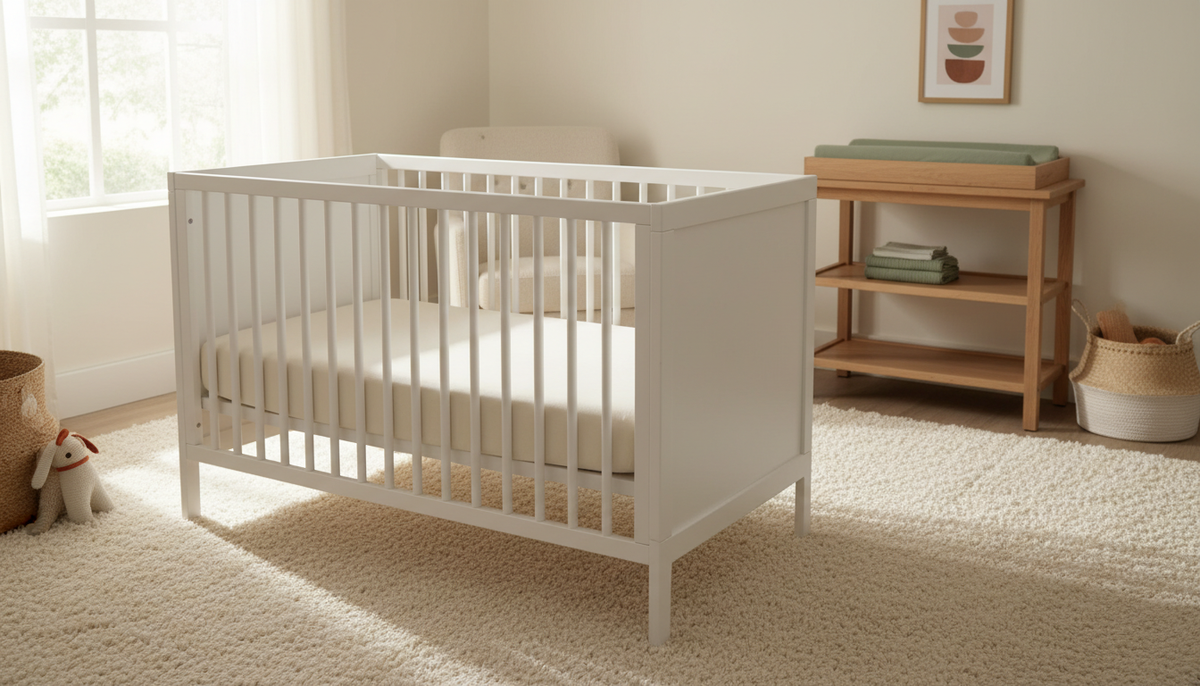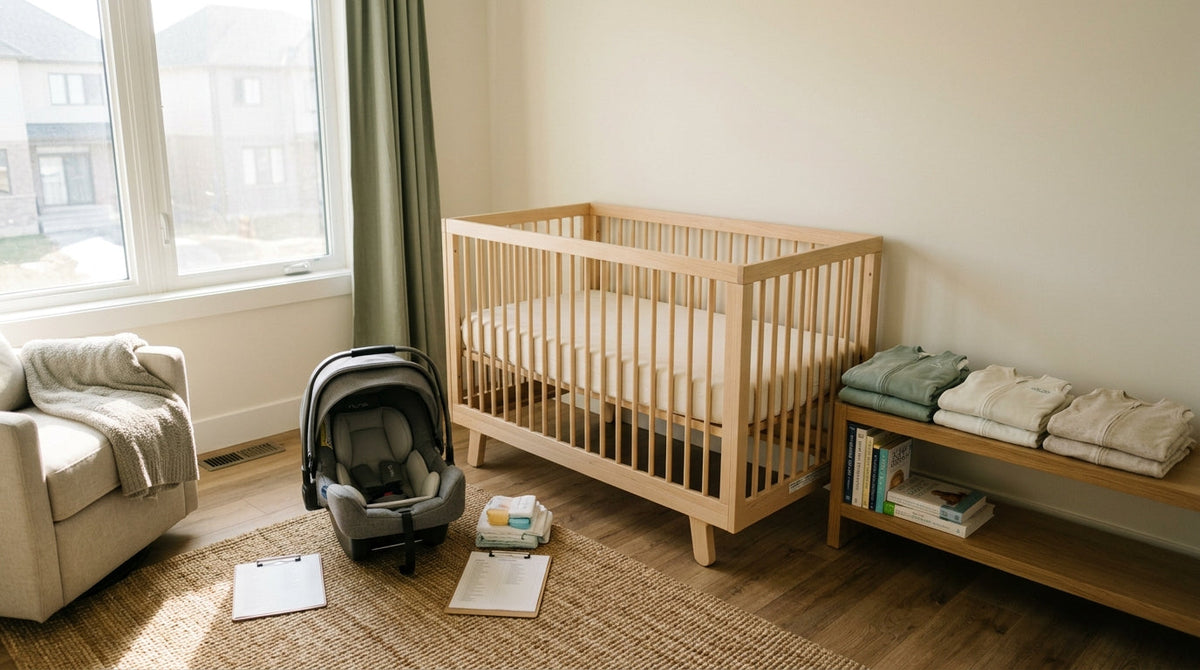

The goal of a yes space is simple: give your baby a defined area where the answer to every question is yes. Yes, you can touch that. Yes, you can pull that out. Yes, you can explore freely. No redirecting, no "gentle hands," no hovering with your heart in your throat.
It sounds peaceful. Getting there takes some deliberate work.
What a Yes Space Is
The term comes from Montessori and RIE philosophy, but you don’t need to subscribe to either to use the concept. A yes space is a contained, fully childproofed zone where a baby or young toddler can move, explore, and make choices without constant adult intervention. It’s not a playpen in the old-sense of a holding pen. It’s a prepared environment.
The distinction matters. A traditional playpen keeps a child contained so an adult can step away. A yes space is designed around the child’s developmental needs: low shelves with a few carefully chosen objects, soft flooring, nothing that can tip, nothing with a cord, nothing that requires you to say no.
My older daughter had a yes space in our living room from about seven months until she started walking confidently, around thirteen months. I used a foam play mat, a low wooden shelf with three or four items rotated weekly, and a soft mirror panel propped against the wall. She would spend twenty minutes in there while I made dinner in the adjacent kitchen. The freedom she had in that space was real. And so was mine.
Start with the Floor
Everything in a yes space begins with the floor, because that’s where babies live. Hard floors are a fall risk and cold. Thick foam tiles or a large padded play mat are the standard solution, and they work well, but check the materials. Look for mats certified free of formamide, phthalates, and heavy metals. Some foam tiles sold for play areas have failed third-party testing for these compounds, so buy from brands that publish their certifications, not just claim them on the packaging.
Size matters more than most parents expect. A mat that’s just big enough for the baby to lie on isn’t a yes space, it’s a landing pad. Aim for at least a 6x6 foot area, more if your room allows. The point is that the child can move, roll, cruise, and eventually toddle within the space without immediately hitting a boundary.
Edges of foam tiles can be a chewing target. If your baby is in the oral stage, either choose a single large mat without removable puzzle edges, or check tiles weekly for bite damage and replace them.


Furniture: Low, Anchored, and Minimal
The Montessori principle of child-sized furniture is practical, not just aesthetic. A low shelf at floor level means a baby can see and reach objects independently. It also means there’s nothing tall enough to tip onto them.
That last point is not minor. CPSC reports one child death every two weeks from furniture, TV, or appliance tip-overs. A yes space should contain nothing taller than about 24 inches, and anything that does have height should be wall-anchored. Even a small bookshelf at 18 inches can tip if a pulling-to-stand baby grabs the edge. Anchor it anyway.
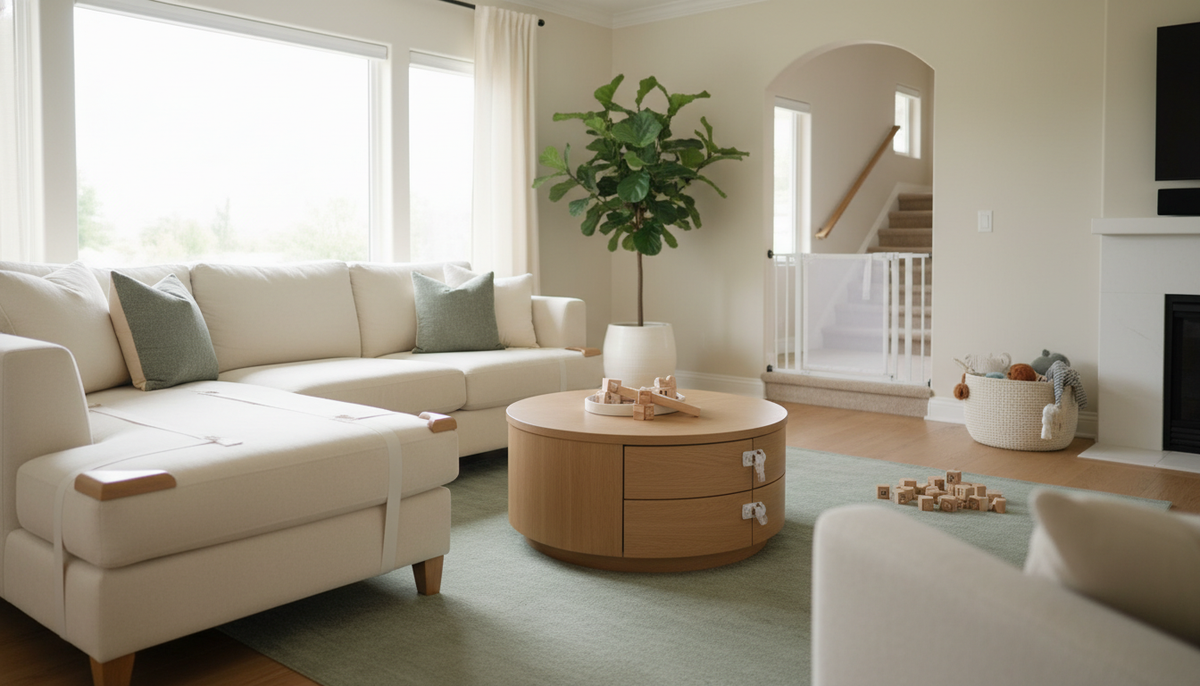
Keep furniture minimal. One low shelf. Maybe a small soft chair or floor cushion as the child gets older. The less furniture, the fewer edges, corners, and climbing opportunities. Corner and edge guards on anything with a hard right angle are worth installing even on low pieces. My younger daughter caught the corner of a low wooden coffee table at about ten months, just pulling herself up. It wasn’t a serious injury, but it was a fast lesson.


The Perimeter: Gates and Enclosures
A yes space needs a defined boundary. Depending on your room layout, that might be a room with a gate across the doorway, or a freestanding play yard enclosure inside a larger room.
If you’re using a gate, buy one that meets ASTM F1004, the federal safety standard for expansion gates and expandable enclosures, made mandatory under 16 CFR Part 1239 (effective 2021). This matters because not every gate on the market is compliant, and pressure-mounted gates vary significantly in how well they hold against a determined toddler. For a yes space entrance you pass through frequently, a walk-through pressure gate works. For a stairway adjacent to the space, use a hardware-mounted gate only.
Freestanding play yards give you more flexibility in open floor plans, but check the panel gaps and height. A baby who is pulling to stand and starting to climb needs a yard tall enough that they can’t hook a leg over the top. Most standard play yards are adequate for babies under twelve months. Reassess as your child grows.

- Corded blinds, strangulation risk
- Unsecured electrical outlet
- Tall furniture, tip-over hazard
- Cabinet without lock, medications inside
What Goes Inside: Objects, Not Toys
This is where yes space design gets interesting, and where Montessori philosophy is useful regardless of your broader parenting approach.
Babies don’t need a bin of forty plastic toys. They need a small number of objects that respond to their actions, offer different textures, and can be mouthed safely. A wooden ring. A soft ball. A small wicker basket they can empty and fill. A fabric book. A simple object permanence box once they’re ready for it.
The rotation principle keeps things fresh without accumulation. Keep six to eight items accessible at a time. Every week or two, swap two or three out for items that have been resting in a basket in the closet. The returning object is interesting again. This also keeps the space visually calm, which matters. A yes space piled with objects is just a different kind of overstimulation.
Remove anything with strings, cords, or small detachable parts. A cord is a tripping hazard and a strangulation risk for infants. The AAP recommends keeping all cords and strings away from babies and toddlers. Check objects weekly for wear, cracks, or pieces that have loosened.
How to Do a Floor-Level Safety Audit
-
Get down to baby height
Sit or lie on the floor inside the yes space boundary and scan at eye level. -
Check for cords and gaps
Look for any cords, finger-trap gaps behind furniture, or loose tile edges you missed from standing. -
Test every anchor point
Pull on each wall-anchored shelf or furniture piece firmly to confirm it holds. -
Inspect objects for wear
Check each toy or object for cracks, loose parts, or bite damage and remove anything compromised. -
Repeat monthly
Schedule a recurring audit. Babies develop quickly and yesterday’s safe setup may need adjustment today.
Hazard Removal Beyond the Obvious
The yes space itself should be clean, but the boundary of the space is where hazards concentrate. Think about what’s just outside the gate or enclosure.
If the yes space is in or adjacent to a living room, check for:
- Cords from blinds or curtains. Corded window coverings are a documented strangulation hazard. If they’re within reach of a child who could push through or over a boundary, replace them or tie them out of reach.
- Electrical outlets. Tamper-resistant receptacles (TRRs) are now required in new construction, but older homes often have standard outlets. Plate covers are a minimum. Furniture placement to block access is better.
- Furniture with tip potential. Anything outside the yes space that a cruising baby could grab through a gate needs to be anchored too.
- Medications and cleaning products. These should never be in the yes space zone or adjacent to it without locked storage. According to CDC PROTECT / NEISS-CADES, about 36,000 children under five are treated in U.S. emergency departments each year for unsupervised medication exposures, roughly 100 children per day. The yes space perimeter is a good moment to audit every cabinet and drawer within a toddler’s eventual reach.
On that last point: under the federal Poison Prevention Packaging regulation (16 CFR Part 1700), specific household chemicals and medications must arrive in child-resistant packages, but child-resistant is not child-proof. Under 16 CFR 1700.15, packaging passes the "child-resistant" bar if at least 85% of tested children (ages 42–51 months) can’t open it within ten minutes, or 80% after an adult demonstrates how. That leaves a meaningful percentage of children who can get in. Cabinet locks are a second layer, not a redundant one.
Supervision and the Real Point of a Yes Space
A yes space is not a substitute for supervision. It’s a tool that makes supervision sustainable.
The goal is that you can be in the adjacent kitchen, or folding laundry in the same room, or sitting on the couch with a cup of coffee, and your baby is safe without you being within arm’s reach every second. That’s a different kind of supervision than hovering. It’s presence without intervention.
When I was building our yes space, I did a floor-level audit. I sat on the floor inside the boundary and looked at everything from baby height. Cords I hadn’t noticed. A gap between the shelf and the wall that looked like a finger trap. A foam tile edge that had started to separate. None of these were catastrophic, but all of them were things I’d missed from standing height.
Do that audit before your child uses the space, and repeat it monthly. Babies change fast. What was safe at seven months may need reassessment at ten.
Adjusting as Your Child Grows
A yes space for a four-month-old who is just beginning to reach is a different setup than one for a ten-month-old who is pulling to stand and cruising furniture. Plan to reassess the space every two to three months in the first year.
The shelf height that was perfect for a seated baby becomes a climbing target for a new stander. The soft ball that was interesting at six months gets ignored at nine in favor of the container it came in. The enclosure that held a crawler may not hold a determined cruiser who has figured out that gates have hinges.
This is normal. The yes space evolves with the child. The core principles stay constant: defined boundary, safe floor, low anchored furniture, age-appropriate objects, hazards removed from the perimeter. What changes is the specific configuration.
Build it carefully, audit it regularly, and you’ll have a space where your baby can do the work of being a baby without either of you spending the whole time on edge.