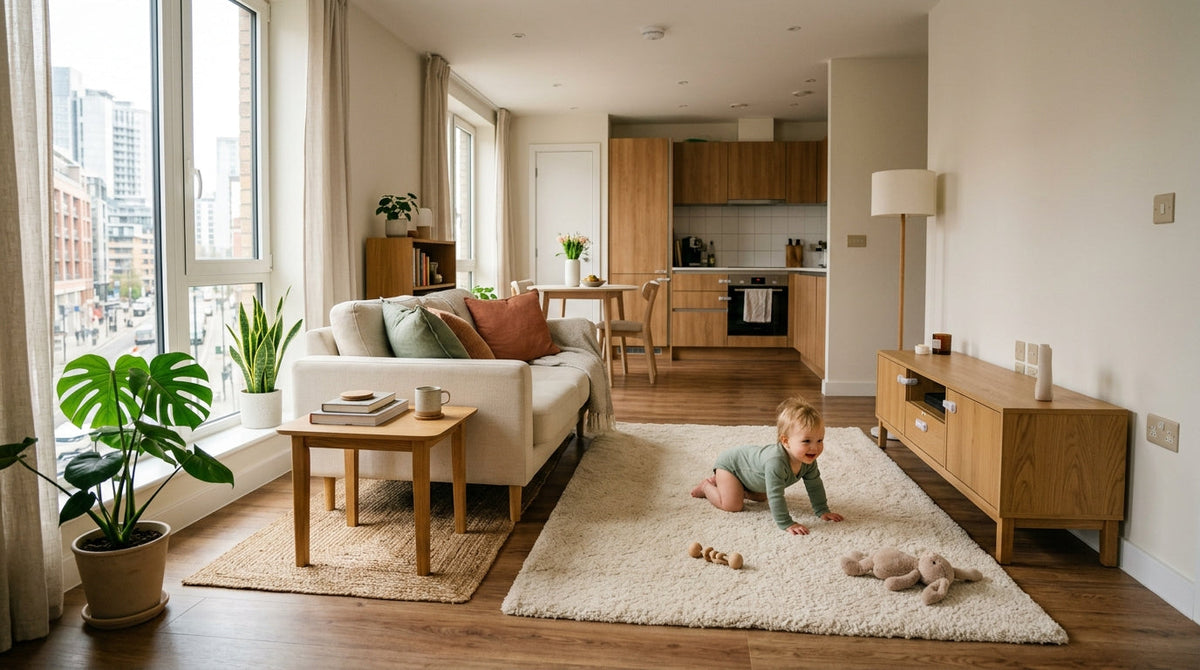
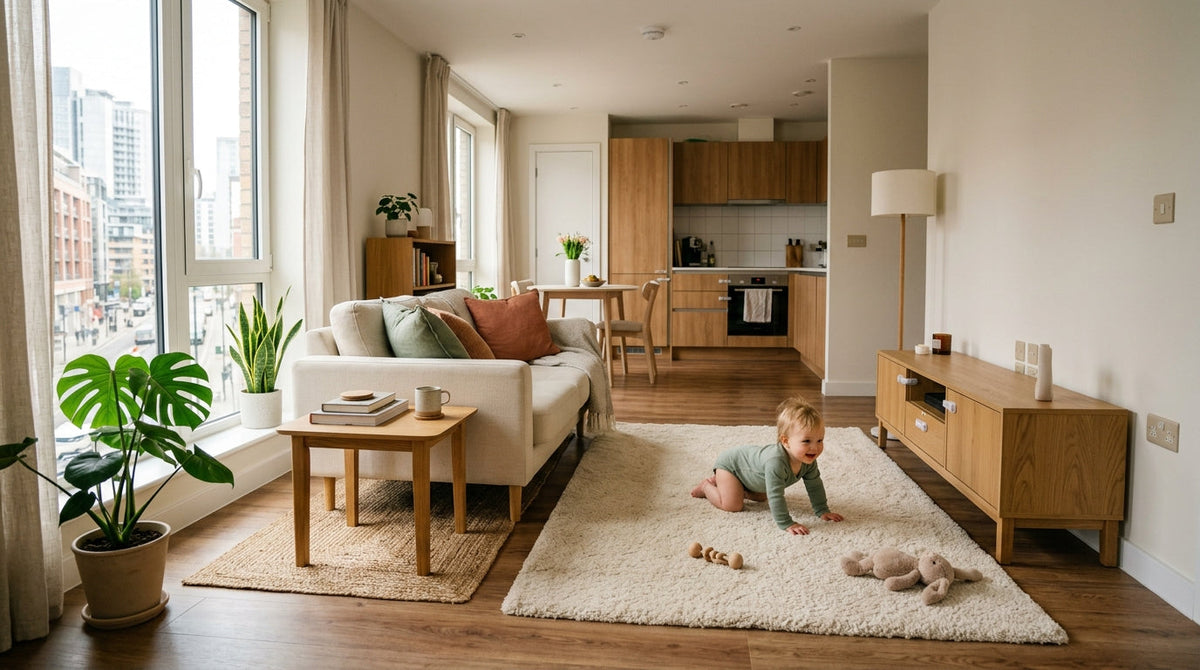
Baby Proofing for Apartment Dwellers: Small Space Solutions

Renting an apartment with a baby or toddler is a specific kind of puzzle. You’re trying to protect a small human who has no concept of danger, in a space you don’t own, using methods your landlord will permit. The usual advice, drill into studs, install hardware-mounted gates, anchor everything to the wall, doesn’t apply when your security deposit is on the line.
The good news is that most of the serious hazards in a small apartment can be addressed without touching a single stud. It takes more thought than brute-force installation, but it’s doable.
Read Your Lease Before You Buy Anything
This sounds obvious. Most people skip it. Before you order a single cabinet lock or safety gate, pull out your lease and read the section on alterations and modifications. Some leases prohibit any wall penetration. Others allow small fasteners under a certain diameter. Some require written approval for anything beyond a picture hook.
Knowing exactly what you’re working with shapes every decision that follows. If your lease bans drilling entirely, you’re building your entire safety plan around adhesive, tension, and pressure-mounted products. If small screws are permitted with written notice, you have a few more options for critical spots like stair gates.
And before you install anything, photograph every room. Document existing scuffs, nail holes, and damage on the walls, floors, and cabinets. Do it the same day you start baby-proofing. This protects your deposit and gives you a clear record of what was there before you touched anything.
Gates and Stair Safety Without Hardware Mounting
Stairs are one of the highest-risk features in any home with a young child. According to Nationwide Children’s Hospital analysis of CPSC NEISS data from 1999 to 2008, about 93,000 children under five are treated in U.S. emergency rooms each year for stair-related injuries.
For renters, the gate question is complicated. Pressure-mounted gates work by wedging between two walls or door frames using tension. They’re removable, leave no holes, and are appropriate for the bottom of a staircase or for blocking doorways. They are not safe at the top of a staircase. A child who falls into a pressure-mounted gate at the top of stairs can push it out of position and fall with it.
Top-of-stair gates need to be hardware-mounted, which means screws into a wall or banister. This is one place where it’s worth having the conversation with your landlord directly. Explain what you’re installing and why. Many landlords will agree in writing to allow a hardware-mounted gate at a stair landing, especially if you commit to patching the holes when you leave. Get that agreement in writing.
When shopping for any gate, look for ASTM F1004 certification on the packaging. This standard covers expansion gates and expandable enclosures and is required under 16 CFR Part 1239 (effective 2021).
Furniture Tip-Over Risk in Small Spaces
Tall furniture in a small apartment presents a real problem. Tip-overs are a leading cause of injury in young children, and apartment layouts often mean you’re placing a tall dresser or bookcase against a wall with no stud behind it, or worse, against a half-wall or a closet partition.
In my experience, hollow-core partitions often lack studs where you need them for furniture anchoring. This changes the calculation for securing tall pieces.
For renters in this situation, the practical options are weighted furniture stabilizers, which add mass to the base of a dresser or bookcase, and low-profile storage. A wide, low four-drawer dresser is harder to tip than a tall narrow one. Spreading storage across multiple shorter pieces rather than one tall unit reduces the tip-over risk without requiring a single wall anchor. Anti-tip straps that use adhesive wall plates rather than screws exist, though their load ratings vary. Check the manufacturer’s stated weight limit and compare it to the piece you’re securing.


Kitchen Cabinet Locks That Don’t Damage Surfaces
Apartment kitchens tend to be compact, which means the cabinet under the sink, where cleaning products live, is often right next to the cabinet where you keep pots and pans, which is right next to where a toddler stands while you cook. My younger daughter emptied the under-sink cabinet in the time it took me to answer the front door. She was 16 months old and very motivated.
You don’t need to lock every cabinet. Prioritize the ones containing cleaning supplies, medications, sharp utensils, and anything with small parts. For rental-friendly installation, adhesive magnetic locks and sliding cabinet latches are the two most practical options.
Adhesive magnetic locks mount inside the cabinet door using strong adhesive pads. A magnetic key held to the outside of the door releases the latch. They work well on smooth cabinet surfaces. On textured or painted wood, adhesive performance varies. In my experience, adhesion can fail on slightly rough surfaces within a month. Test the adhesion for a few days before relying on it, and consider a backup latch on high-priority cabinets.
Sliding cabinet latches clip onto the door and frame without adhesive, using a flexible strap. They’re less elegant but highly reliable and leave no residue.
Cords, Blinds, and Vertical Hazards
Small apartments use vertical space. That means window blinds, blackout curtains, and electronics cords are often within a child’s reach even when you think they’re not. Cords are tripping hazards and strangulation risks for infants and toddlers.
The cleanest solution is cordless window coverings. If you own your blinds, replacing them with cordless versions is straightforward. If the blinds came with the apartment, check with your landlord before replacing them, and keep the originals to reinstall when you move out.
For existing corded blinds you can’t replace, the standard guidance is to keep cords secured at least 5 feet above the floor and use a cord wind-up or cord shortener to eliminate any loop at a reachable height. Cord cleats mounted to the wall with adhesive strips work for this. Check them monthly. Adhesive cleats can loosen over time, especially in humid rooms near windows.
Electronics cords behind entertainment centers and desks should be gathered into cord management channels or flexible tubing and secured to furniture legs rather than running loose across the floor.
Sliding Doors, Large Windows, and Glass Hazards
Many apartments, especially those built in the last 30 years, have sliding glass doors to a balcony or patio. These create two distinct hazards: a child running into glass they can’t see, and a child accessing a balcony unsupervised.
Safety film applied to the glass surface holds shards together if the glass breaks and adds some visual cue to the pane. Decals placed at child eye level, roughly 18–24 inches from the floor, make the glass visible to a toddler moving at speed. Neither requires permanent installation.
For balcony access, a tension-mounted safety gate at the sliding door frame is the renter-friendly approach. Pair it with a door handle cover or a secondary sliding door lock, which is a small bar or pin that drops into the track and prevents the door from opening. These cost a few dollars and require no installation at all.
Balcony railings with vertical slats spaced more than 4 inches apart are a separate concern. Balcony netting or mesh barriers can be attached to railings using zip ties or hook-and-loop fasteners, both of which are removable.
Outlets, Power Strips, and Electrical Safety
Apartments often cluster outlets in inconvenient places, which means extension cords and power strips end up on the floor near where children play. This is worth addressing directly.
Tamper-resistant outlets have spring-loaded shutters that require simultaneous pressure on both slots to open. They’re now standard in new residential construction under current electrical codes. If your apartment is newer, you may already have them. Check by looking for the letters "TR" stamped between the slots. If your outlets are older, plug-in outlet covers provide a basic barrier, though toddlers over 24 months can sometimes remove them. Check them regularly.
For power strips, keep them off the floor and behind furniture where possible. Power strip covers, which enclose the entire strip in a plastic housing, are a practical solution when floor placement is unavoidable.
Apartment Baby-Proofing Checklist
Bathroom Safety in Close Quarters
Apartment bathrooms are often small enough that the toilet, medicine cabinet, and under-sink storage are all within arm’s reach of each other. That proximity matters because it means a toddler who gets into the bathroom has access to multiple hazards simultaneously.
A toilet lock is a simple, inexpensive addition. Most clip onto the seat and lid without tools. Keep medications out of the medicine cabinet entirely if it doesn’t lock. A small lockbox stored on a high shelf is more secure than any cabinet latch.
Under-sink cabinets in bathrooms often have the same pipe cutouts and irregular interiors that make standard latches tricky. A bungee cord looped through the handles is a low-tech but effective interim solution while you find a latch that fits.
Small Objects and Choking Hazards in Limited Storage
According to a Nationwide Children’s Hospital study published in Pediatrics, more than 759,000 children under six were evaluated in U.S. emergency departments for swallowing a foreign object between 1995 and 2015, with coins the most common object at 62% of cases. In a small apartment, coins, batteries, jewelry, and small toy parts tend to concentrate in the same low shelves and baskets where children play.
The practical response is regular auditing of what’s stored low. Anything small enough to fit through a toilet paper tube is a choking hazard for children under three. Age-sort toys every few months and move anything with small parts to a high shelf or a closed bin. Labeled bins at child height should contain only age-appropriate items.
Button batteries deserve specific attention. According to Nationwide Children’s Hospital Pediatrics study of 2010–2019 NEISS data, button batteries accounted for 85% of pediatric battery-related emergency department visits where the battery type was known, and 84% of patients were five years old or younger. Remote controls, key fobs, and small electronics that use button batteries should be stored out of reach, and any device with a loose or unsecured battery compartment should be secured with tape or replaced.
The Renter’s Mindset
Apartment baby-proofing is an exercise in working within constraints, and that’s fine. The goal is the same as in any home: reduce the hazards that cause the most serious injuries, create barriers that buy you time, and build habits that compensate for what you can’t physically install.
Document everything before and after. Communicate with your landlord about anything that requires even minor modification. And revisit your setup every few months, because a child who couldn’t reach a latch at 14 months may defeat it easily at 20. The AAP’s guidance on home safety (HealthyChildren.org) and the CPSC’s baby safety resources (cpsc.gov) are both worth bookmarking for ongoing reference as your child moves through new developmental stages.