Baby Shower Gift Guide: Safety Products New Parents Actually Want

Most baby shower gifts get used for a few weeks, then boxed up or donated. Safety products get used for years, often starting the day parents bring their baby home. Safety products are worth prioritizing over decorative gifts.
New parents are overwhelmed. They’re sleep-deprived before the baby even arrives, and the list of things they need to research, install, and figure out before their infant starts moving is longer than most of them expect. A well-chosen safety gift removes one item from that list entirely. It’s immediately useful, often immediately installed, and it addresses real hazards rather than hypothetical ones.
Here’s what’s worth buying, and why.
Start With Sleep Safety
About 3,500 infants die each year from sleep-related causes in the United States (CDC SUID data). That number includes SIDS, suffocation, and other sudden unexpected infant deaths, and the AAP is direct about what raises the risk: soft objects, loose bedding, and sleep surfaces that aren’t firm and flat.
A crib safety bundle is one of the most protective gifts you can give: a firm, flat crib mattress that meets current standards, two or three fitted sheets sized precisely to that mattress, and a sleep sack in the right weight for the season. Sleep sacks replace blankets entirely, keeping the baby warm without anything loose in the crib.
Unintentional suffocation kills roughly 1,000 infants under age 1 each year in the United States (CDC). Many of those deaths involve soft bedding that parents didn’t realize was dangerous. A sleep sack and a bare crib are the safest choices.
When you’re shopping, look for mattresses with JPMA certification, which signals the product has been tested against juvenile product safety standards. The Juvenile Products Manufacturers Association’s certification program covers cribs, mattresses, and other infant products, and it’s a reliable shortcut when you don’t have time to read every spec sheet.
Outlet Covers and Cord Management
These are the gifts that get installed immediately and then forgotten about, which is exactly what you want from a safety product. Outlets are everywhere in a home, and infants become mobile faster than new parents expect.
The CPSC recommends tamper-resistant outlets as the gold standard. These have internal shutters that require simultaneous pressure on both slots to open, which a child’s finger or a single inserted object can’t do. If the home has older outlets, traditional plug covers are still necessary. They’re inexpensive, and a pack covers an entire house.
Cord management matters just as much. Blind and curtain cords are a strangulation risk for infants and toddlers. Cord winders, cord clips, and cord shorteners keep them out of reach. A cord management kit makes a useful gift because most parents don’t think about this category until they’re already babyproofing and realize every window in the house has a dangling cord.
Baby Gates That Hold
About 93,000 children under 5 are treated in U.S. emergency rooms each year for stair-related injuries, per a Nationwide Children’s Hospital analysis of CPSC NEISS data. That’s roughly one child every six minutes. Gates are the most direct way to prevent stair falls, and they matter at the bottom of stairs as much as the top.
When you’re buying or recommending a gate, look for one that meets ASTM F1004, the federal safety standard for expansion gates and expandable enclosures, made mandatory under 16 CFR Part 1239 (effective 2021). Hardware-mounted gates are the right choice for the top of stairs. Pressure-mounted gates are fine for doorways and room dividers, but they can be pushed out of position and should never go at the top of a staircase.
Installation quality matters as much as the gate itself. A gate that isn’t level, or that’s mounted into drywall without hitting a stud, will fail under pressure. The best gift you can give alongside a gate is a note that says "hardware-mount this one, not pressure-mount."


Cabinet Locks and Drawer Latches
In 2024, household cleaning substances topped the list of substances kids under 6 got into, accounting for roughly 1 in 10 (10.1%) of all pediatric poison center cases (America’s Poison Centers). That’s more than 87,000 cases in a single year, and most of them involved products stored under sinks or in low cabinets.
Cabinet locks are not optional. They’re also not all equal. A 2012 CPSC recall pulled 900,000 Safety 1st Push 'N Snap cabinet locks after reports of children as young as 9 months opening them. Three children reached toxic cleaning products. The lesson isn’t that cabinet locks don’t work. It’s that the specific mechanism matters, and cheaper locks with simple push-release designs can be defeated by determined toddlers.
In my experience, a magnetic lock on a cabinet under the bathroom sink can be defeated if the magnetic key is left on the counter above it, within reach. The lock itself works; the setup matters.
Magnetic cabinet locks are among the most reliable options available. They require a magnetic key held to the outside of the cabinet door to release, and there’s no visible mechanism for a child to manipulate. Look for sets that include multiple locks and two keys, so parents can keep one in a drawer and one somewhere accessible but out of reach.
Video Monitors With Temperature Sensors
An audio monitor tells you your baby is crying. A video monitor shows you why, what position they’re in, and whether the room is too warm, information that matters at 3 a.m. when you’re deciding whether to go in.
The best video monitors now include room temperature displays, two-way audio, and some include motion or breathing sensors. Temperature matters for sleep safety. The AAP recommends keeping the infant’s room at a comfortable temperature, and overheating is a known risk factor in sleep-related deaths. A monitor that shows you the room is 74°F (23°C) when it should be closer to 68°F (20°C) gives parents actionable information.
For a baby shower gift, a video monitor with temperature display and a wide-angle lens is a practical choice that most parents will use every night for two or more years.
Bathtub Safety for Infants
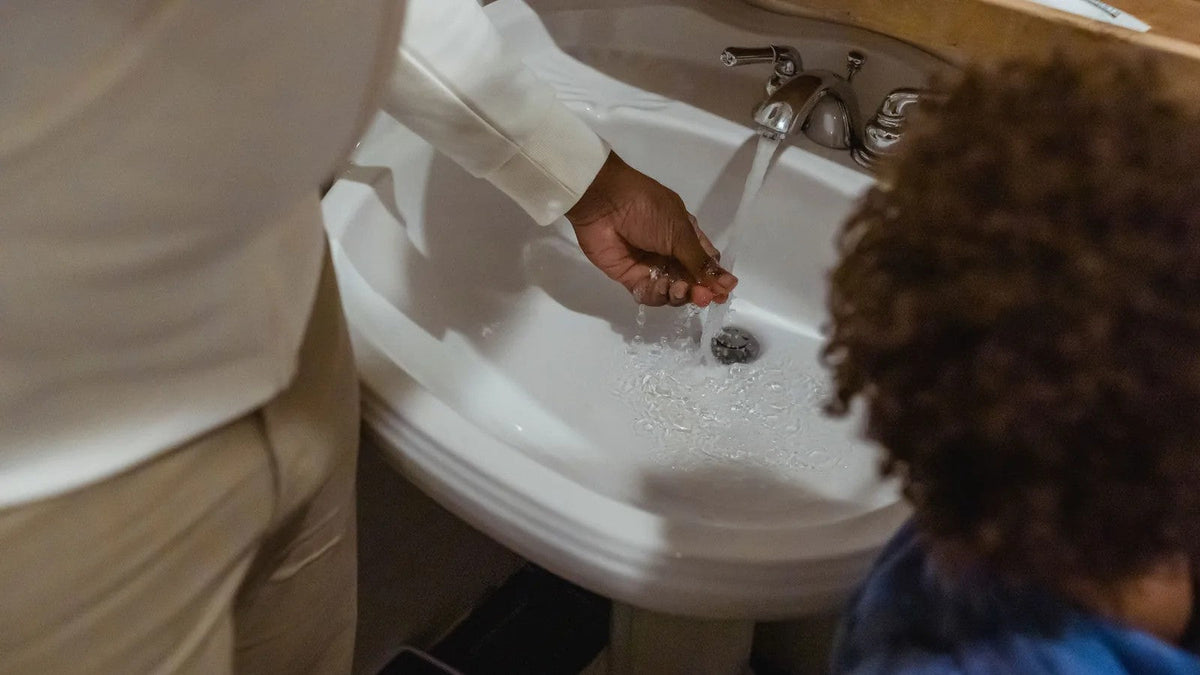
Drowning is the leading cause of unintentional injury death in children ages 1–4 (CDC). A child can drown in as little as one to two inches of water (AAP). Bath time is one of the higher-risk routines in an infant’s day because infants are unpredictable and water is unforgiving.
A non-slip bath mat is the simplest and most immediately useful bathing safety product. It goes in the tub before the baby’s first bath and stays there. Infant bath seats that cradle the baby at an angle are also useful, but no bath seat replaces constant hands-on supervision. These products reduce the physical difficulty of bathing a slippery infant without replacing attention.
For a gift, a non-slip mat combined with a soft faucet cover (to protect against head bumps) and a bath thermometer is a complete, affordable bundle. Bath thermometers help parents confirm water temperature before placing the infant in the tub. The AAP recommends setting water heaters to 120°F (49°C) or below to prevent scalding, and a thermometer makes it easy to verify the bath water is safe before the baby goes in.
Nightlights With Dimmer Controls
Exhausted parents navigating a dark hallway at 2 a.m. are fall risks themselves. A nightlight in the nursery and the hallway outside it is a safety product for the caregiver as much as the child.
The best nightlights for infant rooms have dimmer controls and a red-light option. Red light preserves night vision better than white or blue light, which means parents can see clearly enough to do a diaper change or feeding without waking themselves up enough to struggle falling back asleep. Bright white light suppresses melatonin and disrupts sleep for both parents and infants.
A plug-in nightlight with adjustable brightness and color temperature is an inexpensive gift that gets used every single night.
Thermometers and First Aid Kits
A forehead or ear thermometer designed for infants gives parents a fast, accurate reading without waking a sleeping baby more than necessary. Rectal thermometers are still the most accurate for newborns, and the AAP recommends them for infants under three months. But a forehead thermometer is what parents will reach for at midnight, and a good one is accurate enough for most situations.
Pre-assembled infant first aid kits are worth including on any gift list. A well-stocked kit includes a bulb syringe for nasal congestion, saline drops, infant nail clippers, non-adhesive bandages, a medicine dropper, and a thermometer. The value of a pre-assembled kit is that parents have everything in one place before they need it, rather than searching three different drawers at midnight while a sick baby cries.
Look for kits that include pediatric-appropriate items only. Adult bandages, adult-dose medications, and standard adhesive bandages are not appropriate for newborns, and a kit assembled for infants removes the guesswork.
Mattress Protectors and Waterproof Liners
A crib mattress is an investment that can last through multiple children. A waterproof mattress protector keeps it that way. Spit-up, diaper leaks, and humidity create conditions for mold and bacterial growth on an unprotected mattress surface. A waterproof, breathable cover prevents that.
Buy two. Parents change crib sheets more often than they expect, and having a spare fitted sheet and mattress protector already on the bed means a middle-of-the-night sheet change doesn’t require laundry before the baby can go back down.
Putting It Together as a Gift
The most useful safety gift bundles combine products from the same category. A sleep safety bundle (mattress, two fitted sheets, sleep sack, mattress protector) is immediately usable and addresses the highest-stakes risk category for newborns. A cabinet safety bundle (magnetic locks, outlet covers, cord winders) covers the hazards that become relevant in the first year. A bath safety bundle (non-slip mat, faucet cover, bath thermometer) addresses the daily routine that carries the most risk for mobile infants.
If you’re buying for a first-time parent, include a short note explaining what each product does and when to install it. Most safety products work best when they’re in place before the baby needs them, not after a close call. Parents who receive a cabinet lock kit in month seven, after their baby has already started pulling up on furniture, are behind the curve. Parents who receive it at a baby shower have time to install it before their infant is mobile.
That’s the real value of a safety gift. It gives new parents a head start on hazards they haven’t encountered yet.
Also sold at