How to Store Knives Safely Around Toddlers: Knife Blocks, Magnetic Strips and Locked Drawers
Keep knives out of reach and out of sight: how blocks, magnetic strips and locked drawers compare, and where a drawer lock fits.

Choosing a child proof knife block comes down to placement, not shopping. Keep knives separate from everyday utensils, out of reach and out of sight, and ideally behind a lock.
The kitchen is a hard room to get right. The AAP notes that it is often the center of activity in many homes and that it holds a lot of hidden dangers. Knives are easy to overlook among those dangers because they sit in plain view, right where you use them several times a day.
Three storage options come up most often: a countertop block, a wall magnetic strip and a locked drawer. You can judge each one by the same question. Where does it sit, and what can a toddler see and reach?
The AAP Separation Rule for Knives and Safe Utensils
The AAP’s kitchen safety tips say to keep knives, forks, scissors and other sharp instruments separate from "safe" kitchen utensils. This is a separation rule. It says nothing about which storage product to buy.
Picture this: your toddler loves the utensil drawer. While you unload the dishwasher, they pull it open and start pulling out wooden spoons. If a paring knife shares that drawer with the spatulas, the drawer your child is used to opening is also the one holding the knife.
Separation fixes that. Sharp tools live in one place and everyday tools live in another, so a toddler’s usual routine never leads to the sharp ones. This is one piece of baby-proofing the kitchen as a whole, alongside the stove, appliances and cleaning products.
The AAP adds two related tips. Store sharp cutting appliances, such as food processors, out of reach and/or in a locked cupboard. And consider keeping a toy box or drawer of safe play items in the kitchen for your child.
A Three-Part Check: Out of Reach, Out of Sight, Locked
The AAP’s page on making your home safe from poisons says that before or as soon as your child begins crawling or walking, you should take extra steps. Make sure harmful items are out of reach, out of sight, and ideally stored in a cabinet with a lock or safety latch.
The AAP does not apply that line to knives by name. Using it as a three-part check for knife storage is our own reasoning, and you should treat it as your judgment call, not an AAP ranking.
To baby proof knives, ask three questions about wherever they live now:
- Out of reach: Can a toddler touch the knives or handles, from the floor, from a step stool or by pulling on something nearby?
- Out of sight: Can a toddler see the knives from where they play?
- Locked: Does something that closes on its own, or that you must deliberately unlock, stand between the child and the knives?
The AAP’s home safety tips also say to put safety locks on all cabinets containing cleaning fluids or other dangerous items. The AAP’s childproofing guidance says to install a safety latch that locks when you close the door on child-accessible cabinets. Neither names knives, but the same logic applies to anything that can hurt a child.
Child Proof Knife Block, Wall Strip or Locked Drawer: Three Options Compared
The AAP does not rank these three options, so the decision is yours. Here is what each one is, in plain terms, and how it fares against the check above.
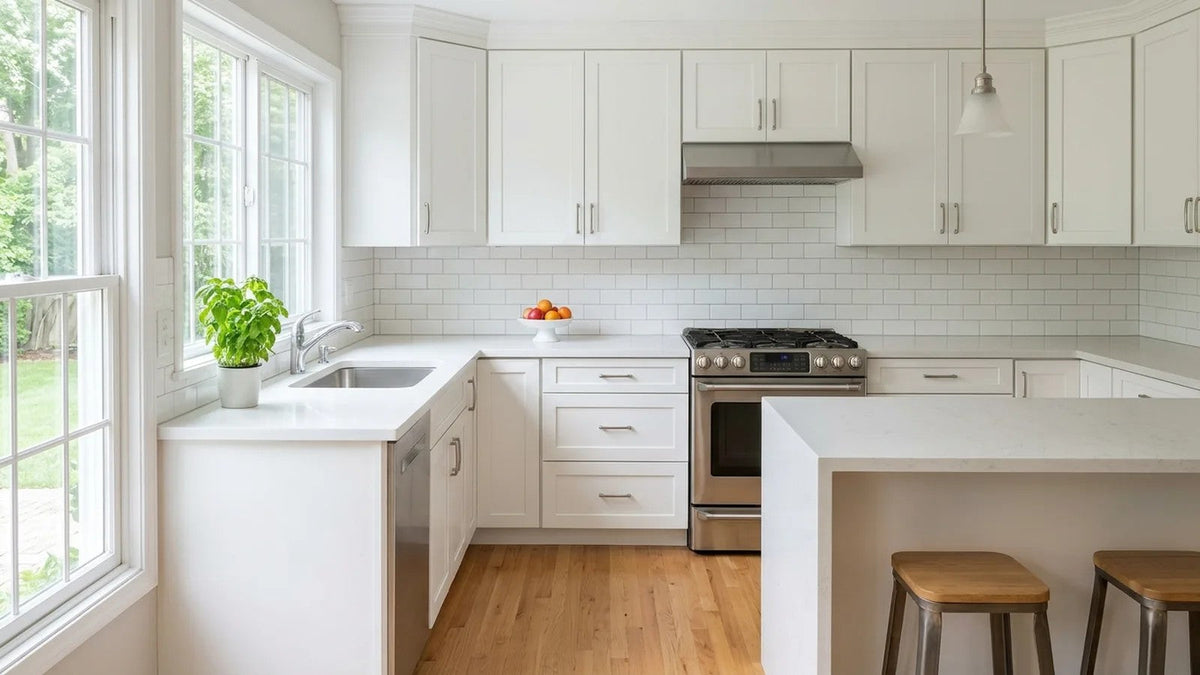
A countertop block holds knives on the counter. It keeps them together and easy to grab. It is also in the open, so the sight question depends on where the block sits, and the reach question depends on how far your child can stretch along the counter.
A wall magnetic strip holds knives on the wall. It frees counter space, but the knives hang in view. Where the strip is mounted, and what a child can see and reach from the floor or a step, decide whether it passes your check.
A locked drawer keeps knives out of sight. With a lock on it, a drawer also comes closest to the AAP’s line about storing harmful items in a cabinet with a lock or safety latch. It asks more of you in daily routine, because you open and relock it each time.
Picture this: you kneel in your kitchen and look around at your toddler’s eye level. Whatever you can see from down there, your child can see too. Check the counter edge, the wall by the stove and the spots near the dishwasher.
A block or strip can fit your kitchen if your layout keeps it out of reach and out of sight. If it can’t, a drawer is the simpler fix. No label settles this for you. Phrases like child proof knife holder or baby proof knife storage describe a goal, not a result, so judge any option by its location in your kitchen.
The same applies to shopping for sets. Names such as baby proof knife set or child proof knife set do not change the check. Every knife you own needs a place that passes the three questions, whatever it came with.


Setting Up a Knife Drawer and a Safe Drawer
A knife drawer is one way to put the AAP’s separation rule into practice. This is our own suggestion, and the AAP does not recommend a locked knife drawer by name.
Here is a simple setup:
- Choose one drawer for knives and other sharp tools, such as kitchen shears. Pick one you can lock.
- Move every sharp item out of the drawer your toddler is allowed to open.
- Fill a separate, low drawer or a small toy box with safe play items.
- Keep sharp cutting appliances, like food processors, out of reach or in a locked cupboard.
Other kitchen drawers with sharp objects, like skewers and graters, need the same treatment. If you give your toddler a drawer that is truly theirs, "no" gets easier to say about the others.
The safe drawer matters as much as the locked one. A toddler who is told "not that drawer" with nothing offered in return will keep testing the rule. A toddler with a drawer of their own has somewhere to go.
Adding the Magnetic Safety Lock Kit to the Knife Drawer
The Baby Proof Me Magnetic Safety Lock Kit is the drawer layer of this setup. The product page describes hidden magnetic locks that fit most furniture and suit cabinets and pull-out drawers. You secure them with 3M adhesive or with screws.

If you use adhesive, allow 24 hours for it to fully bond before you rely on the lock. That means installing it when you can leave the drawer alone, like the evening before a quiet day. Do not stack the drawer with knives and call it done within the hour.
The kit comes in sizes from 6 locks and 2 keys up to 36 locks and 9 keys. One kit can therefore cover the knife drawer and other kitchen drawers or cabinets, such as the one under the sink. If you are still deciding among hardware types, a comparison of drawer latches and locks can help you weigh them. Magnetic drawer locks in other rooms of the house are covered in the guide linked above.
Picture this: you’re stirring a pot while your toddler wanders over to the drawer by the stove. The drawer is locked and the knives are inside, out of sight. That is one layer working. You still turn around and watch.
The product page says the kit is not a substitute for adult supervision. Treat the lock as one layer beside the AAP’s separation and placement advice. It guards the drawer, and it does not make knives safe to leave out on the counter. A knife that is out of the drawer is out of the layer, so return it before you walk away.
Keeping the Lock Keys Out of Children’s Reach
The kit’s keys are magnets. That brings a second safety question: where does the key live?
The CPSC says to keep small magnets away from children. The AAP’s kitchen tips say not to use small refrigerator magnets that a baby could choke on or swallow. Neither source mentions lock keys by name, but a small magnet is a small magnet. Apply the same rule.
A few habits help:
- Store keys high, out of sight, in a spot your toddler cannot reach even with a stool.
- Do not stick a key on the refrigerator, a metal shelf or any other surface where a child can pull it off.
- Keep a count of the keys in your kit. With up to 9 keys in the largest size, one can go missing without anyone noticing.
- Tell every adult and older child in the house where keys belong and why.
Guests are the weak point. A grandparent or babysitter who sets a key on the counter has put a magnet within reach. Say it out loud when someone new is in the kitchen.
If You Suspect a Swallowed Magnet
If you suspect a child has swallowed a magnet, the CPSC says to seek immediate medical attention. Call 911 or Poison Help at 1-800-222-1222 (America’s Poison Centers).
Putting the Layers Together
No single step covers everything. Separation keeps sharp tools away from the utensils your child is allowed to touch. Placement keeps knives out of reach and out of sight. A lock adds a barrier between a curious toddler and the drawer. Supervision sits on top of all three.
Walk through the kitchen once, with the three-part check in mind, and fix the knife spot first. If you are working through the whole home, a room-by-room walkthrough helps you set priorities. The AAP’s kitchen safety tips on HealthyChildren.org are worth reading in full.
Recheck your setup whenever your child gains a new skill, like climbing or opening latches. What passed last month may not pass now.