Best Baby Proofing Products for Small Spaces 2026

Every square foot counts when you’re living in a small apartment or a compact house, and that pressure gets sharper the moment a child starts moving. A studio or one-bedroom that felt perfectly manageable before a baby arrives can transform into an obstacle course of sharp corners, reachable cabinets, and exposed outlets, all within arm’s length of each other. The challenge in small spaces is density. Hazards that would be spread across a larger home are compressed here, which means your baby-proofing choices have to work harder and smarter.
Why Small Spaces Change the Baby-Proofing Equation
In a larger home, you have room to create distance. You can push a bookshelf against a far wall, tuck a cleaning cabinet behind a door, and still have floor space between your child and the hazard. In a small apartment, that buffer disappears. Your coffee table edge is three feet from the couch. Your under-sink cabinet is directly adjacent to where your child plays. The stairs, if you have them, might be the first thing you see when you open the front door.
This compression matters for product selection. A bulky outlet cover that protrudes two inches from the wall is a minor inconvenience in a wide hallway. In a narrow galley kitchen, it’s a toe-stub waiting to happen. A sliding bolt cabinet lock needs clearance between the cabinet door and the adjacent wall to operate. If that clearance doesn’t exist, the lock doesn’t work. Every product decision in a small space has to account for the physical constraints of the space itself, not just the hazard it’s designed to address.
In small homes, stairs are often unavoidable and central to the layout. Stair gates should be a first purchase, not an afterthought.
Gates and Barriers: Pressure-Mounted First
Hardware-mounted gates are the gold standard for stair tops, and if you own your home, use them there. But in small apartments, renters can’t always drill into walls, and even homeowners may be dealing with doorways that are too narrow, too wide, or oddly shaped for standard gate hardware.
Pressure-mounted gates have improved substantially. The better models use dual-tension systems that distribute force across both sides of the doorway without requiring wall anchors. They’re appropriate for doorways and room dividers, though not for the top of stairs where a hardware mount remains the safer choice.
For expandable gates covering odd-shaped passages or wider openings, look for products that meet ASTM F1004, the federal safety standard for expansion gates and expandable enclosures, made mandatory under 16 CFR Part 1239 (effective 2021). That standard sets minimum requirements for structural integrity, slat spacing, and stability. A gate without that certification is a gamble.
When I was living in a two-bedroom apartment with my older daughter, I used a pressure-mounted gate to block off the kitchen during meal prep. It held up through about 18 months of daily use. The key was choosing a model with a wide base plate that distributed pressure across the door trim rather than concentrating it at two small contact points. No wall damage, no deposit issue.
Corner Guards and Edge Bumpers: Low Profile Is Non-Negotiable
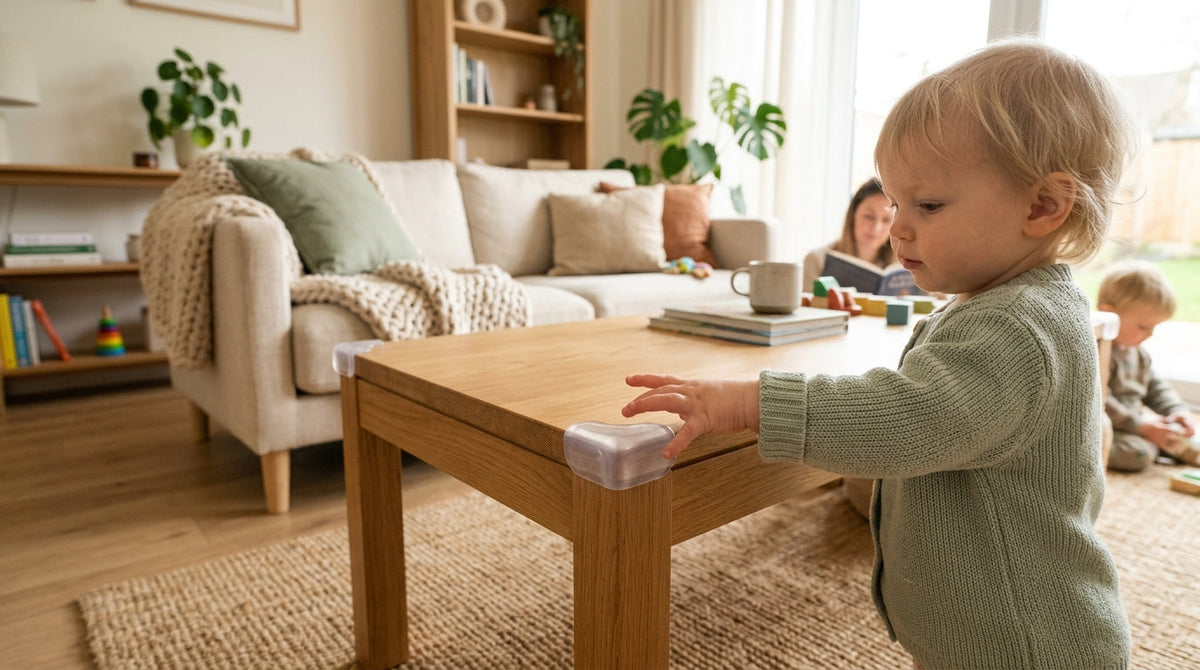
Standard foam corner guards work fine in a large playroom. In a small space, they create their own hazards. A thick, protruding corner guard on a coffee table in a narrow living room adds to the obstacle density rather than reducing it. Children trip over them. Adults stub toes. The guard becomes part of the problem.
Choose low-profile edge bumpers with a flat adhesive backing. Clear or furniture-matched options are preferable because they’re less likely to be peeled off by curious toddlers who notice a bright yellow object on every corner. Adhesive-backed models also preserve your furniture arrangement. In a small space, you’ve already optimized where everything sits. A product that requires you to move the couch to install it is a product you won’t use.
Test the adhesive on a small section first. I installed six different corner guard products across various surfaces in my current house, and the adhesive failed on one brand within a week on a lacquered table edge. The fix was cleaning the surface with isopropyl alcohol before application, which the packaging mentioned in fine print. Do that step.


Outlet Covers and Cord Management: Flat and Recessed
Bulky plug-in outlet covers consume the outlet. In a small apartment where every outlet is doing double duty, that’s a real cost. Flat, sliding outlet covers that replace the existing faceplate are the better choice. They require no outlet space, can’t be pulled out and swallowed, and don’t create a visual or physical protrusion.
Cord management in small spaces is about two things: preventing strangulation risks and reducing clutter that makes the space feel smaller. Cord clips and adhesive cable channels route cords along baseboards and out of reach. Cord shorteners bundle excess cable length rather than letting it pool on the floor. For window blind cords specifically, retrofit cord wind-ups or replacement cordless blinds are worth the investment. Cords are tripping hazards and strangulation risks for infants.
Cabinet and Drawer Locks: Adhesive and Magnetic Over Sliding Bolts
Sliding bolt locks require the cabinet door to swing open a few inches before the bolt can be released. In a kitchen where cabinets are close together or adjacent to a wall, that clearance may not exist. The lock either can’t be operated or can’t be installed at all.
Adhesive magnetic locks are the right solution for small spaces. The locking mechanism mounts inside the cabinet, invisible from the outside, and releases with a magnetic key held against the exterior. No clearance needed. No drilling required for most models. And critically, they work on cabinets that are flush against walls or other furniture.
Household cleaning substances are a leading cause of poisoning in young children. The under-sink cabinet is where most of those products live. Locking it is not optional.
In my experience, children can access an unlocked cabinet in seconds. That was the moment I understood that every cabinet in a home with a young child needs to be secured.
Vertical Storage for Hazardous Items
When floor space and counter space are limited, vertical storage is the only direction left. Wall-mounted shelves positioned above a child’s reach (and above their projected reach for the next 18 months) are the right place for medications, cleaning supplies, and sharp objects. Over-door organizers work for bathrooms where a medicine cabinet is already full. Magnetic knife strips mounted high on a kitchen wall keep blades accessible to adults and out of reach of children.
The principle here is simple: if a hazardous item has no floor or counter footprint, it can’t be reached from the floor. In a small space, that trade-off is worth making even if it means a slightly less convenient reach for you.
Furniture Anchors: Required, Not Optional
Furniture tip-overs are a leading cause of furniture-related injuries in young children, and the CPSC identifies them as a persistent hazard. In small spaces, children navigate between furniture pieces more frequently and use them for support while cruising and climbing. A dresser or bookshelf that might stand undisturbed in a larger room gets grabbed, leaned on, and tested daily.
Anti-tip straps anchor furniture to wall studs and are inexpensive. Most take under 15 minutes to install. For renters concerned about wall damage, ask your landlord first: an anchor leaves two small screw holes that are easy to patch, and the CPSC’s advice is to anchor furniture to the wall. Linking one piece of furniture to another is not a substitute.
In my experience, adhesive-only solutions have a ceiling. Children can work at them and defeat them over time. Screwed hardware, used where walls permit, is the more reliable choice for anchoring.
Small-Space Baby-Proofing Checklist
Window Safety Devices: Slim Profile, Full Function
Window stops and guards in small spaces need to do their job without blocking light. Compact window stops that limit how far a sash can open (to no more than 4 inches) are available in low-profile designs that sit flush with the window frame. They don’t obstruct the view, don’t reduce natural light, and don’t require tools to temporarily release for adult use.
Avoid window guards that span the full opening with bars unless you’re on an upper floor with a fire egress plan. In a small apartment, a window is often a significant light source. A product that blocks it substantially affects the livability of the space.
Portable Play Yards and Foldable Enclosures
One of the most effective strategies in a small space is containment rather than comprehensive baby-proofing of every inch. A portable play yard or foldable safety enclosure creates a defined safe zone where a child can play freely while you cook, work, or handle something that requires your full attention.
The advantage in small spaces is flexibility. A foldable enclosure can be set up in the living area during play time and folded flat against a wall when not in use. It doesn’t permanently claim floor space. It doesn’t require baby-proofing the entire room to the same standard. And it gives children a predictable, familiar space that’s theirs.
Look for models with a low folded profile and a carry bag. In a small apartment, storage is part of the product evaluation.
Multi-Function Products and the Clutter Calculus
Single-purpose baby-proofing products multiply fast. A gate here, a bumper there, a lock on every cabinet, a cord wrap on every appliance. In a small space, that accumulation creates visual and physical clutter that makes the environment harder to live in.
Multi-function products earn their place. Gates that also serve as room dividers. Storage ottomans with locking lids that keep hazardous items inside and provide seating. Wall-mounted organizers with integrated cord management. When evaluating any product for a small space, ask whether it does more than one thing. If it doesn’t, make sure it at least disappears when not in use.
Look for JPMA certification when buying gates, play yards, and enclosures. The Juvenile Products Manufacturers Association certification program tests products against ASTM standards and provides an independent check on safety claims. Measure your doorways before you buy gates. Test adhesive on your specific surfaces. Anchor everything that can tip. Prioritize products that disappear into the space rather than dominating it.