Common Baby Injuries at Home: Prevention Guide for Every Stage

Every year, Safe Kids Worldwide’s 2015 Report to the Nation found that more than 3.4 million children experience an unintentional home-related injury each year, and more than 2,200 die from those injuries, about six every single day. That number stops me every time I read it. Six families. Six ordinary days that became something else entirely.
The home feels like the safe place. It’s where you control the environment, where you know the layout, where you’ve done the work. But that familiarity is also what makes it dangerous. You stop seeing the hazards because you walk past them fifty times a day. The cabinet under the sink is just the cabinet. The stairs are just the stairs. Until they aren’t.
Because what protects a two-month-old on a changing table is different from what protects a fourteen-month-old who has just figured out how to climb.Falls: The Hazard You Can See Coming
Falls are the leading cause of nonfatal injury-related emergency department visits for children ages 1–4, accounting for 39% of those visits in 2019–2020, per CDC NHAMCS data reported in America’s Children, 2023. That’s not a surprise to anyone who has watched a toddler move through a room. What surprises parents is how early the risk starts.
My older daughter rolled off our bed at four months old. She had never rolled before. I turned to grab a fresh diaper from the basket on the floor, and in the two seconds my back was turned, she was on the carpet. She was fine. I was not fine for approximately three days.
Changing tables, bed edges, and stairs account for most fall incidents in the infant and toddler period. About 93,000 children under 5 are treated in U.S. emergency rooms each year for stair-related injuries, per a Nationwide Children’s Hospital analysis of CPSC NEISS data. That works out to roughly one child every six minutes. The AAP recommends a 2-inch (5 cm) guardrail on all four sides of any changing table. Never leave a baby unattended on an elevated surface.
Prevention by stage:
- Newborn to rolling (0–4 months): Keep one hand on the baby any time they’re on a raised surface. Change diapers on the floor if you’re distracted.
- Rolling to crawling (4–9 months): Install safety gates at both the top and bottom of all stairs. The top gate must be hardware-mounted. A pressure-mounted gate at the top of stairs can be pushed out.
- Cruising and walking (9–18 months): Add window guards or stops. Windows in homes with young children should not open more than 4 inches, per CPSC and AAP guidance. About 3,300 children age 5 and younger are treated in U.S. emergency rooms each year for window fall injuries, per the CPSC.
Drowning: The Silence Is the Warning
The CDC reports that more children ages 1–4 die from drowning than from any other cause of death. CDC MMWR Vital Signs Drowning death rates among children aged 1–4 years rose 28.9% in 2021 and 28.3% in 2022 compared with 2019. Those numbers moved in the wrong direction during years when families were spending more time at home.
What most parents don’t know is that the bathtub is not the only risk inside the house. Buckets, toilets, and even large dog water bowls can hold enough water to drown an infant. Drowning can happen in inches of water, and it happens silently. There is no splashing. There is no crying. This is why the rule is one hand on the baby, always, during bath time. Not a towel’s reach away. On the baby.
Install toilet locks on every bathroom a baby or toddler can access. Empty buckets immediately after use. If you have a decorative indoor fountain or a standing pet bowl, treat it the same way you’d treat a pool.
Prevention by stage:
- Infants (0–12 months): Never leave the bath, even to answer the door. Bring the baby with you or let whoever is at the door wait.
- Toddlers (12–36 months): Toilet locks, empty buckets, and door alarms on any room with standing water. This is also the stage to begin formal water familiarization, not swim lessons that promise drowning prevention, but supervised water exposure.


Sleep Space Suffocation: What Belongs in the Crib
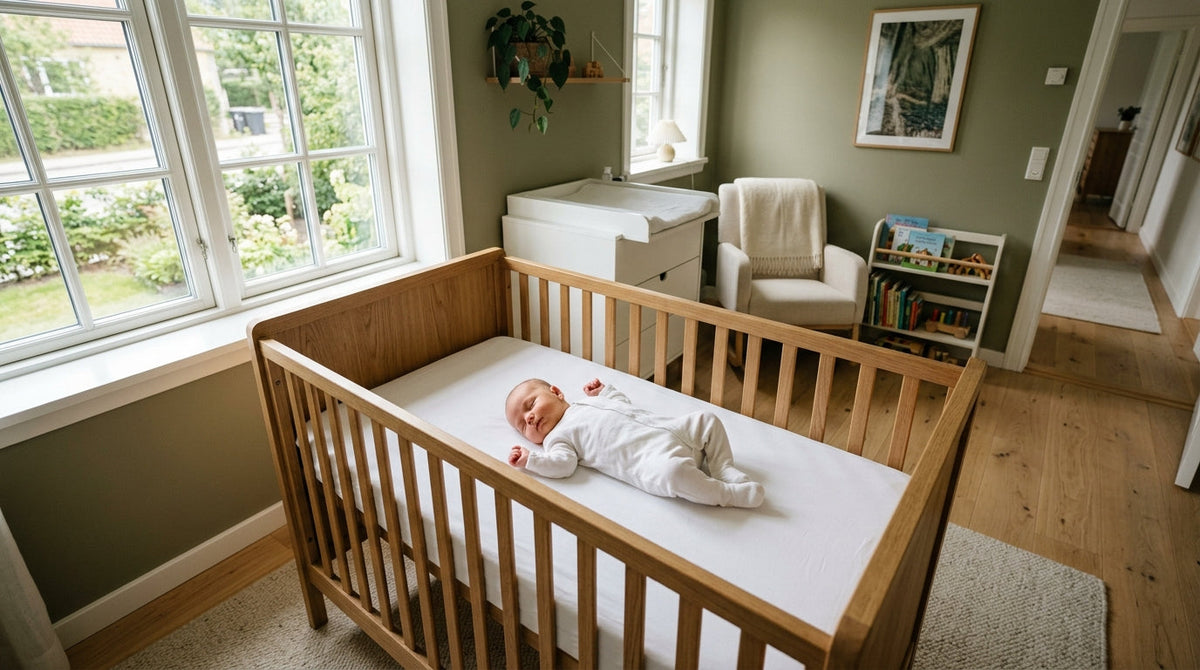
Per AAP guidance, infants should sleep on a firm, flat, bare surface in a crib, bassinet, or play yard that meets current safety standards, with nothing else in the sleep space. No blankets, no pillows, no bumpers, no stuffed animals. The surface should be firm enough that it doesn’t conform to the baby’s face if they roll into it.
Older and hand-me-down cribs are a specific concern. Safety standards for cribs have changed significantly over the past fifteen years. Any crib should have a firm mattress that fits snugly with no gaps at the sides, no missing or broken slats, and should have been manufactured after the current federal standards took effect. If you’re unsure, the CPSC maintains a searchable recall database worth checking before you use any secondhand sleep equipment.
Verify the mattress fit by trying to fit two fingers between the mattress edge and the crib side. If you can fit more than two fingers, the gap is too large.
Choking: Knowing the Size Rule Before You Need It
Anything that fits through a toilet paper tube is a choking hazard for a child under three. That’s the practical test. It covers most small toys, toy parts, button batteries, coins, and dozens of common household objects.
Food choking hazards shift as children develop. Infants under 12 months can choke on anything they can grasp and bring to their mouth. Toddlers are at risk from foods that are round, firm, or slippery: whole grapes, cherry tomatoes, nuts, hard candy, chunks of raw carrot, hot dog rounds. These foods should be cut lengthwise and into small pieces, not just halved.
Supervise every meal. Eating while walking, running, or lying down increases choking risk. Learn infant and child CPR before you need it. In the first sixty seconds of a choking emergency, knowing what to do matters.
Poisoning: Storage Is the Prevention
Many of the products parents store in cabinets, from acetaminophen to furniture polish, are required by 16 CFR 1700.14 (poison prevention packaging) to ship in child-resistant packaging. Child-resistant is not child-proof. My younger daughter emptied the under-sink cabinet in the time it took me to answer the doorbell. She didn’t get into anything dangerous that day because I had moved the cleaning products to a locked cabinet after her older sister started crawling. But the speed of it still unsettles me.
Store all medications, vitamins, cleaning products, and laundry pods in their original containers, in a locked cabinet, out of reach. Laundry pods deserve specific mention: they are brightly colored, soft, and look like toys. They are also highly concentrated and cause serious injury when ingested.
Common houseplants are a less obvious hazard. Pothos, philodendron, dieffenbachia, and peace lily are all toxic to children. The ASPCA and Poison Control (1-800-222-1222) maintain current lists. Post the Poison Control number somewhere visible.
Burns: Temperature and Distance
The CDC reports that every day 435 children ages 0–19 are treated in emergency rooms for burn-related injuries and two children die from burns. A 2025 Journal of Burn Care & Research analysis of NEISS data (2013–2022) estimated about 125,000 scald burns nationally among children ages 0–3, with 81% occurring at home.
Per CPSC Publication 5098, setting a residential water heater to 120°F (49°C) can reduce or eliminate the risk of most tap-water scald injuries. Check your water heater setting. Many are factory-set higher. This takes five minutes and costs nothing.
Beyond water temperature: never hold a hot beverage while holding a baby. A spilled cup of coffee causes full-thickness burns in seconds. Use stove knob covers to prevent toddlers from turning on burners. Keep a three-foot "no-kid zone" around the stove during cooking. Hot surfaces, including oven doors, slow cookers, and space heaters, stay hot long after you’ve stopped using them.
Furniture Tip-Overs and Cord Strangulation
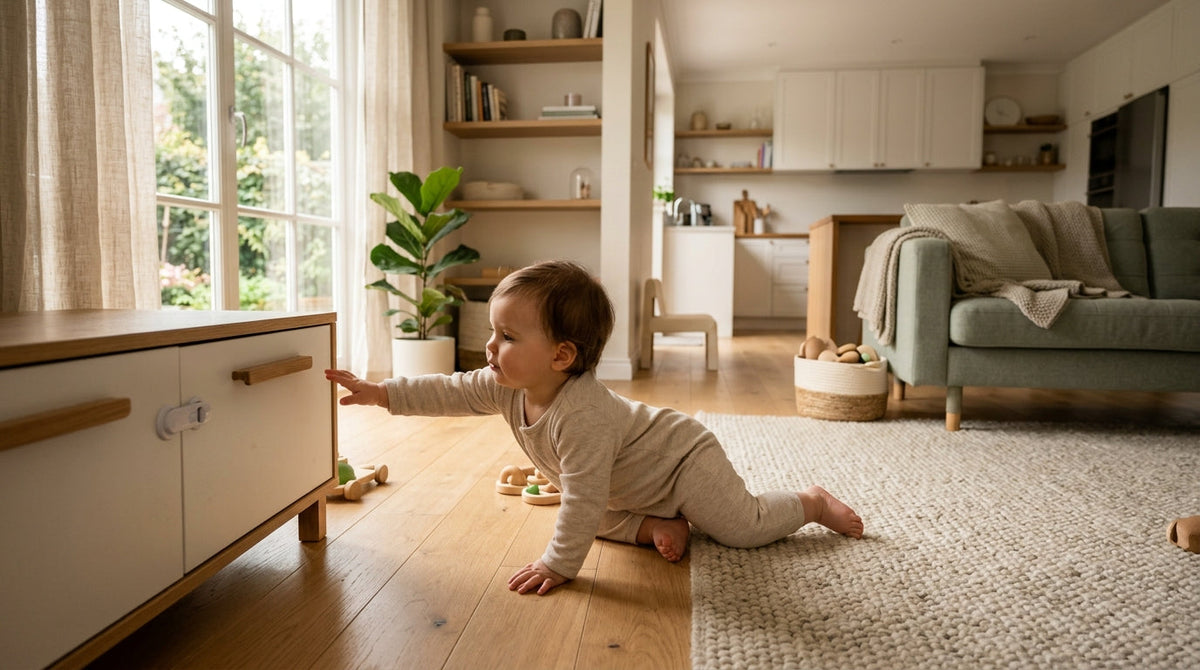
Dressers, bookshelves, and televisions on furniture are tip-over hazards that cause serious injuries and deaths in young children. Anchor all tall furniture to wall studs using anti-tip hardware rated for the weight of the piece. Avoid placing televisions on top of dressers or unstable stands. A TV on a low dresser is particularly dangerous because toddlers climb drawers like stairs to reach it.
Window blind cords and window covering cords are a strangulation risk and a choking hazard. Replace older blinds with cordless models, or retrofit them with cord wind-ups. Keep all cords secured and out of reach. Check sleeping areas and play spaces specifically, since these are where children spend the most unsupervised time.
Home Safety Checklist
Entrapment and Gate Safety
Doors, safety gates, and spaces between furniture can trap fingers, hands, and in the worst cases, a baby’s head. Install door pinch guards or door holders on interior doors. Check any safety gate for compliance with ASTM F1004 (the federal safety standard for expansion gates and expandable enclosures, made mandatory under 16 CFR Part 1239 effective 2021). Gates that predate this standard may not meet current requirements.
Check gaps between furniture and walls, between crib slats, and between gate bars. A baby’s head can fit through any gap wider than about 2.375 inches (the standard used in crib slat spacing). If you can fit more than two adult fingers in a gap, it warrants attention.
Reassessing as Your Child Grows
The most important thing I’ve learned across two kids and years of writing about child safety is that the hazard profile changes faster than most parents expect. A baby who is beginning to roll needs different protections than a crawling infant. A crawling infant needs different protections than a toddler who has just learned to climb onto the kitchen counter using the dishwasher door as a step (yes, this happened).
Build in a monthly walkthrough. Get down to your child’s eye level and look at the room from their perspective. What’s reachable now that wasn’t last month? What’s climbable? What’s been left out that belongs in a locked cabinet? The hazards don’t change. Your child’s ability to reach them does, and that changes fast.
Prevention is mostly about removing the gap between what your child can do today and what your home is set up to handle. Close that gap regularly, and most of the injuries on this list become avoidable.