How to Baby Proof a Toilet: Lid Locks Seat Straps and Bathroom Rules

Drowning is the leading cause of unintentional injury death in children ages 1–4 (CDC). That number stops most parents cold, and it should. Pools get most of the attention, and rightly so. But toilets sit in nearly every home, they hold several inches of water, and toddlers are top-heavy enough to fall in headfirst and lack the strength to push themselves back out. The risk is real, and the fix is straightforward once you understand what you’re trying to do.
This is a layered problem. A toilet lid lock is one layer. A closed bathroom door is another. Supervision is the one that holds everything else together. None of these works well in isolation.
Why Toddlers and Toilets Are a real Combination
A child can drown in as little as one to two inches of water (AAP). A standard toilet bowl holds considerably more than that, and the geometry is particularly dangerous for a child between roughly 9 and 24 months: curious, mobile, and front-heavy. They lean in to look, their center of gravity tips forward, and they cannot right themselves.
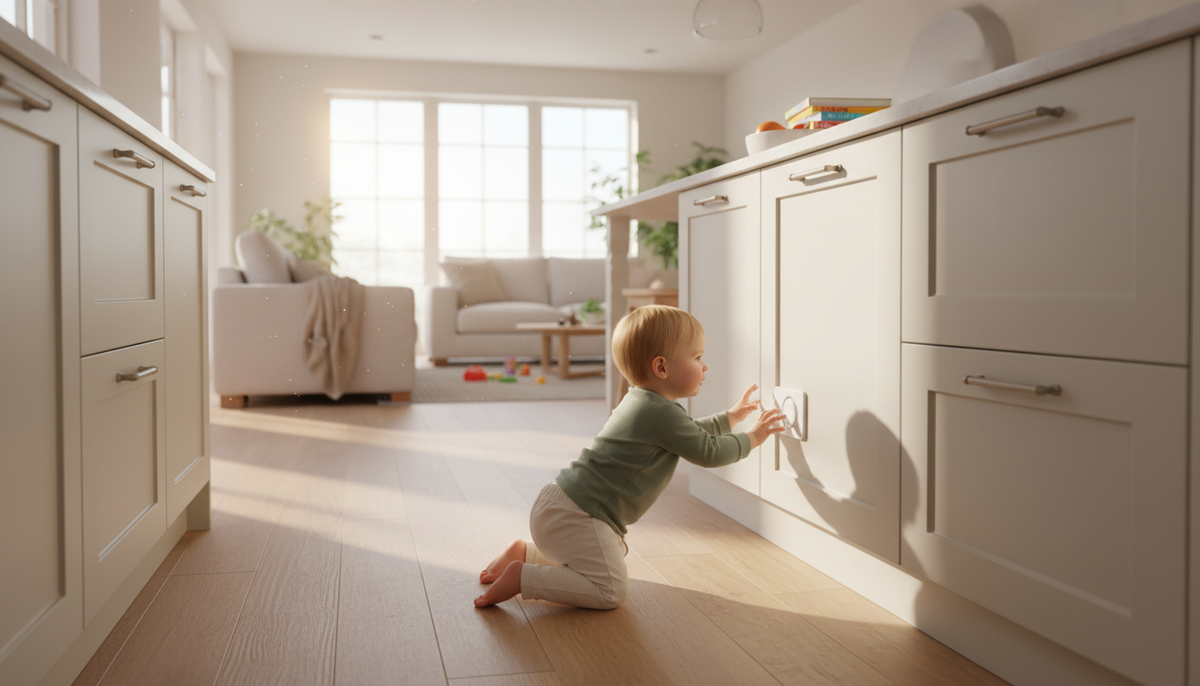
My younger daughter was 18 months old when she got into the bathroom while I answered the door. I was gone maybe 90 seconds. She hadn’t touched the toilet that time, but she had opened the cabinet under the sink and pulled out everything in it. That’s how fast it happens. The bathroom is not a room you leave a toddler in unattended, even briefly.
The toilet itself is one hazard among several in that space, which is exactly why bathroom access control matters as much as any individual device.
How Toilet Lid Locks Work
A toilet lid lock prevents a child from lifting the lid. Most designs use a latch that wraps under the front of the bowl and clips or locks at the lid, requiring the user to press, squeeze, or slide a release that demands adult hand strength or fine motor coordination a toddler doesn’t have.
The best models require two simultaneous actions to open, which is the same principle behind childproof medicine caps. A toddler can apply force in one direction. Applying force in two directions at once, while coordinating the motion, is reliably beyond most children under three.
When you’re shopping, look for:
- A release mechanism that requires pinching and lifting, or pressing two points simultaneously
- No sharp edges on the latch body or hinge
- A design that folds flat against the lid when unlocked, so it doesn’t interfere with normal use
- Installation that doesn’t require tools, but is secure enough to stay put in a humid environment
That last point matters more than it sounds. Bathroom humidity is hard on adhesive. More on that shortly.


Seat Straps: A Different Device for a Different Purpose
Seat straps secure the toilet seat to the bowl rim. They’re designed to prevent a child from lifting the seat itself, not the lid. The distinction matters because some toilet configurations have a lid that’s easy to hold down but a seat that can still be lifted if the lid is propped.
Most families who use a seat strap use it alongside a lid lock as a second layer. In practice, a quality lid lock alone is sufficient for most homes, because if the lid can’t be lifted, the seat underneath is inaccessible. But if your toilet has an unusual lid-to-seat ratio, or if you’ve already had a close call, layering both makes sense.
Seat straps are typically adhesive-mounted to the bowl rim. The same moisture-and-adhesive cautions apply.
-
Clean the surface
Wipe the toilet lid and bowl rim with rubbing alcohol. Let it dry fully before applying any adhesive. -
Position the lock
Hold the lock in place with the lid closed. Confirm the latch sits flush and the release is reachable by an adult. -
Apply and press
Remove the adhesive backing, press firmly for 30 seconds, and avoid using the toilet for at least one hour. -
Test the hold
Try to lift the lid with moderate force. The lock should hold without flex or movement at the mounting pad. -
Check monthly
Press the mounting pad and try to work it loose. Replace adhesive at the first sign of give.
Installation and the Adhesive Problem
Most toilet locks attach via adhesive strips, a clamp mechanism, or a combination of both. Adhesive is convenient. It’s also the weakest point in the system over time.
In my experience, adhesive-only locks are the weakest point. The surface near the toilet gets humid, then dry, then humid again. The adhesive bond weakens with those cycles. It doesn’t fail all at once. It loosens gradually, and you might not notice until the lock no longer holds.
Check every adhesive-mounted lock monthly. Press the mounting pad firmly against the surface and try to work it loose with your fingers. If there’s any give, replace the adhesive before you rely on the lock again. Most manufacturers include replacement strips, or you can use the same adhesive tape used for cabinet locks. Clean the surface with rubbing alcohol before reapplying.
For clamp-style locks, check that the clamp hardware hasn’t corroded. Bathroom metal gets wet regularly, and corrosion can make a mechanism stiff in a way that feels secure but is just sticky, not locked.
Beyond the Lock: Controlling Bathroom Access
A toilet lock is a last line of defense. Your first line is keeping your toddler out of the bathroom without you.
The CPSC recommends treating bathrooms as high-risk zones for young children and keeping them off-limits without adult presence. The practical tools for this are a baby gate across the bathroom doorway, a door knob cover that prevents a child from turning the handle, or a hook-and-eye latch mounted high on the door frame, out of reach.
In our house, the bathroom door stays closed. That’s the rule. It’s not a complicated rule, but it requires everyone in the household to follow it consistently, including older kids, babysitters, and grandparents. A lock on the toilet means nothing if the door is left open and a toddler wanders in.
If you have a bathroom that doesn’t have a door, or one with a door that doesn’t latch reliably, a pressure-mounted gate is a reasonable substitute. Some families also use door alarms that chime when the bathroom door opens, which gives you an audio alert if a child enters unsupervised. That’s a useful addition, not a replacement for physical barriers.
Teaching Bathroom Rules to Older Toddlers
Hardware protects children who don’t yet understand language. But by age two and a half or three, most children can begin to internalize simple rules, and consistent messaging reinforces the physical barriers you’ve put in place.
The rules worth teaching:
- We don’t play near the toilet
- The bathroom is for grown-up supervision
- Always ask an adult before going into the bathroom alone
Keep the language simple and repeat it without making it frightening. You’re not trying to scare your child. You’re building a habit. My older daughter, at about three, started correcting her own impulse to push the bathroom door open on her own. That took months of consistent reinforcement. It’s worth the effort.
Bathroom Safety Checklist
Briefing Caregivers and Guests
Your toilet lock is only as effective as the people who use your bathroom understand it to be. Babysitters, family members, and houseguests may not know the lock exists, may not know how to operate it, and may leave it unlatched after use.
Before any caregiver takes over, walk them through the lock mechanism. Show them how to open it and how to re-engage it. Explain that the bathroom door should stay closed when not in use. This takes two minutes and closes a real gap in your safety plan.
Putting It Together
The combination that works: a toilet lid lock that requires adult dexterity to open, checked monthly for adhesive integrity and corrosion; a closed bathroom door or gate that prevents unsupervised access; and active supervision whenever a young child is in the bathroom. Add a door alarm if your layout makes it hard to hear a child entering the bathroom from another room.
No single device replaces watchful oversight. But layered defenses reduce the likelihood that a brief lapse in supervision becomes a tragedy. Install the lock, close the door, and check both regularly.