How to Child-Proof an Above-Ground Pool: Removable Ladders, Locking Steps, Covers and Alarms
CPSC says an above-ground pool’s ladder or steps can be secured, locked, removed or surrounded by a barrier. Here is how that fits with barriers, gates, door alarms and covers.

More children ages 1–4 die from drowning than any other cause of death, according to the CDC. That is the backdrop for every decision about a backyard pool. Here is how to child proof an above ground pool. Secure, lock or remove the ladder and add a barrier. Then layer a self-latching gate, a door alarm and a cover on top.
No single piece is a guarantee. Each one covers for the others. Baby Proof Me sells no pool fence, alarm or cover, so nothing below steers you toward a purchase.
How to Child Proof an Above Ground Pool in Five Layers
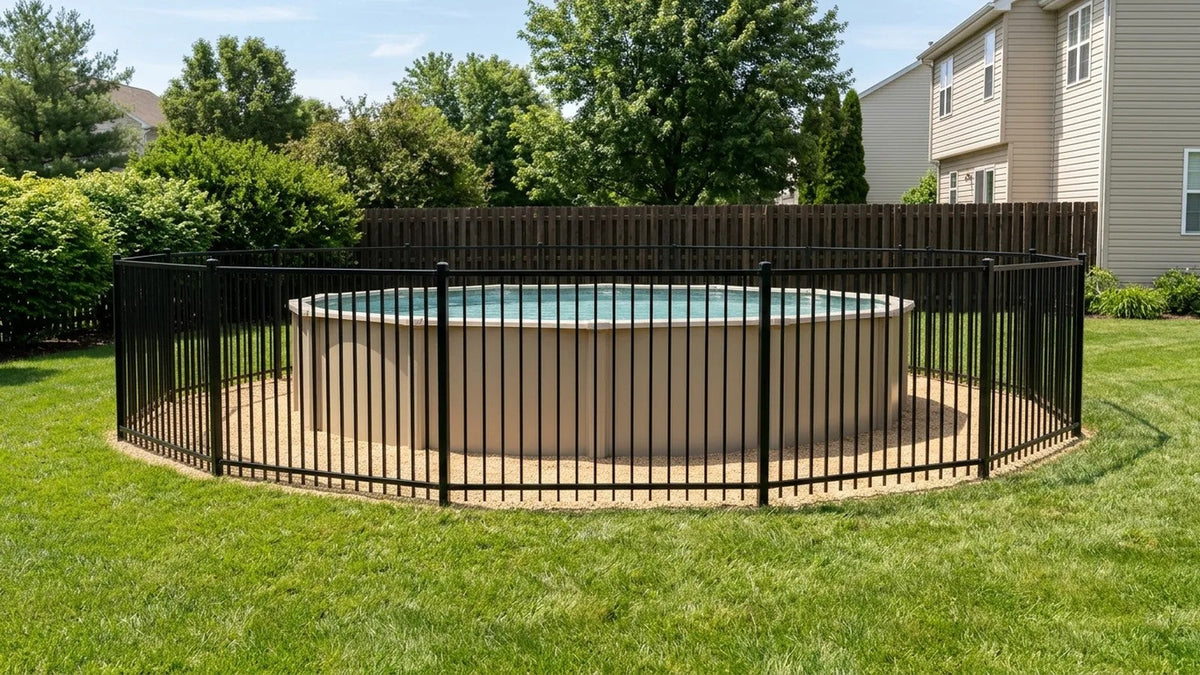
CPSC’s barrier guidelines say above-ground pools should have barriers. The pool structure itself can serve as the barrier if its walls are high enough, or a barrier can be mounted onto the top of it. CPSC adds that barriers are not childproof, but they give a child layers of protection when there is a lapse in adult supervision.
CPSC also states that its barrier guidelines are not a CPSC standard and are not mandatory requirements. The numbers below are CPSC’s guideline numbers, not a legal test your pool must pass.
The Five Layers in CPSC’s Words
| Layer | CPSC’s wording |
|---|---|
| Ladder or steps | Secured, locked, removed, or surrounded |
| Barrier | At least 48 inches high, 4-inch sphere limit |
| Gate | Opens out, self-closing, self-latching |
| Door alarm | 30 seconds, 7-second start, 85 dB |
| Cover | Well maintained, control out of reach |
Why the Ladder Is the Weak Point
An above-ground pool has built-in walls, which looks like a head start. The ladder can undo it. CPSC’s guidelines explain that children are often able to get in if the pool walls are not high enough. The same is true when other structures sit close to the pool, such as a ladder, a table or a chair.
Picture this: after an afternoon swim, the ladder is still hooked over the wall. You step inside to answer the door, and the pool is now reachable by anyone who can climb.
A child can drown in as little as 1–2 inches of water, and it can happen quickly and silently, according to the AAP. A toddler does not need to reach the deep end to be in danger.
CPSC has singled the ladder out. On June 3, 2026, the Commission granted a petition on child-resistant ladders for aboveground and portable pools. CPSC staff identified 128 reported fatal drowning incidents involving children under five between 2020 and 2025 where pool ladders were reported or believed to have been used to enter such pools.
Above Ground Pool Ladder Safety: Secure, Lock, Remove or Surround
CPSC gives two routes for the steps or ladder. They can be designed to be secured, locked or removed. Or they can be surrounded by a barrier, such as the barriers described in the guidelines. CPSC does not tell you to pick one tool. It describes ways to close off the access point.
To child proof an above ground pool ladder, start with how your pool is built. A ladder that lifts off or swings up can be taken out of play when no adult is at the water. A fixed set of steps may call for a lock, or for a surrounding barrier with its own gate.
Whatever you choose, check the result against CPSC’s opening rule. When the ladder or steps are secured, locked or removed, CPSC says any opening created should not allow a 4-inch diameter sphere to pass. A ball about 4 inches across is a quick household test. If it fits through the gap, the gap is too big.
A removable ladder helps only on the days it is removed. Decide where it goes when the last swimmer gets out, and make that spot far from the pool wall. A ladder leaning against the outside of the pool becomes a way in.


What CPSC’s June 2026 Ladder Decision Means for a Ladder With a Safety Lock
You may see an above ground pool ladder with safety lock on product pages and assume the problem is solved. CPSC’s decision does not say that. The Commission granted the petition because the record shows the issue “warrants further action.” It did not publish a finished rule or a test that a lock can pass.
In his June 3, 2026 statement, Acting Chairman Peter A. Feldman said the Commission directed staff to continue its work with ASTM, PHTA, medical experts, consumer advocates and industry stakeholders. The goal he named is to develop "meaningful performance requirements, objective measures of child resistance and stronger warnings." He also said, "If adequate progress is not achieved, mandatory federal requirements remain on the table."
Objective measures of child resistance are still being developed, and mandatory rules are a possibility, not a fact. A lock on a ladder is one layer. It does not replace removing the ladder, surrounding it with a barrier, or watching the water.
Behind any lock, keep a second layer, such as a barrier around the pool or a ladder that comes off.
Barriers for Above-Ground Pools: Walls, Top-Mounted Barriers and the Climbing Check
If the walls of your pool are tall enough, they can serve as the barrier. If they are not, a barrier can be mounted on top of the pool structure. CPSC’s guideline numbers apply either way.
- The top of the barrier is at least 48 inches above the surface, measured on the interior side.
- No opening lets a 4-inch diameter sphere pass.
- Where the barrier is mounted on top of the pool structure, there is no more than 4 inches of vertical clearance between the top of the pool structure and the bottom of the barrier.
Check the joints closely. A top-mounted barrier with a wide gap underneath, or a wall with a gap beside the ladder, defeats the point of the height.
Climbing is one way children get past a barrier. CPSC says barriers should be located to keep children from using permanent structures, equipment or similar objects to climb them, and that handholds and footholds on barriers should be eliminated. For an above-ground pool, CPSC names a ladder, a table or a chair close to the pool as ways children often get in.
Picture this: after a cookout, a patio chair sits against the pool wall. Nobody thinks twice about it. To a toddler, it is a step.
Walk the full perimeter and look at everything within reach of the wall: furniture, coolers, planters, a deck rail. Move what can be moved. Then look for anything on the barrier itself that works as a foothold.
Pools, including large inflatable above-ground pools and other temporary pools, should be completely surrounded by a fence on all 4 sides that is at least 4 feet high, according to the AAP. CPSC says a barrier that completely surrounds the pool is better than a fence on three sides with the house as the fourth. The same climbing logic applies to baby-proofing a pool of any type, and inflatable and kiddie pool safety is a related topic with its own details.
Gates, Door Alarms and Covers as Extra Layers
These are the layers of pool protection that cover for human error, which is the heart of child safety for above ground pools. They matter because adults get busy.
Gates. CPSC says pedestrian gates should open out from the pool and be self-closing and self-latching. The AAP describes a self-closing and self-latching gate that opens away from the pool. CPSC puts the risk bluntly: "The weak link in the strongest and highest fence is a gate that fails to close and latch completely." Check that the gate swings shut and latches from any open position, every time.
Door alarms. If an outside wall of the home forms one side of the barrier, CPSC says to install door alarms on all doors leading to the pool area. It also says the doors should have self-closing and self-latching devices or locks that are beyond the reach of children. For the alarm itself, CPSC’s features are a sound that starts within 7 seconds after the door is opened and lasts 30 seconds or more. It should be at least 85 dB, measured 10 feet away from the alarm mechanism. Door alarms are an additional protection against a toddler going outside unnoticed, according to the AAP.
Covers. CPSC says pool covers add another layer of protection. The cover should be well maintained, and the control device for the cover should be kept out of the reach of children. CPSC’s guidelines also say power safety covers can be installed on pools to provide security barriers, especially when one side of the house serves as the fourth side of a barrier.
A cover is only as useful as its upkeep. A torn or sagging cover, or a remote left on a patio table, takes the layer away.
Above Ground Pool Safety for Toddlers: Supervision and Layers
The AAP recommends multiple layers of water safety protection because no single method can prevent all drowning. The AAP also calls for close, constant supervision whenever a toddler is in or near water.
The AAP names this "touch supervision." You stay within arm’s length, and you avoid distractions such as a cell phone.
Picture this: you are standing near the pool, scrolling through a message, while a toddler walks toward the water’s edge. Nothing would warn you, because drowning can be quick and silent, as the AAP puts it.
Barriers, gates, alarms and covers lower the chance a child reaches the water unnoticed. They do not replace an adult within arm’s length. Pools are one part of drowning prevention at home, and the same watchfulness applies to bathtubs, buckets and toilets.
Check Your Local Rules Before You Finish
CPSC notes that many communities have enacted safety regulations requiring barriers for residential in-ground and above-ground pools. It tells parents to follow their community’s laws in addition to the guidelines. It also says to consult your local building department or code authority.
Call before you buy or build. Ask whether your above-ground pool needs a permit, whether the walls can count as the barrier, and what the rules say about ladders and gates. Local requirements may be stricter than CPSC’s guideline numbers, and they are the ones that apply to you.
Then run a final check on the pool itself. Is the ladder removed, locked or surrounded, with no gap a 4-inch sphere can pass? Is the barrier at least 48 inches high on the interior side, with no more than 4 inches of clearance under a top-mounted barrier? Is the gate self-closing and self-latching, are the door alarms on, and is the cover in good repair with its control out of reach? For the rest of the house, an evidence-based guide to home safety can help you work through other rooms with the same layered approach.