Montessori Toys for 3-Year-Olds: Gross-Motor and Practical-Life Picks
Movement toys and real-life helper picks for 3-year-olds, with the CDC, AAP and CPSC checks to run first.

Montessori toys for 3 year olds sort into two groups: toys for big movement, and real-life helper items your child can use alongside you. Choose what fits your child, since CPSC’s toy advice is to "choose toys that match each child’s interest and abilities." Then check every item for small parts before it reaches the shelf. The CDC’s 3-year milestones under movement and physical development include: "Strings items together, like large beads or macaroni," "Puts on some clothes by himself, like loose pants or a jacket" and "Uses a fork." For younger toddlers, see Montessori toys for 18-month-olds.
What the CDC Milestones Tell You
The CDC defines developmental milestones as "things most children (75% or more) can do by a certain age." That makes the 3-year list a picture of what many children do by this age. It is not a test for your child, and it is not a shopping checklist.
Use it as a prompt for ideas. A fork, a jacket and a handful of large beads are ordinary household things, and they show how the two groups of picks overlap with daily life.
Here is the full set of pick types, sorted by what each one asks your child to do:
- Stepping: a set of stepping stones laid across the floor
- Balancing: a low balance board
- Stacking: a set of blocks
- Carrying: a basket or small bucket to haul from room to room
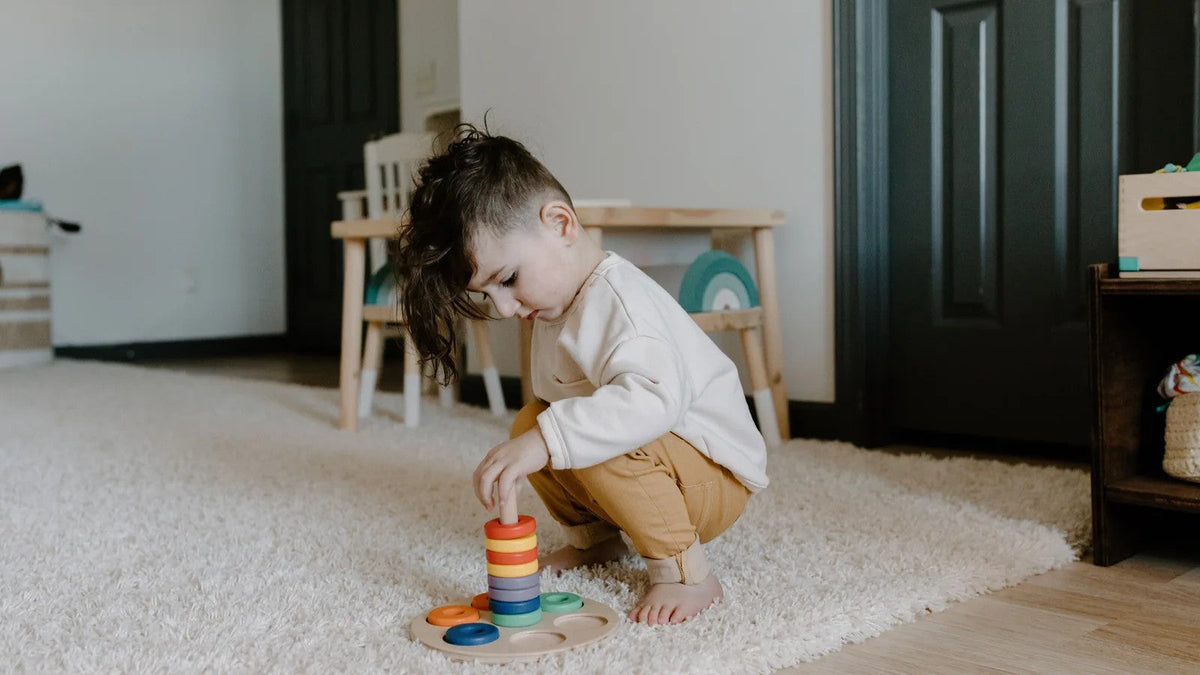
- Stringing: a large-bead stringing set
- Eating: a child’s own fork at meals
- Dressing: a loose jacket on a hook your child can reach
- Helping at the counter: a kitchen tower, covered below
Gross-Motor Picks: Montessori Toys for a 3 Year Old That Ask for Big Movement
Start with the AAP. It says "Physical activity is important for everyone, including toddlers" and "Every wiggle, jump and step helps build skills for a lifetime." Not every active idea needs a purchase. Among its ideas for active fun at any age, the AAP suggests child-led walks "if it is safe to do in your neighborhood," letting your toddler lead the way, dancing together to toddler-friendly music, and bubble play.
For indoor toys, the useful question is what the toy asks the body to do: step, balance, stack or carry. A toy that asks for none of those is probably not a gross-motor pick, however it is labeled.
The AAP’s "How Active Is Your Toddler?" page gives a sense of the range. At 31 to 36 months, it says, a child "may be able to stack 5 or more blocks, pedal a tricycle, climb stairs one foot after the other or even tackle small ladders." Notice the wording: "may be able to." Some children will do all of that and some will do part of it.
The same AAP page suggests a "Floor is Lava" game across household items "that are safe to walk on, like stable couch cushions or books." That is a free version of a stepping-stone set. If you buy stepping stones, the game shows what they ask for: walking across them without touching the floor.
Stacking and carrying pair well. Blocks go in a basket, the basket goes to the next room, and the blocks come out again. One pick, two jobs.


Where to Set Up Movement Toys
The AAP’s safety page for ages 2 to 4 is blunt: "Your child will be able to open any drawer and climb anywhere curiosity leads." It also warns that a child at this age "can fall off play equipment, out of windows, down stairs, off a bike or tricycle, and off anything that can be climbed on."
Its home-safety advice is to "Use gates on stairways and install operable window guards above the first floor."
One practical way to apply that is to set up stepping, climbing and balance toys away from stairs and windows, with an adult within reach. That is this page’s suggestion, not an AAP rule. Picture this: you lay a balance board near the top of the stairs because that is where the open floor is, then step into the next room to fold laundry. The AAP’s list of falls is the reason to pick a different corner.
Surfaces matter for the bigger equipment. The AAP says to "be sure the surface under play equipment is soft enough to absorb a fall." That advice is for play equipment, so apply it to a backyard climber or slide. It does not describe a stepping stone on the living-room floor.
For a wider look at indoor climbing setups, active play safety for toddlers goes into more detail.
Practical-Life Picks: Real Items for Real Tasks
Practical-life picks are real-life helper items, scaled to your child, that let a 3-year-old copy what you do. The AAP’s list is plain: "Provide simple and safe items, like plastic cups and plates, pots and pans, books, blocks, play tools, and crayons." That way, it says, your child can copy your actions and work.
Storage is part of the pick. The AAP says "Items should be stored in a safe place or in a container where children can easily see and get to them." A low shelf or an open basket does that. The idea behind a Montessori yes space fits well with a low shelf of cups, books and blocks.
The three CDC movement milestones turn into home activities without much effort:
- Stringing: The CDC lists "Strings items together, like large beads or macaroni." A large-bead stringing set gives that a home. Check the age label on the set first, as the small-parts section below explains.
- Using a fork: The CDC lists "Uses a fork." A child’s own fork at meals is the practical-life version.
- Dressing: The CDC lists "Puts on some clothes by himself, like loose pants or a jacket." A jacket on a hook your child can reach makes the daily routine a chance to practice.
None of these needs special gear, and none should turn into a drill. Offer them, then let your child lead.
The Kitchen Helper Station
The kitchen is a natural place for helper tasks, and it is also where the stakes rise. The AAP says "The kitchen can be a dangerous place for your child, especially when you are cooking." If your child is underfoot, hot liquids, grease and hot foods can spill on them and cause serious burns. Its advice is to "Find something safe for your child to do while you are cooking."
Picture this: you are stirring a pot and your toddler appears at your knee, asking to see. A spot at the counter, away from the stove, gives that curiosity somewhere to go.
Baby Proof Me’s Montessori Standing Tower is one practical-life pick for the counter. Per the product page, it has three height settings of 9.8, 13.7 and 17.7 inches. It fits children aged 18 months to 5 years, and its weight capacity is 150 lbs. The page lists a safety rail at the back with detachable safety bars that use knob screws, plus six anti-slip strips and four non-slip pads. It names handwashing, teeth brushing and countertop activities as uses. Sizing and buying details sit in a learning tower buying guide.
The AAP notes that "kitchen appliances and other hot surfaces such as irons, ovens, wall heaters and outdoor grills can burn your child long after you have finished using them." So keep the stove side of the kitchen off limits, even when nothing is cooking. A tower adds one layer at the counter and does not replace an adult within reach. Place it away from the stove, and never leave a child on it unattended.

The Small-Parts Check
Your child is 3, so the under-3 rule might seem behind you. It still belongs in the process. CPSC says: "Keep small balls and toys with small parts away from children younger than age 3." It also says toys "must have age labels if the toy is a choking hazard for children under 3-years-old."
The rule matters most when there is a younger child in the house. Picture this: a baby crawls into the playroom while your older child is stringing beads, and a large bead ends up on the floor. If a younger sibling shares the room, large beads and small-part toys need a spot out of the younger child’s reach. A look at toys for babies by age can help you decide what stays on a high shelf.
Small objects also matter after age 3. A Nationwide Children’s Hospital study in Pediatrics estimated that more than 759,000 children younger than six were evaluated in U.S. emergency departments for swallowing a foreign object from 1995 through 2015. Coins were most common (62%), followed by toys (10%), jewelry (7%) and batteries (7%).
CPSC also says to "follow age guidance and other safety information on toy packaging." Read the label before you buy, and again before you hand a set to a younger child.
If your child swallows something, call Poison Help at 1-800-222-1222 (America’s Poison Centers). If your child is not breathing, is having a seizure or is unresponsive, call 911. You can also call your pediatrician and see the AAP’s guidance at HealthyChildren.org.
Matching Picks to Your Child
Start with one movement pick and one helper item, then watch what your child reaches for. CPSC’s advice to match toys to each child’s interest and abilities is the guide. Set movement toys away from stairs and windows, keep a hand nearby at the counter, and check labels and sizes before anything small joins the shelf.