Pet and Baby Safety During the Holidays: Decorations, Food, and Stress

The holidays are the one time of year when your home fills up with things that are dangerous to both your baby and your pet, and nobody warns you in advance. Twinkling lights. Wrapped gifts. Candles. Guests who mean well and follow no rules. It all arrives at once, layered on top of a schedule that’s already been shredded.
In my experience, baby-proofing and pet-proofing are not separate projects during the holidays, they’re the same project. Within 48 hours of putting up a tree, a cat can bat ornaments onto the floor and a crawling baby can have one in her mouth.
The Tree Is the Centerpiece of the Problem
A Christmas tree is, structurally, a tall unstable object covered in breakable things, with a cord running out of the bottom and a water reservoir that pets will drink from. Treat it accordingly.
Anchor your tree to the wall with a hook and fishing line or a purpose-built tree anchor strap. A freestanding stand is not enough if you have a dog that weighs more than 20 pounds or a toddler who has discovered the concept of pulling. Per the NFPA, U.S. fire departments responded to an average of 160 home fires per year started by Christmas trees from 2016 to 2020, causing about 2 deaths annually. Most of those fires involved dry trees and heat sources in close proximity. Keep the tree at least three feet from any heat vent, fireplace, or lamp.
Real trees shed needles. Cats and dogs that ingest them in quantity can develop gastrointestinal upset. More immediately, fallen needles are a puncture risk for bare baby feet and curious pet paws. Vacuum under the tree every day during the season. Cover the water reservoir completely. Additives like aspirin or fertilizer in tree water are toxic to pets, so skip them entirely.
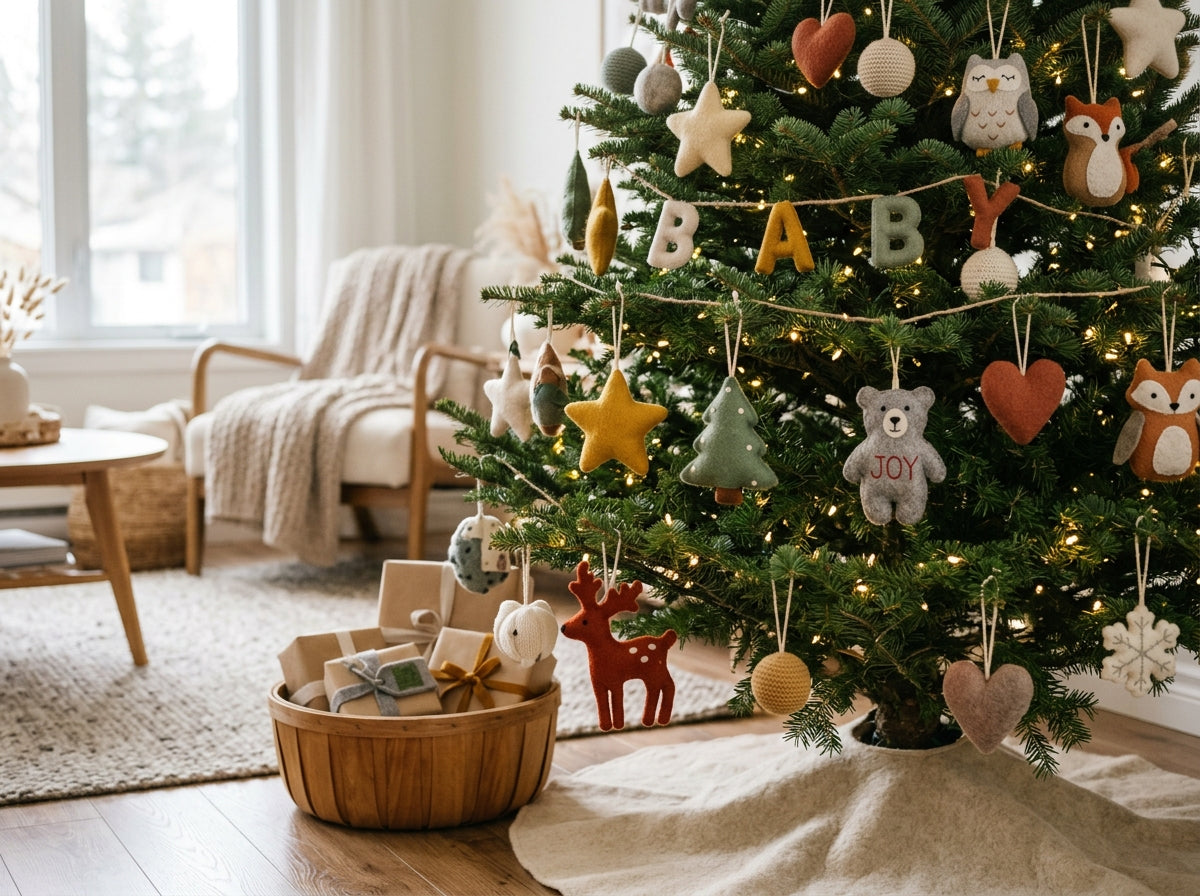
For ornaments, apply a simple rule: anything that can fit through a standard toilet paper tube goes on the upper half of the tree only. Glass and ceramic ornaments belong out of reach entirely. My younger daughter, at about 14 months, managed to pull a low-hanging ornament off the branch and was examining the broken edge before I got across the room. That ornament style hasn’t come back out since.
Lights, Batteries, and the Hazard Nobody Expects
String lights are a cord hazard for babies and a chew hazard for dogs. Tuck cords behind furniture or use cord covers, and inspect lights before use for fraying or cracked sockets. Unplug them when you leave the room or go to bed.
The less obvious hazard is button batteries. Light-up ornaments, flameless candles, and small decorative figures frequently use them. The CPSC warns that button cell and coin batteries are linked to thousands of emergency-department visits every year, and per a CPSC safety alert, a swallowed button or coin battery can cause burns and devastating injuries in as little as two hours. That window is terrifyingly short. Check every battery compartment in your holiday decor and make sure the covers require a tool or a firm twist to open. If they don’t, tape them shut or move the item out of reach.


Candles and Open Flames
The NFPA reports December was the peak month for home candle fires in 2014–2018 (11%, tied with January), and 12% of December candle fires started with decorations versus just 4% the rest of the year. Candles next to garland, ribbon, and dried greenery are a high-risk combination.
The simplest fix is flameless candles. Modern LED versions with warm flicker effects are difficult to distinguish from the real thing at a dinner table. If you use real candles, place them on surfaces a toddler cannot reach and a pet cannot jump onto, and never leave the room while they’re lit. NFPA data for 2014–2018 show candles caused roughly 7,610 home structure fires a year, with an annual average of 81 civilian deaths and $278 million in property damage. That’s a year-round number. December concentrates the risk.
Scented candles and essential oil diffusers are a separate concern for pets. Cats in particular have limited ability to metabolize certain compounds found in many essential oils, and concentrated diffuser mist can irritate their respiratory tracts. If you use a diffuser, keep it in a room your cat doesn’t access, and make sure the space is ventilated.
Holiday Plants
Poinsettias are widely feared but the concern is overstated. According to Poison Control (National Capital Poison Center), ingestion typically causes no effect or, at most, mild stomach upset. That said, holly, mistletoe, and amaryllis are toxic to dogs and cats and can cause serious symptoms including vomiting, lethargy, and cardiac effects depending on the plant and the amount consumed. Keep those out of homes with pets, or place them in rooms that are off-limits.
For babies, the choking concern with plants is real regardless of toxicity. Berries, leaves, and small decorative elements can all become airway hazards. Any plant with small detachable parts belongs out of crawling and toddling range.
Food Hazards for Pets and Babies
The holiday table is a minefield for dogs and cats. Chocolate, grapes, raisins, onions, garlic, xylitol (found in sugar-free baked goods and some candies), and macadamia nuts are all toxic to dogs and cats to varying degrees. Store these in sealed containers in elevated or locked locations, not on the counter. Guests who don’t know your rules will leave things out. Your dog will find them.
For babies, the holiday spread introduces a cluster of choking hazards at exactly the age when children are grabbing everything within reach. Hard candy is the single most common cause of nonfatal food choking in children (15.5%), followed by other candy (12.8%), meat (12.2%), and bone (12.0%) (Chapin et al., Pediatrics, 2013). Holiday tables are full of all four. The AAP’s 2010 policy statement on choking prevention notes that, on average, a U.S. child dies every 5 days from choking on food, with risk highest in children younger than 4.
Keep hard candies in a closed dish on a high surface. Cut meat off the bone before it goes near a toddler. Watch for guests who offer babies bites of adult food without checking with you first.
Wrapping Paper, Ribbons, and Packaging
Ribbons and bows are intestinal obstruction hazards for cats and dogs. Cats especially will eat ribbon given the opportunity, and the resulting linear foreign body can require emergency surgery. Collect and dispose of all ribbon and wrapping paper immediately after gifts are opened. Don’t let it pile up on the floor.
For babies, small toy parts that come out of packaging during unwrapping are a direct choking hazard. Supervise unwrapping closely and have a dedicated trash bag or bin nearby that closes. A standard open trash can in the corner of the room is not sufficient. Pets and babies will both investigate it.
Managing Guests, Stress, and Pet Behavior
Guests change the dynamics of your home in ways that affect both your pet and your baby. Doors open and close more frequently, creating escape opportunities for dogs and cats. People who don’t live with your pet may feed them table scraps, leave glasses of wine or holiday punch within reach, or simply not notice when the dog is getting overwhelmed.
Alcohol is toxic to pets and a poisoning hazard for babies and toddlers. Keep all drinks in closed containers or on surfaces that are out of reach, and brief guests on the rule before the party starts.
Holiday gatherings also stress pets. Dogs and cats that are normally calm can become reactive when their routine is disrupted and their space is crowded with unfamiliar people. Watch for stress signals: stiff posture, tucked tail, flattened ears, growling, or attempts to hide. A pet showing those signs around a baby or toddler needs to be separated before the situation escalates. Set up a quiet room with your pet’s bed, water, and a familiar blanket before guests arrive. Give them a place to go.
Supervise every interaction between your pet and your baby during gatherings, even if your pet is normally gentle. Tired, overstimulated animals behave differently than they do on a regular Tuesday afternoon.
Holiday Safety Checklist
Keeping Routines Intact
Consistent feeding and exercise schedules reduce anxiety in dogs significantly. When the holidays compress your schedule, the dog’s walk is usually the first thing to go. It shouldn’t be. A dog that hasn’t been exercised is a dog that is more likely to jump, chew, or act out around a baby. Even a 15-minute walk matters.
The same principle applies to your baby’s sleep and feeding schedule. Disrupted routines make babies harder to read and more prone to meltdowns, which in turn creates more noise and chaos that stresses your pet further. The two systems feed each other. Protect the schedule where you can, and you’ll have fewer problems on both fronts.
Traveling During the Holidays
If you’re traveling with both a baby and a pet, plan the logistics in advance. Pets need appropriate crates or vehicle restraints, not just a loose spot in the back seat. Babies need properly installed car seats checked before every trip. Never leave either a pet or an infant unattended in a vehicle, even briefly. In winter, temperatures inside a parked car can drop to dangerous levels rapidly. In the sun, even on a mild day, they can rise just as fast.
Book pet-friendly accommodations in advance and confirm the pet policy. Bring your pet’s regular food, since switching foods during a stressful trip compounds digestive problems. Bring your baby’s familiar sleep environment. A travel crib in a separate space from your pet’s sleeping area avoids the middle-of-the-night supervision problem entirely.
The holidays require the same approach you’ve already applied to the rest of your home: identify the hazards, address them before something goes wrong, and build systems that work even when you’re tired and distracted.