Baby Proofing for Hanukkah: Menorahs, Candles, and Gift Safety

Eight nights of candles, wrapping paper scattered across the floor, and a baby who has just figured out she can pull herself up on anything within reach. That combination deserves a plan.
Hanukkah is a beautiful holiday, and it also happens to involve open flame, small decorative objects, bags of foil-wrapped chocolate, and enough gift wrap to bury a coffee table. None of that is inherently dangerous for adults. For babies and toddlers, the calculus changes fast.
The Menorah Is the First Priority
A lit menorah is not a centerpiece. It is an open flame at a height that varies wildly depending on where you set it, and it needs to be treated with the same seriousness as a lit burner on your stove.
December is the peak month for home candle fires, with 12% of December candle fires starting with decorations versus 4% the rest of the year. That context matters when you are deciding where to place yours.
Place the menorah on a high, stable surface that a child cannot reach by pulling, climbing, or grabbing. A bookshelf bracket, a high mantel, or a dedicated shelf well above counter height are all reasonable options. A dining table is not. In my experience, a child can reach the center of a dining table by 22 months simply by grabbing and pulling, without any climbing involved. A menorah on a tablecloth is especially dangerous because the cloth itself becomes a handle.
Keep the menorah away from curtains, paper, holiday cards, and anything else that can catch. The candles burn down to nothing over roughly 30–40 minutes, but that window is long enough for a distraction to become a disaster.
LED Menorahs Solve the Problem Entirely
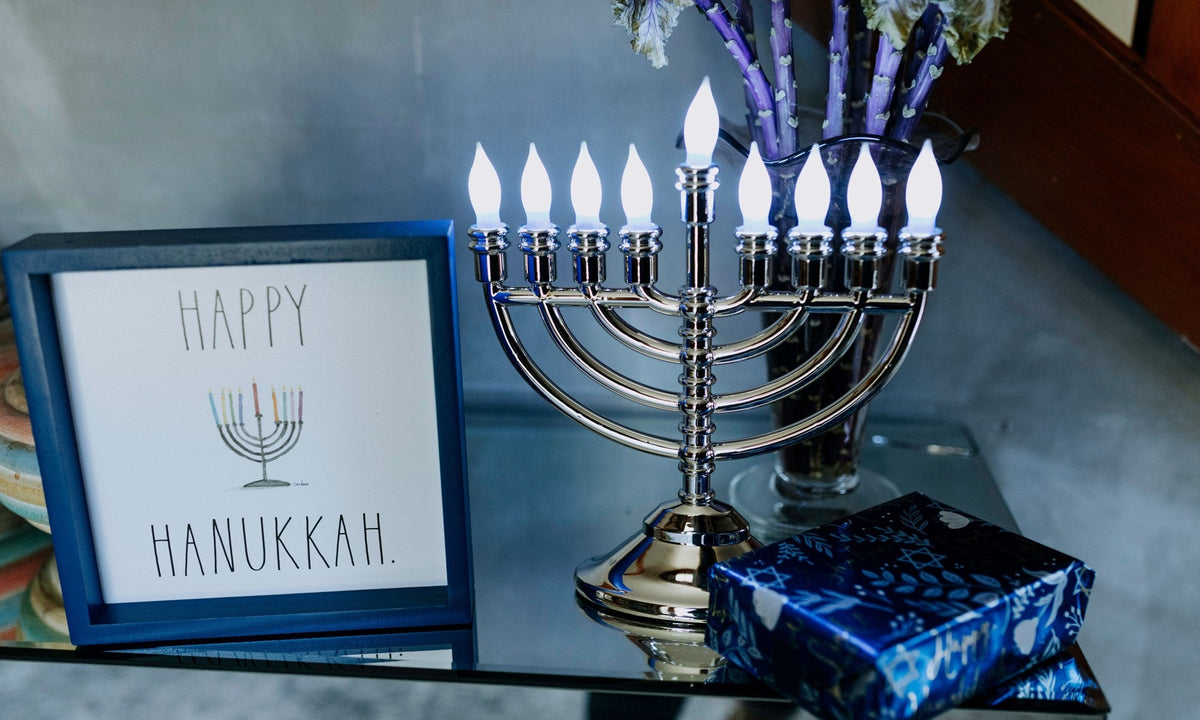
If you have a baby or young toddler in the house, the simplest answer is a battery-operated LED menorah for the nights when active supervision isn’t possible. This is not a compromise of the tradition. The visual ritual, the blessings, the songs, the gathering of family are all intact. The open flame is not.
I used a combination approach the first year my younger daughter was mobile. We lit real candles for the actual ceremony with every adult in the room and eyes on the menorah the entire time. After the blessings, once the candles burned down, the LED version went on the windowsill for the rest of the evening. It worked well. She was fascinated by the lights either way.
If you do use real candles, the rule is simple: never leave a lit menorah in a room with a child without active supervision. Not to answer the door. Not to check on dinner. Extinguish the candles before you leave the room, and extinguish them before bedtime without exception.


Toy Safety for Hanukkah Gifts
Gifts for babies and toddlers under 3 years old must meet CPSC toy safety standards. The key hazards to screen for: small parts that pose choking risks, cords longer than 7 inches, and sharp edges or points that could cause injury during normal play. Age labels on toy packaging reflect these standards, and they are worth reading.
Decorative menorahs with dangling beads, small ornamental pieces, or components that could break off are a separate concern. These are not toys, but a baby does not know that. Keep decorative items with small parts out of reach entirely. A bead or a small metal charm can become a choking hazard or cause an intestinal blockage if swallowed.
Battery-operated decorations and gifts carry an additional risk. The CPSC warns that button cell and coin batteries, found in light-up decorations, flameless candles, and ornaments, are linked to thousands of emergency-department visits every year. A swallowed button or coin battery can cause burns and devastating injuries in as little as two hours. Check that battery compartments on any light-up gift are secured with a screw, not just a snap closure.
Wrapping Paper, Gift Bags, and the Mess After
The unwrapping is half the fun, and it creates a hazard zone in about 90 seconds. Plastic bags, tissue paper, ribbon, and large sheets of wrapping paper all pose suffocation risks for infants and young toddlers.
Supervise unwrapping closely. Remove all paper, plastic, and ribbon immediately after each gift is opened rather than letting it accumulate on the floor. Assign one adult specifically to cleanup during the gift-opening process if you have a baby in the room. Store all wrapping materials, including unused rolls and bags, in a closed closet or cabinet that a toddler cannot access.
Hanukkah gelt deserves its own mention. Chocolate coins wrapped in foil are a choking risk for babies and young toddlers, and the foil wrapping adds a secondary hazard. Store gelt and other holiday treats in a location that requires an adult to retrieve them, and give them only under direct supervision. Keep in mind that chocolate is toxic to dogs and cats, so the same storage rule applies if you have pets.
Electrical Cords and String Lights
String lights, electric menorahs, and other plugged-in decorations all generate cords. A cord at floor level is a grab-and-chew hazard for babies and a pull-down hazard for toddlers. Route cords behind furniture, secure them with cord covers or cable management tape, and make sure nothing is dangling at a height a child can reach.
Check that any electrical decoration you use is in good condition. Frayed cords, cracked sockets, and loose connections are fire risks regardless of whether a child is present.
Hanukkah Safety Checklist
Hosting Hanukkah Gatherings
When other families come over, your baby-proofing setup gets tested by a crowd that may not know your house rules. Before guests arrive, brief adults on where the menorah is, why it is placed where it is, and what is off-limits. This is not awkward. Most parents understand immediately, and guests without young children are usually glad to know.
Designate a separate play area away from the menorah and candle zone. A gated corner of the living room or a dedicated room with age-appropriate toys gives children a clear space and reduces the gravitational pull toward the interesting glowing thing on the shelf.
Older siblings are part of this equation too. Teach them early and directly that the menorah is not a toy and cannot be touched without an adult present. Explain why in concrete terms: the flame is hot, it can burn skin, it can start a fire. Children as young as 3 or 4 can understand cause and effect when it is explained plainly rather than just prohibited.
After the Holiday: Storage Matters
When Hanukkah ends, the menorah, candles, and decorations need to go somewhere a toddler cannot reach during the other eleven months of the year. A high closet shelf or a locked cabinet is the right answer. A basement shelf at toddler height, a garage corner, or an unlocked storage bin are not. Curious toddlers explore off-season, and a candle stub or a decorative piece with small components is just as hazardous in March as it is in December.
Keep a working fire extinguisher in your kitchen and know how to use it. A multipurpose (ABC-rated) extinguisher is the right choice for a home, because a candle fire usually spreads to paper, fabric, or wood. Having one accessible and knowing its location reduces response time if something goes wrong.
Eight nights is enough time to build good habits around all of this. Place the menorah high, supervise the flame, clear the wrapping paper, lock up the gelt, and secure the cords. The holiday stays joyful when the safety work is done before the first candle is lit.