Baby Proofing for Parents of Premature Babies: Adjusted Timelines

The day you bring a premature baby home, you’re handed a discharge packet, a list of follow-up appointments, and an enormous amount of anxiety. What you probably don’t get is a clear answer to the question most parents ask around month three or four: when do I need to start baby proofing?
For parents of full-term babies, the general rule is simple. Start before they move. But for premature babies, "before they move" is a harder target to hit, because your child is developing on two separate clocks at once.
Two Ages, One Baby
Every premature baby has a chronological age, the number of weeks or months since birth, and a corrected age, which adjusts for how early they arrived. The AAP recommends using corrected age to track developmental milestones until age 2–3, because corrected age reflects what’s happening neurologically and physically. A baby born 10 weeks early at 6 months chronological age has a corrected age of roughly 4 months. Biologically, that’s where they are.
This matters for baby proofing in a direct, practical way. A 4-month-old is not crawling. They’re not pulling to stand. They’re not reaching into cabinets. Installing stair gates and outlet covers at 6 months chronological age for this baby is unnecessary and a distraction. You’re spending money and mental energy on hazards that are still months away.
Calculate corrected age by subtracting the number of weeks born early from your baby’s current age in weeks. A baby born 8 weeks premature who is now 20 weeks old has a corrected age of 12 weeks, roughly 3 months. That’s your planning baseline.
Why Motor Development Is the Real Variable
Premature infants often have lower muscle tone in their first year, and motor milestones tend to arrive later, sometimes significantly so. This affects every stage of proofing: crawling, pulling to stand, cruising along furniture, and walking all determine which hazards become relevant and when.
Per the CDC’s Learn the Signs. Act Early. milestones, most babies (75% or more) roll from tummy to back by 6 months. For a baby born 8 weeks early, that milestone may not arrive until 8 months chronological age. The CDC’s 12-month checklist lists "pulls up to stand" and "walks, holding on to furniture" as movement milestones, meaning at least 75% of children reach them by 1 year. For a baby born 10 weeks early, that window shifts to roughly 12.5 months chronological age. Per the CDC’s 2022 milestones, most children walk without holding on to anyone or anything by 18 months. For a premature baby, that may be 20–22 months chronological age.
None of this means your child is behind. It means their timeline is calibrated differently, and your proofing plan should be too.
In my experience preparing for my younger daughter’s mobility phase, I front-loaded everything: gates, locks, corner guards. She was nowhere near ready to need most of it. I spent three weeks tripping over a gate I’d installed in the wrong doorway before I admitted I’d jumped the gun. For families with premature babies, this kind of over-preparation is even more likely, and even more avoidable.


What to Proof Before Mobility: The Day-One List
Some hazards don’t wait for your baby to move. These apply from the moment you leave the hospital, regardless of gestational age.
Sleep surface safety is non-negotiable from birth. A firm, flat mattress with no pillows, bumpers, positioners, or loose bedding. About 3,500 infants die each year from sleep-related causes in the United States, per CDC SUID data. Premature babies, who may have lower respiratory reserves, face these risks just as much as term infants, sometimes more.
Car seat positioning is also a day-one concern. NICU discharge teams typically review this before you leave, but confirm that your infant seat is installed at the correct angle and that your baby’s head is not falling forward. Some NICUs conduct a car seat challenge before discharge for babies under a certain gestational age.
Bathing safety applies from the first bath at home. Never leave a baby unattended in any amount of water. The AAP states that a child can drown in as little as one to two inches of water. Bathtub seats and infant tubs do not change this. Your hands stay on the baby.
Medication and chemical storage matters even before your baby is mobile, because you are the one moving around the home with a baby in your arms, and a chaotic household is its own hazard. Lock up medications and cleaning products now, not when your baby starts crawling.
The Proofing Window: Corrected Age Milestones Drive the Schedule
Once your premature baby begins to roll, scoot, or show early signs of crawling on their corrected age timeline, the same core proofing priorities apply as for any mobile infant. The window just arrives later.
Furniture anchoring should be done before your baby pulls to stand. Unsecured televisions, dressers, and bookshelves are a serious hazard once a child uses furniture as a support. Don’t wait until you see them pulling up. Install anti-tip straps when you see them starting to push up on hands and knees.
Stair gates become relevant when your baby begins to move across the floor independently. ASTM F1004 is the federal safety standard for expansion gates and expandable enclosures, made mandatory under 16 CFR Part 1239 (effective 2021). For stairs, use a hardware-mounted gate, not a pressure-mounted one. About 93,000 children under 5 are treated in U.S. emergency rooms each year for stair-related injuries, per a Nationwide Children’s analysis of CPSC NEISS data from 1999–2008. That number doesn’t shrink for premature babies once they’re mobile.
Outlet covers and cord management should go in before your baby begins to cruise. Cords are a tripping hazard and a strangulation risk for infants. Outlet covers take 20 minutes to install across a whole house. Do it early on the corrected age timeline, not after.
Cabinet locks matter when your baby begins to pull open doors, which typically follows pulling to stand. In my experience, my older daughter defeated an adhesive strap lock at 26 months, which is why I recommend hardware-mounted locks for any cabinet containing cleaning products or medications. Adhesive versions are fine for low-risk cabinets, but not for under-sink storage.
Choking Hazards: Follow the Mouth, Not the Calendar
Babies begin mouthing objects when they develop the hand-to-mouth coordination to do so. For premature babies, this happens on the corrected age timeline, not the chronological one.
Chapin et al. (Pediatrics, 2013) found that 37.8% of treated food-choking cases were children 1 year or younger, and over 60% were 4 years or younger. Once your baby starts bringing objects to their mouth, anything smaller than a toilet paper tube needs to be off the floor and out of reach.
Coins, button batteries, small toy parts, and certain foods (grapes, nuts, chunks of raw vegetable) all become relevant at this stage. For a baby born 8 weeks early, that stage may arrive at 10–11 months chronological age rather than 8–9 months. Watch your baby’s behavior, not the calendar date.
Talking to Your Pediatrician About the Real Timeline
Some premature babies close the developmental gap faster than others. Birth weight, health complications during the NICU stay, and individual variation all affect how quickly a child catches up. A baby born at 34 weeks with no major complications may track very close to term peers by 12 months. A baby born at 28 weeks with respiratory or neurological complications may have a longer adjusted period.
Your pediatrician is the right person to help you map this out. Ask directly: based on where my child is developmentally right now, which mobility milestones should I be preparing for in the next two to three months? That question gets you a proofing timeline, not just a developmental reassurance.
The AAP guidance is to use corrected age for milestone tracking until age 2–3, at which point most premature children have caught up and chronological age becomes the relevant measure. Your pediatrician will tell you when that transition makes sense for your specific child.
NICU Discharge Instructions Are Part of Your Safety Plan
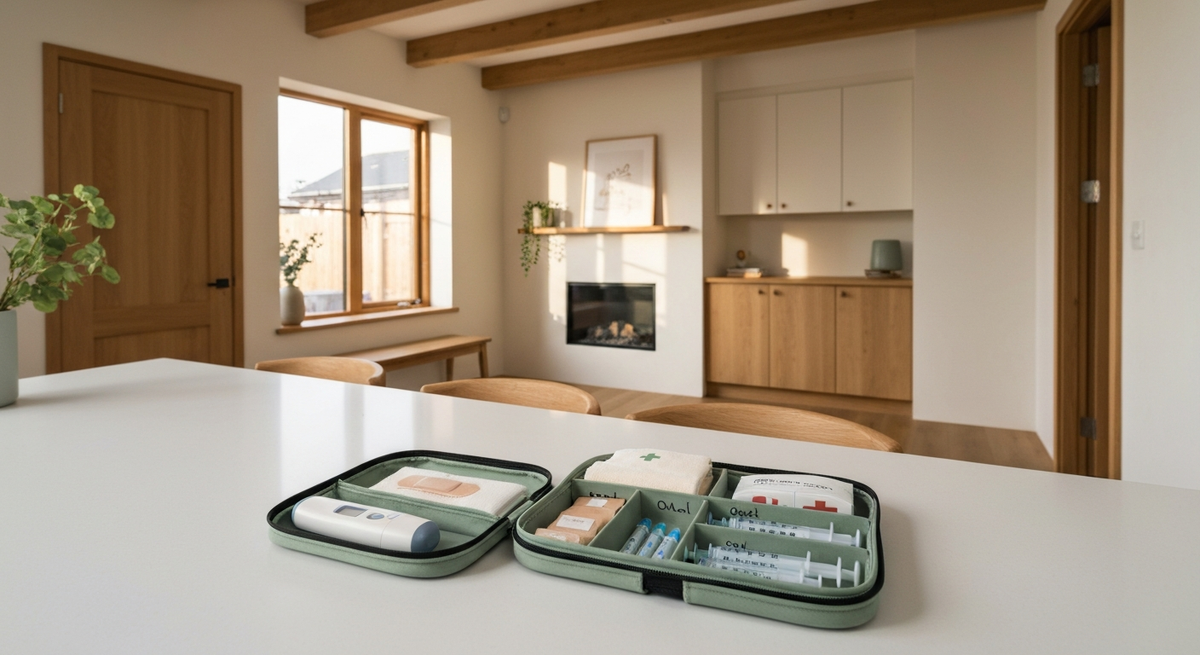
Families leaving the NICU receive specific guidance on positioning, monitoring, and environmental controls that may not match standard baby proofing advice. Some babies go home on monitors. Some have positioning requirements that affect where and how they sleep. Some have feeding equipment that needs to be stored safely.
Follow those discharge instructions as the foundation of your home safety plan, and layer standard proofing measures on top of them as your baby develops. If anything in your home setup conflicts with what the NICU team recommended, call and ask before you change it.
Building a Checklist That Fits Your Child
The most useful thing you can do is build your proofing checklist around corrected age milestones rather than chronological ones. Start with the day-one list: sleep surface, car seat, bath supervision, medication storage. Then add each proofing layer when the corresponding milestone is two to four weeks away on the corrected age timeline.
This approach keeps you ahead of your baby’s abilities without turning your home into an obstacle course months before it needs to be. It also keeps your focus on the hazards that are relevant right now, which is where your attention should be. A premature baby’s first year is already full of monitoring and appointments and adjustments. Your proofing plan should reduce your cognitive load, not add to it.