Complete Baby Proofing Kit: What Should Be Included and Our Top Picks

Every year, parents spend hours researching strollers and car seats while the inside of their home stays unaddressed. Then the baby starts pulling up on furniture, and the panic sets in.
A complete baby proofing kit solves that problem systematically. Rather than buying a corner guard here and a cabinet lock there, a well-designed kit covers the categories that drive injuries: falls, poisoning, drowning, burns, and strangulation. What follows is a breakdown of what every kit should include, what to look for in each component, and where the budget versions tend to fail.
Safety Gates: The Non-Negotiable Starting Point
According to a Nationwide Children’s Hospital analysis of CPSC NEISS data, 93,000 children under 5 are treated in U.S. emergency rooms each year for stair-related injuries. That works out to roughly one child every six minutes. Gates are the most direct intervention, and the standard that governs them matters.
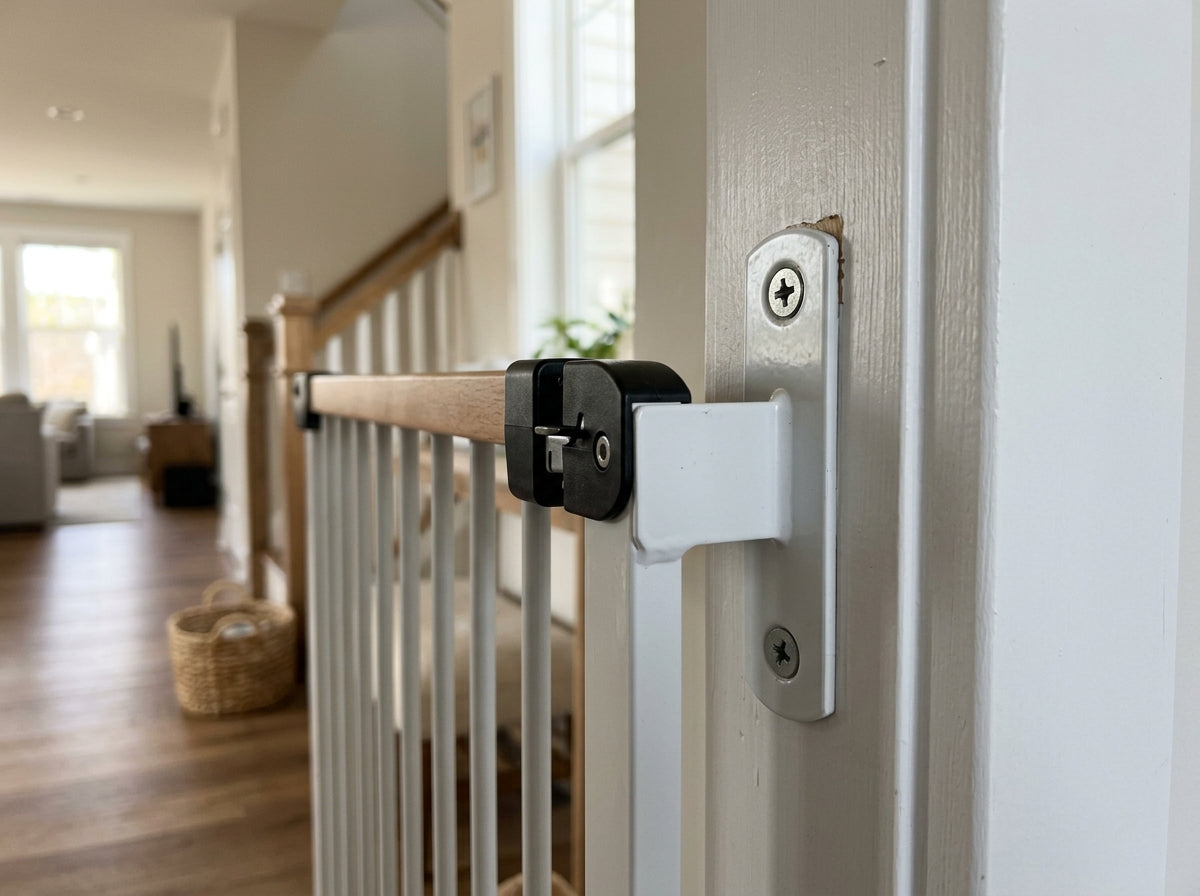
ASTM F1004 is the federal safety standard for expansion gates and expandable enclosures, made mandatory under 16 CFR Part 1239 (effective 2021). When you’re buying, look for the JPMA certification seal, which means the product has been independently tested against that standard.
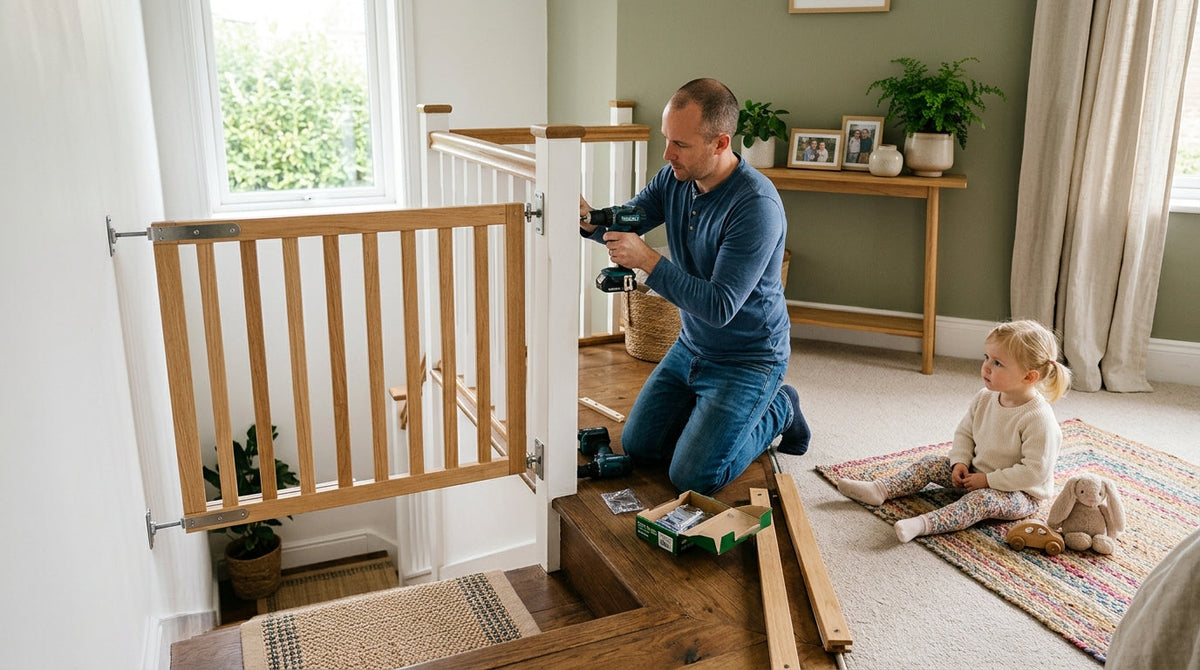
The hardware-versus-pressure distinction is critical. Hardware-mounted gates bolt directly into the wall or banister post and are required at the top of stairs. A pressure-mounted gate at the top of a staircase can be pushed out by a determined toddler, and the fall that follows is not a minor one. Pressure-mounted gates work fine for doorways and room dividers where a tumble wouldn’t mean a full staircase descent.
Before you buy, measure your opening. Many kits include a gate sized for standard doorways (roughly 28–32 inches), but older homes, wider hallways, and banister-to-wall configurations often require an extension panel. Check the gate’s maximum width and whether extensions are sold separately.
Cabinet and Drawer Locks: Blocking the Poison Risk
In my experience, cabinet locks are not optional. A toddler can empty an under-sink cabinet in seconds, exposing cleaning supplies and medications before a parent can intervene.
A complete kit should include both magnetic locks and slide locks, because different cabinet styles require different mechanisms. Magnetic locks mount inside the cabinet and require a magnetic key held against the door to release the latch. They’re invisible from the outside and very difficult for toddlers to defeat. Slide locks mount to the exterior and use a two-step motion that small hands struggle to coordinate.
For under-sink cabinets, bathroom vanities, and any storage holding medications or cleaning products, magnetic locks are worth the extra installation time. For low-traffic drawers and pantry doors, slide locks are faster to install and still effective. A good kit includes at least eight to twelve of each type, since most kitchens and bathrooms have more lockable surfaces than parents initially estimate.
Outlet Covers: Choose Sliding Plates, Not Plug Inserts
Simple plastic plug inserts are everywhere, and they create a false sense of security. A determined toddler can remove them with fingernails. More concerning, the inserts themselves can become choking hazards if pulled free.
The CPSC recommends tamper-resistant receptacles as the gold standard. These have internal shutters that only open when equal pressure is applied to both slots simultaneously, which is something a child pressing a single object into one slot cannot do. If your home was built or renovated recently, you may already have them. Check by looking for the letters “TR” printed on the outlet face. Never test an outlet by pushing an object into it.
If your home lacks them, sliding plate covers are the next best option. They replace the entire outlet cover and require a deliberate adult sliding motion to expose the slots. They cannot be pulled free, which eliminates the choking hazard problem. A complete kit should include enough sliding covers for every outlet in rooms where your child spends time, typically 20–30 covers for a standard home.


Corner Guards and Edge Bumpers: Protecting Against the Falls That Will Happen
Falls to hard furniture edges send children to emergency rooms constantly. A toddler learning to walk falls dozens of times per day. The goal isn’t to prevent every fall. It’s to make sure the landing surface doesn’t have a 90-degree edge at eye level.
Adhesive-only corner guards fail consistently. Children pull on them, the adhesive weakens with cleaning, and eventually the guard comes off and the corner is exposed again.
Look for guards with a wrap-around design that grips the edge mechanically, with adhesive as a secondary hold rather than the only attachment. For table edges, long foam bumper strips with reinforced adhesive backing perform better than individual corner pieces. A complete kit should cover a standard coffee table, dining table corners, and any low shelving units.
Door Locks and Handle Covers: Controlling Access to High-Risk Rooms
Bathrooms and kitchens concentrate several hazards in one place. Bathroom doors need locks that adults can operate easily but toddlers cannot. Lever handle covers are effective for lever-style handles; they encase the lever in a rotating shell that requires a squeeze-and-turn motion beyond most toddlers’ coordination. For round knobs, doorknob covers work similarly.
Exterior doors require a different approach. A toddler who wanders out to a driveway, street, or pool area faces hazards that are far harder to mitigate after the fact. Door alarms that chime when a door opens are a useful backup layer, especially for homes with pools or unfenced yards. Some kits include sliding door bar locks that mount high on the door frame, out of a child’s reach entirely.
A complete kit should include at minimum two bathroom door covers, a kitchen door cover, and one exterior door alarm or high-mount lock.
Furniture Anchors: Tip-Over Prevention
Furniture tip-overs kill and injure children every year. Dressers, bookcases, and televisions are the most common culprits. Children climb drawers like ladders, pull on shelves to stand up, and grab at screens. The physics are unforgiving.
Per CPSC guidance, any furniture taller than the child should be anchored to the wall. A complete kit should include heavy-duty anti-tip straps rated well above the weight of your specific furniture pieces. For a standard six-drawer dresser weighing 80–120 pounds, look for straps with a rated load capacity of at least 300–400 pounds, not the minimum.
Installation matters as much as the strap itself. Anchor into wall studs whenever possible. If you’re going into drywall without a stud, use the appropriate drywall anchors rated for the load. Many kits include hardware for both scenarios. Check before you buy.
Window Safety: Guards, Locks, and the 4-Inch Rule
Per CPSC data, 3,300 children age 5 and younger are treated in U.S. emergency rooms each year for window fall injuries. Windows in homes with young children should not open more than 4 inches, per CPSC and AAP guidance.
Window stops and opening limiters are the practical solution. They mount to the window frame and physically prevent the window from opening beyond the set point. Window guards are appropriate for upper-floor windows and must include a quick-release mechanism for emergency egress. A guard that traps a child during a fire is not a safety device.
A complete kit should include window stops for every operable window in rooms where your child sleeps or plays. If you have double-hung windows, note that stops designed for one type may not fit another.
Complete Kit Checklist
Stove, Oven, and Bathroom Safety Devices
Stove knob covers prevent accidental ignition and are included in most complete kits. Many covers marketed as universal don’t seat securely on all knob profiles. Before relying on them, test that the cover cannot be removed by a child gripping and pulling. If it comes off easily, it’s not doing its job.
Oven door locks mount across the door and prevent it from opening far enough for a child to reach inside or pull items from oven racks. Toilet seat locks require adult hand strength and a deliberate two-step motion to open. A tub spout cover cushions the hard metal spout and protects against head injuries during bath time. These are not glamorous products. They are also not optional if you have a child under three.
Cord and Blind Safety: A Strangulation Hazard That Hides in Plain Sight
The CPSC recommends cordless window coverings as the safest option for homes with young children. If you have corded blinds, the cord loops are a strangulation risk. Cord shorteners and safety clips keep loops wound tight and mounted high, out of reach.
A complete kit should include cord wind-ups for every window with corded coverings. This is one of the lower-cost items in any kit and one of the higher-stakes ones. Check every room, including bedrooms where children sleep.
What to Look for When Buying a Complete Kit
The best complete kits include clear installation instructions, hardware appropriate for both drywall and wood framing, and enough quantity to cover a standard home without requiring immediate supplemental purchases. Look for JPMA certification on gates and any product category where it applies. Check that outlet covers cannot be removed by a child before you install them throughout your home.
Assess your specific home before buying. Older construction may have non-standard door widths, plaster walls that require different anchoring hardware, or window frames that don’t accept standard stops. A kit that works perfectly in a new construction home may need supplementing in a 1960s split-level.
The goal is systematic coverage of the hazard categories that injure children, installed correctly, checked periodically, and updated as your child grows and finds new ways to defeat what you thought was secure.