Pet Gate vs Baby Gate: Can You Use One for Both

About 93,000 children under 5 are treated in U.S. emergency rooms each year for stair-related injuries, according to a Nationwide Children’s Hospital analysis of CPSC NEISS data. That number stops people cold. Then I watch parents glance at the pressure-mounted pet gate they installed years before their baby arrived, the one their dog has already shouldered open twice, and the math starts to sink in.
Can you use one gate for both the dog and the baby? Sometimes yes. Often no. The answer depends entirely on which gate you’re starting with, where you’re putting it, and what standard it was built to meet.
Why Baby Gates and Pet Gates Are Not the Same Product
A baby gate is a safety device regulated under a federal consumer product standard. A pet gate is, in most cases, a containment product with no equivalent federal mandate behind it.
ASTM F1004 is the federal safety standard for expansion gates and expandable enclosures, made mandatory under 16 CFR Part 1239 (effective 2021). Gates certified to this standard must pass specific structural tests, meet requirements for bar spacing, and resist the kind of force a determined toddler or a falling child can generate. The Juvenile Products Manufacturers Association (JPMA) runs a voluntary certification program that layers additional testing on top of that baseline.
Pet gates don’t have to meet any of this. A manufacturer can design a gate specifically for dogs, market it with photos of golden retrievers and border collies, and never once test whether a 14-month-old could get her head stuck between the bars. Many don’t. That gap is exactly where the danger lives.
Baby Gate vs. Pet Gate: Key Differences
| Feature | Baby Gate | Pet Gate |
|---|---|---|
| Federal safety standard | ASTM F1004 / 16 CFR 1239 | None required |
| Bar spacing limit | Max 2 3/8 inches | No mandate |
| Mounting for stairs | Hardware-mounted required | Often pressure-mounted |
| Typical height range | 28–42 inches | 24–30 inches |
| JPMA certification available | Yes | No |
| Head entrapment testing | Required | Not required |
The Bar Spacing Problem
Crib slats must be no more than 2 3/8 inches (6 cm) apart per CPSC standard 16 CFR 1219, and that same 2 3/8 inch threshold is widely applied to gate openings to prevent head entrapment. The reason is straightforward: a young child’s head can pass through a gap that their body cannot, and the result is a strangulation scenario that happens in seconds.
Pet gates are frequently designed with wider spacing. A gate meant to contain a medium-to-large dog doesn’t need to account for a baby’s head circumference. Some feature decorative cutouts or wide vertical slats that look charming and create exactly the kind of opening the CPSC threshold is designed to prevent.
In my experience, a 20-month-old can spend several minutes trying to push her head through the gap in a decorative pet gate. A wrought iron gate with scroll details and 3.5-inch spacing creates exactly the kind of opening the CPSC threshold is designed to prevent.


Hardware-Mounted vs. Pressure-Mounted: This Is the Critical Distinction
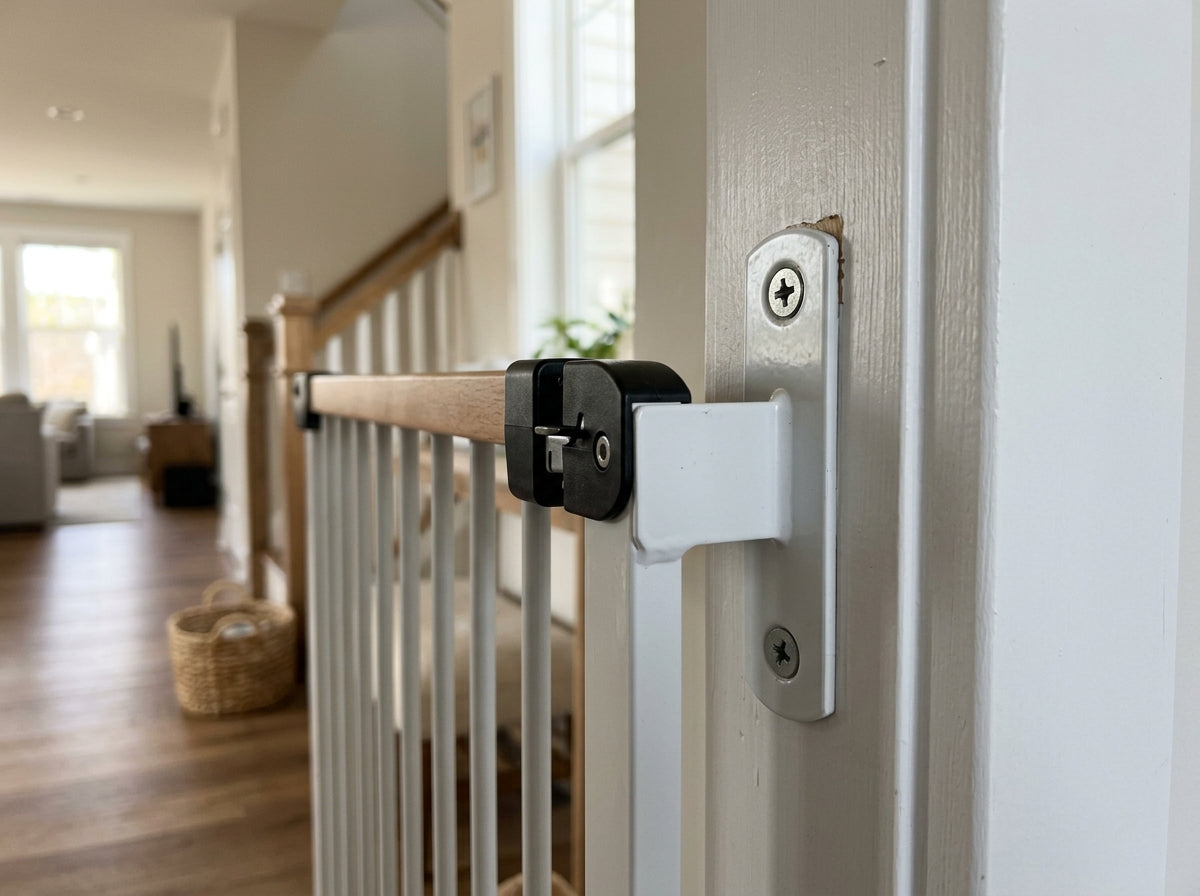
For stairs, there is no debate. Hardware-mounted gates are the only appropriate choice. They anchor directly into wall studs or a mounting kit, and they hold under the kind of force that happens when a child falls against them or a 60-pound dog hits them at speed.
Pressure-mounted gates work by tension. They grip the walls or door frame through compression, and that grip has limits. A large dog can dislodge a pressure-mounted gate through repeated force. A toddler who grabs the gate and pulls while descending a step can shift it enough to create a gap. Put a pressure-mounted gate at the top of a staircase and you’ve created a false sense of security with a product that was never designed to be a last line of defense.
Use pressure mounts for room division, for blocking kitchen doorways, for keeping the dog out of the living room. Never at the top of stairs. Never in a location where the gate failing means a child falls.
Height Matters More Than You’d Think
Pet gates for small-to-medium dogs often run 24–30 inches tall. That’s sufficient to stop a beagle. It is not sufficient to stop a 2-year-old who has figured out that the top of the gate is a handhold.
Baby gates for stair applications and room division typically run 28–42 inches. The taller end of that range matters for climbing-prone toddlers, which is most toddlers between 18 and 36 months. A toddler scaling furniture at 22 months will treat a 26-inch pet gate as a step stool.
If you’re evaluating a gate for dual use, measure it. A gate marketed as "pet and baby" that tops out at 27 inches is not a baby gate for a child who can already pull to stand.
Mesh and Fabric Gates: A Specific Risk Category
Some pet gates use mesh or fabric panels instead of rigid bars. The appeal is obvious: you can see through them, they’re lightweight, and they fold flat for travel. For a dog, they’re often fine.
For a baby or toddler, they introduce two problems. First, mesh can tear. A child who grabs, chews, or pulls at a fabric gate can create openings large enough to create an entrapment or pass-through hazard. Second, loose or sagging mesh can wrap around a child’s neck or face in ways that rigid bar gates cannot.
Rigid construction is the right call for any gate that will be in a child’s environment. If you want the visibility benefit, look for rigid gates with vertical bar designs rather than mesh panels.
Accordion-Style Expansion Gates: Avoid Them for Children
Accordion-style gates with diamond or X-shaped panels have been a recurring safety concern for decades. The V-shaped openings at the top and the diamond-shaped gaps throughout the panel can trap small fingers, hands, and in worst cases, heads and necks. ASTM F1004 specifically addresses expansion gates and expandable enclosures, and a gate that doesn’t meet that standard should not be used with children present.
I’ve seen these gates sold in pet stores with no child safety warning anywhere on the packaging. They’re cheap, they extend to wide openings, and they look functional. For a dog in a hallway with no children in the house, maybe. For any space where a baby or toddler is present, no.
What "Pet and Baby" Marketing Means
Many gates are marketed as suitable for both pets and children. Some are. Many are not. The phrase "pet and baby gate" on a box is a marketing claim, not a certification.
What you’re looking for is explicit ASTM F1004 certification and CPSC compliance in the manufacturer’s documentation, not on the front of the box in cheerful font, but in the product specifications or on the certification label. JPMA certification is an additional indicator that independent testing has been done.
Check the bar spacing. If the manufacturer doesn’t publish it, measure it on the product itself. It should be no wider than 2 3/8 inches. Check the mounting type relative to where you’re installing it. And check the height against your child’s current climbing ability, not their age.
In my experience testing gates, I’ve found two that passed the spec check but had auto-close mechanisms that didn’t latch reliably after the dog pushed through them. An auto-close feature that doesn’t close is worse than no auto-close, because you stop checking.
Gate Safety Verification Checklist
The Safest Setup for Multi-Pet, Multi-Child Households
The cleanest solution is separate gates for separate purposes. Use a hardware-mounted gate certified to ASTM F1004 for every stair opening and any high-risk location where child safety is the primary concern. Use pet-specific pressure-mounted gates for room separation where the stakes are lower, where you’re keeping the dog out of the dining room rather than keeping a toddler off a staircase.
This isn’t about spending more money than necessary. It’s about matching the product to the risk. According to a Nationwide Children’s Hospital analysis of CPSC NEISS data, about 93,000 children under 5 are treated in U.S. emergency rooms each year for stair-related injuries. A hardware-mounted baby gate at the top of your stairs is the single most direct intervention you can make against that risk. A pet gate repurposed for that location is not an equivalent substitute.
If budget is a real constraint and you need one gate to serve both functions, buy the baby-rated hardware-mounted gate and use it where child safety is the priority. Let the dog adapt to the higher standard. The dog will be fine.
Checking Any Gate Before You Trust It
Whatever gate you install, verify these things before you rely on it. Confirm the bar spacing is no wider than 2 3/8 inches. Pull on it from both sides with meaningful force before you walk away. If it has an auto-close mechanism, push it open and watch it close and latch without assistance, then do it again after the dog goes through it three times. Check the wall anchors on hardware-mounted gates every few months, because wood compresses and screws work loose.
A gate that met every standard on installation day can fail six months later if no one has checked it. The standard is the floor, not the ceiling.