Dog Growling at the Baby or Jealous of the Baby: What It Means and What to Do Today
Separate the dog and baby today with a gate or door, never leave them alone together, and ask your vet about a behaviorist for the growling.

A dog growling at the baby is a reason to put a closed door or a gate between them today. It is not something to wait out. The AAP says to be alert for signs of aggression or jealousy when the baby comes home. It also says never to leave your dog or cat unsupervised near a new baby. The CDC says to always supervise young children around dogs, even trusted family pets.
The next step is a call to your veterinarian. Ask about a referral to a veterinary behaviorist or a certified behavior consultant.
Dog Growling at Baby: Separate Them Today
Picture this: you are folding laundry while the baby lies on a play mat. The dog wanders over, stops near the baby’s head, and growls. Nothing happens. The baby doesn’t even notice.
That is still the moment to change the setup for the rest of the day. The first move is distance and supervision, not a verdict on the dog. You are not deciding what kind of dog you have. You are deciding that the two of them do not share a floor without an adult watching.
In practice, that means three rules starting now:
- When you can watch both the dog and the baby, they can share a room, and you stay close.
- When you can’t watch both, a closed door, a gate or the dog’s crate sits between them.
- No one leaves the room "just for a second" with the dog and baby together.
A dog barking at the baby gets the same first response as a growl. You don’t need to work out which behavior is the serious one before you act. Distance comes first.


Your Veterinarian Is the First Call
Why one particular dog growls is a question no article can answer. Neither the AAP nor the CDC explains an individual dog’s growl, and a parent watching from the couch can’t read the dog’s mind either.
Start with your veterinarian, and mention both the growling and the baby. The CDC says dogs may bite when they aren’t feeling well and want to be left alone.
Then ask for a referral to a veterinary behaviorist or a certified behavior consultant. Any plan for the dog’s behavior, including training, comes from them and not from internet advice.
What the CDC and AAP Say About When Dogs Bite
The AAP’s dog-bite page puts the baseline plainly: "Never leave a small child and a dog alone together, no matter if it is the family dog." It also says: "Any dog can bite."
The CDC adds three facts that matter for a household with a baby. Most dog bites affecting young children happen during everyday activities with familiar dogs. Children are more likely than adults to be bitten, and their injuries tend to be more severe. The CDC also calls most dog bites preventable, which is why the supervision rules matter.
The CDC says any dog can bite, especially:
- when scared or nervous
- while eating
- when playing with toys or protecting them
- when protecting puppies
- when not feeling well and wanting to be left alone
The AAP’s dog-bite page names "growling and barking" as examples of a dog behaving in a threatening manner. That is a reason to take them seriously. It is not an explanation of why your dog is doing it.
Read the CDC list as a set of situations to keep a baby out of. Keep the baby away from a dog with a chew, a dog at its bowl, a dog resting on its bed and a dog that seems off. None of these labels the dog. They tell you where the baby should not be.
Jealousy Is the AAP’s Word, Not a Diagnosis
The AAP’s advice for the baby’s homecoming uses the word jealousy. It says to be alert for signs of aggression or jealousy in the pet, and never to leave the dog or cat unsupervised near the baby.
So if your dog seems jealous of the baby, treat "jealousy" as a prompt to watch, not a diagnosis, and keep the distance and supervision rules above. Why it is happening is a question for the veterinarian and the behaviorist.
Baby-proofing a home with pets means looking at the dog’s things as well as the outlets and cabinets. The next section covers that.
Crawling Baby and a Dog: Safe Zones, Crate Rules and Supervision
A crawler raises the stakes.
The AAP gives two reasons young children get bitten. It says younger children have difficulty distinguishing an animal from a toy. They may unintentionally provoke a bite through teasing or mistreatment. The AAP also says many bites occur during playful roughhousing because the child doesn’t realize when the animal gets overexcited.
Picture this: you turn to grab a burp cloth, and the baby crawls straight toward the dog’s bed. A dog growling at the baby crawling toward its resting spot is the moment a closed door would have helped. That is the risk when a dog and a crawling baby share the same floor space.
Keep these out of the baby’s reach
The CDC says not to disturb a dog while it is eating, sleeping or caring for puppies. It also says not to continue petting a dog that seems scared, sick or angry. The AAP says to make sure children don’t disturb an animal when it is sleeping or eating.
A baby can’t follow those rules, so you build them into the room. This is our practical reading of the sources: the dog’s bed, food bowl, chews and any crate become places the baby cannot reach. Feed the dog where the baby isn’t. Put chews away when the baby is on the floor, and treat the crate as the dog’s space that the baby never touches.
When you can’t watch both
When you can’t watch the dog and the baby together, put a closed door, a gate or the crate between them. Pick whichever is easiest to use every time. Questions about crate training belong with the behaviorist.
An indoor play fence can give a crawler a defined space on the floor. It adds a layer, and an adult still has to be watching.
The CDC says not to let young children play with dogs without supervision, even if the child has met the dog before. The AAP says never to leave a young child alone with an animal. Supervision means eyes on both of them, every time they share a room.
Dog Crate, Baby Gate or Closed Door: Choosing the Gate
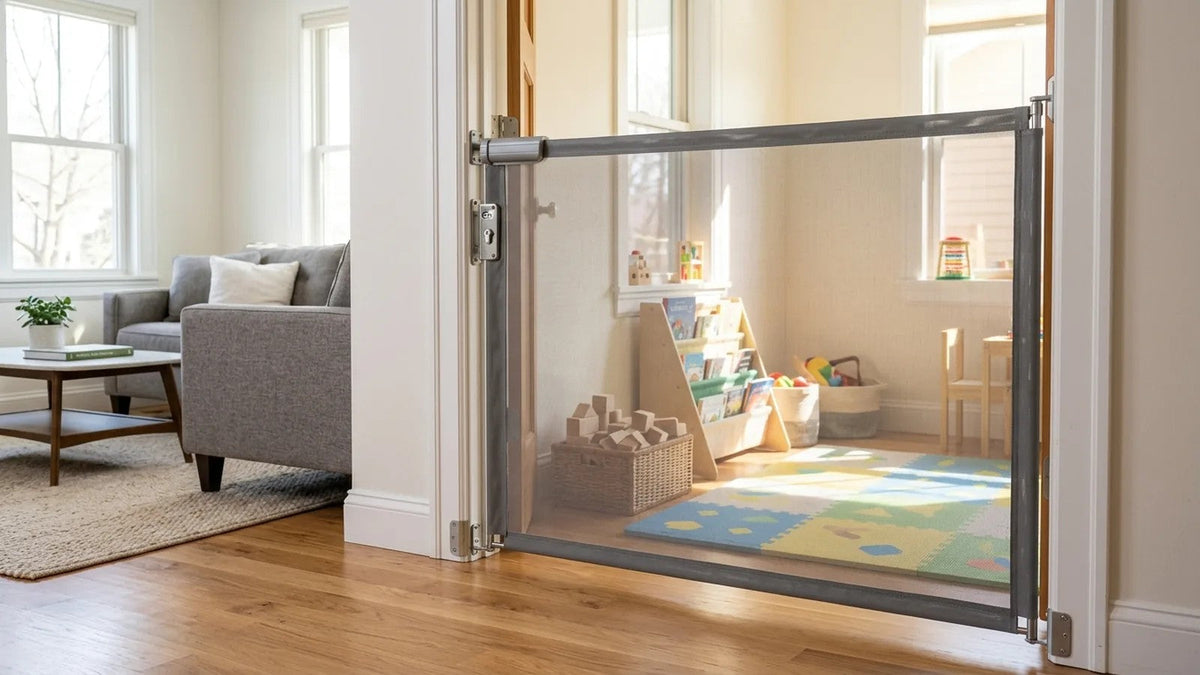
A closed door is the simplest barrier. A gate is useful when you want to see through, or when a door isn’t practical. If you choose a gate, pick a child gate.
CPSC says pet gates should never be used as a child safety gate. It says to look for safety gates that children cannot dislodge easily but that adults can open and close without difficulty. For the top of stairs, CPSC says to only use gates that screw to the wall. That is CPSC’s guidance, and it applies to whichever gate you buy.
Our own practical reading of "easy for adults" is to pick a gate you can open and close while holding the baby. You will often pass through it with a baby on your hip.
A gate only helps if it is shut. CPSC says safety devices must be properly installed and reengaged after use to be effective, and to follow installation instructions carefully. Picture this: you carry a laundry basket through the gateway, your hands are full, and the latch stays open behind you. The gate was installed correctly and still did nothing.
Make latching a habit. Latch it after every pass, even for a quick trip, even when the dog is asleep.
If a Child Is Bitten
Call your pediatrician after a bite. The AAP’s dog-bite page says so.
If a child is severely bitten, call 9-1-1 or go to an emergency department. For more guidance, see the AAP’s dog-bite page at HealthyChildren.org.
Baby Proof Me’s Mesh Retractable Baby Safety Gate
Baby Proof Me’s Mesh Retractable Baby Safety Gate is hardware-mounted. The listed contents include upper and lower brackets, two latches, installation and anchor screws, drywall screws and anchors, and two optional floor hooks, plus an instruction manual.
The gate is extra-wide. Its mesh rolls up with one hand when not in use, and it has no bottom bar. The dual-rotation lock turns clockwise to lock and anticlockwise to unlock, and it works with one hand. It stands 34 inches tall and is sold for babies and pets.
Before you choose a spot, check the product page for fit and follow the instructions for your own gate. A gate that isn’t latched adds nothing.
No gate replaces supervision. CPSC notes that no safety device offers total protection and that determined toddlers have been known to overcome or disable them. Baby Proof Me’s product page says the gate is not a substitute for adult supervision, and to stop using it immediately if it becomes faulty.
Until a veterinary behaviorist or certified behavior consultant has worked with your dog, the plan is simple. Keep a door, gate or crate between the dog and the baby whenever you can’t watch them both. Keep an adult’s eyes on them whenever they share a room.