Toddler Keeps Falling Out of Bed: Rails, Foam Bumpers, Floor Beds and Other Fixes
What the AAP and CPSC say about the fixes for a toddler who keeps falling out of bed: bed rails, foam bumpers, a mattress on the floor and the room around the bed.

If your toddler keeps falling out of bed, four fixes have sources behind them. In the order this page covers them, they are a lower sleeping surface (the AAP’s crib-mattress-on-the-floor stopgap), a cleared and gated room, a portable bed rail for a child who is 2 or older, and a toddler bed with built-in guardrails. None of them replaces an adult who is watching and listening. The sources used here name no age when toddlers stop falling out of bed.
The CPSC does set an age and weight range for the gear. The table puts each fix next to its limit.
| Fix | Source basis | Limit |
|---|---|---|
| Crib mattress on the floor | AAP stopgap | Only while awaiting new bed |
| Cleared and gated room | AAP room advice | Does not stop the fall |
| Portable bed rail | CPSC, 16 CFR part 1224 | Typically age 2 to 5, never under 2 |
| Foam or inflatable rail | CPSC: counts as rail | Same age, gap, label rules |
| Toddler bed guardrails | CPSC, 16 CFR part 1217 | 15 months+, 50 pounds max |
| Rails for platform beds | No rule in these sources | Check rail’s own label |
| Ranking mesh, foam, rigid | No ranking in these sources | None given |
When Your Toddler Keeps Falling Out of Bed: Check the Crib Stage First
Before you shop for a rail, look at what your child is sleeping in now. The AAP says the most common crib falls occur when a baby tries to climb out. Its height rule is concrete. Move your child to another bed when they are 35 inches (89 cm) tall, or when the side rail is less than three-quarters of their height, which is approximately nipple level.
The AAP’s "Big Kid Beds" page adds a second signal. Once your toddler can climb out of the crib, it may be time to move to a "big kid" bed.
Picture this: you walk in and find one leg already over the crib rail. That is the moment to measure, not to wait for a fall. Add this height check to your safe nursery setup, because the AAP’s numbers give you something to measure instead of a guess.


What Age Do Toddlers Stop Falling Out of Bed?
The honest answer is that no source used here gives an age. What the CPSC sets are ranges for products:
- Toddler bed: intended for a child not less than 15 months old who weighs no more than 50 pounds (CPSC toddler bed rule and FAQ).
- Portable bed rail: intended for children who can get in and out of bed unassisted, typically 2–5 years of age (CPSC business guidance). The CPSC’s 2012 release describes children age 2 to 5 who can get out of an adult bed without help.
- Under 2: the improved warnings in the CPSC’s 2012 announcement state that bed rails should never be used with children younger than two years old.
Falls lead the nonfatal injury figures for children:
In its review of injury reports for the 2011 toddler bed rule, the CPSC worked from a small set of NEISS reports, too few to publish national estimates. Within that set, falls out of the toddler bed to a lower level were the most frequent hazard. The head and face were the most often injured body parts.
Room Fixes That Matter Around the Bed
If your question is “how do I stop my 2 year old from falling out of bed?”, the AAP’s advice starts with the room around the bed.
While you wait for a new bed, the AAP says to place the crib mattress on the floor. Its wording is for a child who climbs out of the crib, so treat it as a stopgap.
Clear the landing zone. The AAP says to make the room as safe and hazard-free as you can. Clear away furniture and large toys, like rocking horses, that could injure your child if they fell against them. If you are weighing foam tiles and play rugs for the bedroom floor, start with that list of hard objects to remove.
Keep the bed away from windows. The AAP says not to place a crib, or any other child’s bed, near a window. It also notes that the CPSC recommends cordless window coverings if possible.
Protect what happens after your child is out of bed. Picture this: it is 2 a.m., your toddler slides out of bed and wanders toward the hallway while you sleep. The AAP says you may need:
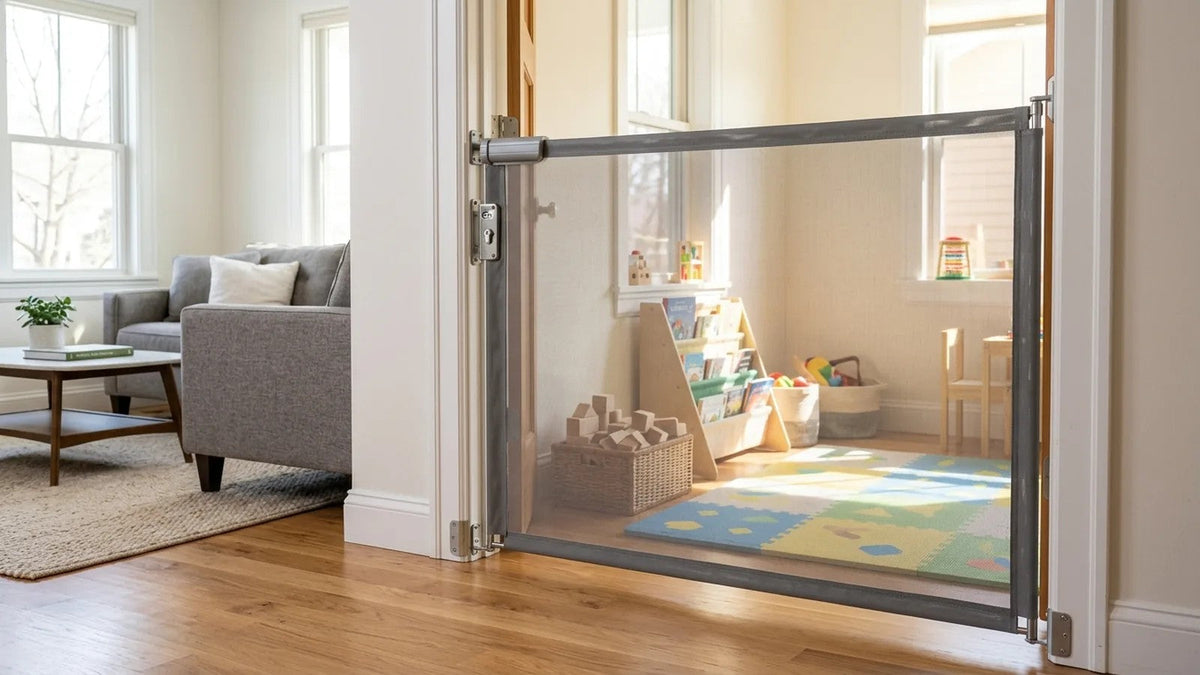
- a safety gate across the bedroom door, to keep a toddler from wandering when you are not awake
- a gate at the top of the stairs, to guard against injury when your toddler gets out of bed
- steps to keep dressers and other furniture from tipping over
- latches on chests of drawers, or taped-shut drawers, so they cannot be pulled out and used as steps
For hard furniture corners near the bed, Baby Proof Me Large TPE Safety Corner Protectors come 12 to a pack in Clear, White, Black or Oak. They are made of TPE with a larger and denser design, and attach with an adhesive backing: just peel and stick, no tools needed. They are made for tables, desks, coffee tables, countertops and shelves. They are not a toy, not a substitute for adult supervision, and not a fall-out fix. The product page says to stop using it immediately if it becomes faulty, so remove any guard that loosens. Never put one inside a crib. The AAP’s checklist says to keep the crib free of all small objects a baby could swallow.

Baby Proof Me | Large TPE Safety Corner Protectors (12 Pack)
4 options available
View ProductPortable Bed Rails for a Child Who Is 2 or Older
The CPSC defines a portable bed rail as a device intended to be installed on an adult bed to prevent children from falling out. It falls under the CPSC’s portable bed rail standard, 16 CFR part 1224, which incorporates ASTM F2085.
Toddler bed rail safety comes down to two checks: the child’s age and the fit. The CPSC’s 2012 announcement of the standard spells out why. Portable bed rails must not create a dangerous gap with the mattress into which a child can fall. The CPSC also says gaps in and around bed rails have entrapped young children and killed infants. So a rail is for a toddler who is already 2 or older, and its fit with the particular mattress is the test.
Picture this: a rail fits the mattress it was matched to in the instructions, and then the bed gets a different mattress. The CPSC warns about a dangerous gap with the mattress, so re-check the fit whenever the mattress changes.
Foam Bed Rails for Toddlers and Foam Bumpers
The CPSC’s portable bed rail guidance says foam or inflatable products differ from traditional rigid rails. It also says they "meet the definition of a portable bed rail and are included in the scope of the standard," even when their packaging does not use the words "bed rails."
So foam bed bumpers for toddlers on an adult bed follow the same CPSC rules as any rail:
- the child is 2 or older and can get in and out of bed unassisted
- there is no dangerous gap with the mattress
- the product’s own label and instructions are followed
You may also run into the AAP’s crib statement: "Do not use bumper pads in cribs. There is no evidence that they prevent injuries, and there is a possible risk of suffocation, strangulation, or entrapment." The AAP adds that "toddlers can use a bumper guard to help them climb and fall out." Those are the AAP’s words about cribs. They are not a verdict on a bumper used on a bed.
Toddler Bed Rails for Platform Bed Frames
The CPSC pages used here do not rank mesh, foam or rigid rails, and they give no platform-bed rule. What the CPSC does set applies to any portable rail:
- it must not create a dangerous gap with the mattress
- it is for children who can get in and out of bed unassisted, typically 2–5
- the warnings say never to use bed rails with children younger than two
Check the rail’s own label and instructions for the bed and mattress it is made for. Then re-check the fit with your child’s actual mattress. Do not improvise a barrier with pillows or by pushing furniture against the bed. A rail adds a layer and never replaces supervision.
Toddler Beds With Built-In Guardrails
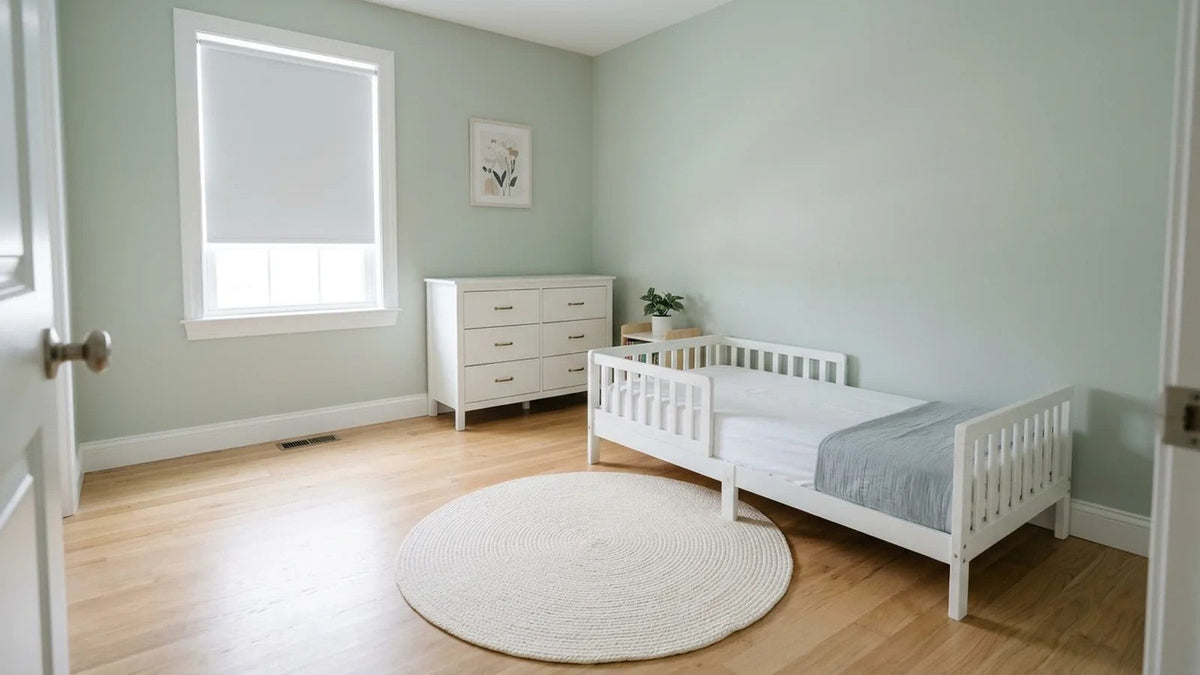
The other route is a bed made for this age. The CPSC’s toddler bed standard, 16 CFR part 1217 (which incorporates ASTM F1821), addresses guardrails. The CPSC’s toddler bed FAQ says entrapment of a child’s head or neck can result in asphyxiation. Start any toddler bed transition checklist with the CPSC’s age and weight range. A toddler bed is for a child at least 15 months old who weighs no more than 50 pounds.
The CPSC’s 2011 rule also notes that consumers may choose a twin or larger bed, and possibly portable bed rails, rather than a separate toddler bed.
One mistake to avoid: do not move a crib mattress onto a twin frame. The CPSC’s May 2026 toddler bed rule, which updated the standard to ASTM F1821-26, explains the problem with an example. A twin bed frame is large enough to accept a full-size crib mattress but is not intended to, because it would leave large gaps between the mattress and the bed frame.
Check any rail or bed against your child’s age, weight and actual mattress, and follow its label and instructions, before you rely on it.
If a Fall Happens
The AAP says: "If you’re not sure what’s wrong, but you believe your child is in danger, call 911." Otherwise, call your pediatrician. The AAP’s HealthyChildren.org page "When Your Child Needs Emergency Medical Services" is the place to read more.