Are Baby Proofing Products FSA or HSA Eligible?
What IRS Publication 502 and your plan’s rules say about FSA and HSA money for baby gates and other baby-proofing items, and what to ask before you buy.

Is baby proofing FSA eligible? There is no general yes. Whether an FSA or HSA pays for a baby gate or any other baby-proofing item depends on the IRS definition of medical care. For an FSA, it also depends on what your plan specifies.
Baby Proofing FSA Eligible: The Short Answer
IRS Publication 502 defines medical expenses as "the costs of diagnosis, cure, mitigation, treatment, or prevention of disease and for the purpose of affecting any part or function of the body." It adds that medical care expenses "must be primarily to alleviate or prevent a physical or mental disability or illness." They do not include expenses "merely beneficial to general health."
That definition is the test. A product being useful around a baby does not satisfy it on its own.
IRS Publication 502 also says it "covers many common medical expenses but not every possible medical expense." So Publication 502 does not list every piece of baby gear. Your answer depends on the definition, your plan’s wording and, for an HSA, your own records.
Is a Baby Gate FSA Eligible?
The question "is baby gate FSA eligible" invites a one-word answer. IRS Publication 502 (2025) does not name baby gates or baby-proofing, so a yes or no from this page would be a guess.
The closest rule to everyday household items is the Personal Use Items rule. Under IRS Publication 502, you cannot include "the cost of an item ordinarily used for personal, living, or family purposes unless it is used primarily to prevent or alleviate a physical or mental disability or illness." The IRS example is a toothbrush and toothpaste.
Who decides depends on the account. For an FSA, IRS Publication 969 says qualified expenses are "those specified in the plan." The plan decides. For an HSA, the IRS medical-care definition applies, and IRS Publication 969 says you "must keep records sufficient to show" that distributions were "exclusively to pay or reimburse qualified medical expenses."
Picture this: you are at a store checkout with a gate, a pack of outlet covers and a shelf tag that says "FSA/HSA eligible." That tag is the store’s label. It is not your plan’s list, and it does not replace the IRS definition.


What the IRS Counts and Does Not Count Around a Baby
Start with what does not count. IRS Publication 502 says you cannot include amounts paid for the care of children, under the heading "Baby Sitting, Childcare, and Nursing Services for a Normal, Healthy Baby." It also says you cannot include diapers or diaper service "unless they are needed to relieve the effects of a particular disease."
Read together with the definition, these entries show that a cost being for a baby does not make it medical care. The diaper entry turns on a medical need. Parents sorting out which purchases a new baby requires may find it useful to think through newborn essentials on a budget separately from what any account reimburses.
Now the home items the IRS does count. IRS Publication 502 lets you include "special equipment installed in a home or for improvements if their main purpose is medical care for you, your spouse, or your dependent." Its list of improvements made "to accommodate a home to your disabled condition" includes modifying hardware on doors and moving or modifying electrical outlets and fixtures.
Those entries are the IRS’s wording about disability-related home changes. They do not describe ordinary baby-proofing. IRS Publication 502 also says "only reasonable costs to accommodate a home to your disabled condition are considered medical care," and costs "for personal motives" are not.
A second example involves a child. IRS Publication 502 lets you include the cost of removing lead-based paint from surfaces in your home "to prevent a child who has or had lead poisoning from eating the paint." The surfaces must be in poor repair (peeling or cracking) or within the child’s reach.
The pattern is the same in both examples. The IRS ties the home item to a person’s condition, not to a general wish for a safer house.
FSA Versus HSA in Plain Terms
Are baby proofing products FSA eligible? That depends on which account you mean, because the two accounts follow different rules.
FSA and HSA at a glance
| Feature | FSA | HSA |
|---|---|---|
| Governing rule | Plan specifies expenses | IRS medical-care definition |
| Paperwork | Independent third-party statement | You keep your records |
| First step | Ask plan administrator | Check IRS definition |
FSA. IRS Publication 969 says "qualified medical expenses are those specified in the plan that would generally qualify for the medical and dental expenses deduction." The plan’s own list decides, so two plans can differ. Reimbursement needs documentation. You must give the health FSA "a written statement from an independent third party stating that the medical expense has been incurred and the amount of the expense." You must also state that the expense has not been paid or reimbursed under any other health plan coverage.
HSA. IRS Publication 969 says you "can receive tax-free distributions from your HSA to pay or be reimbursed for qualified medical expenses you incur after you establish the HSA." It defines the term as amounts paid for "medical care" (as defined in Code section 213(d)) for you, your spouse and your dependent, to the extent not compensated by insurance or otherwise.
IRS Publication 969 is blunt about the other side. If you take distributions "for other reasons, the amount you withdraw will be subject to income tax and may be subject to an additional 20% tax."
In short, an FSA asks what your plan specifies. An HSA asks whether the expense is medical care under the IRS definition, and you hold the records.
Is Baby Proofing Tax Deductible?
This is a separate question from FSA and HSA use. IRS Topic No. 502 says that if you itemize deductions on Schedule A (Form 1040), you "may be able to deduct" medical and dental expenses to the extent they exceed 7.5% of your adjusted gross income (AGI). It says the deduction "applies only to expenses not compensated by insurance or otherwise."
IRS Publication 502 says that "generally" you can deduct on Schedule A only the amount that is more than 7.5% of your AGI. So the deduction applies only if you itemize, and only to medical expenses above that floor.
An item that is not medical care under the definition above does not count toward the deduction. Whether baby proofing is tax deductible for your household depends on that definition and on your own return, so a tax professional is the right person to ask.
Cost still matters whatever the tax answer. Baby-proofing on a budget is its own topic, and it does not depend on any account.
Letters of Medical Necessity and Plan Documentation
You may have seen mentions of letters of medical necessity. Neither IRS Publication 502 nor IRS Publication 969 mentions them.
What the IRS texts do say is narrower. The medical-care definition governs. For an FSA, the expenses are those "specified in the plan," and reimbursement needs "a written statement from an independent third party."
So the person to ask is your plan administrator, before you buy anything. Ask what documentation, if any, the plan accepts for the specific item you have in mind.
What to Ask Before You Buy
A few checks keep you from guessing.
- FSA: Read the plan’s covered-expense list, or ask the administrator about the specific item. Expect to supply the third-party statement IRS Publication 969 describes.
- HSA: Remember that you keep the records showing a distribution paid a qualified medical expense. An HSA distribution not used for qualified medical expenses is subject to income tax and may be subject to an additional 20% tax (IRS Publication 969).
- Your own return: A tax professional can answer questions about your situation.
Do not assume a store’s FSA/HSA label, a blog post or a social-media list settles it for your plan.
Picture this: you open your plan’s portal on a quiet evening with a cart of items. Instead of guessing, you send one message to the administrator listing each item and asking what, if anything, the plan needs. You get an answer in writing before you spend anything.
It also helps to know what you need before you ask. Walking through a room-by-room baby-proofing checklist first gives you a short, specific list to put in front of the administrator.
Safety Items That Matter Whatever You Pay With
Safety does not wait on eligibility. The AAP’s home-safety list names common baby-proofing items.
- Outlets: The AAP recommends "non-choking hazard safety plugs" in all unused electrical outlets.
- Cabinets: The AAP recommends safety locks on all cabinets containing cleaning fluids or other dangerous items.
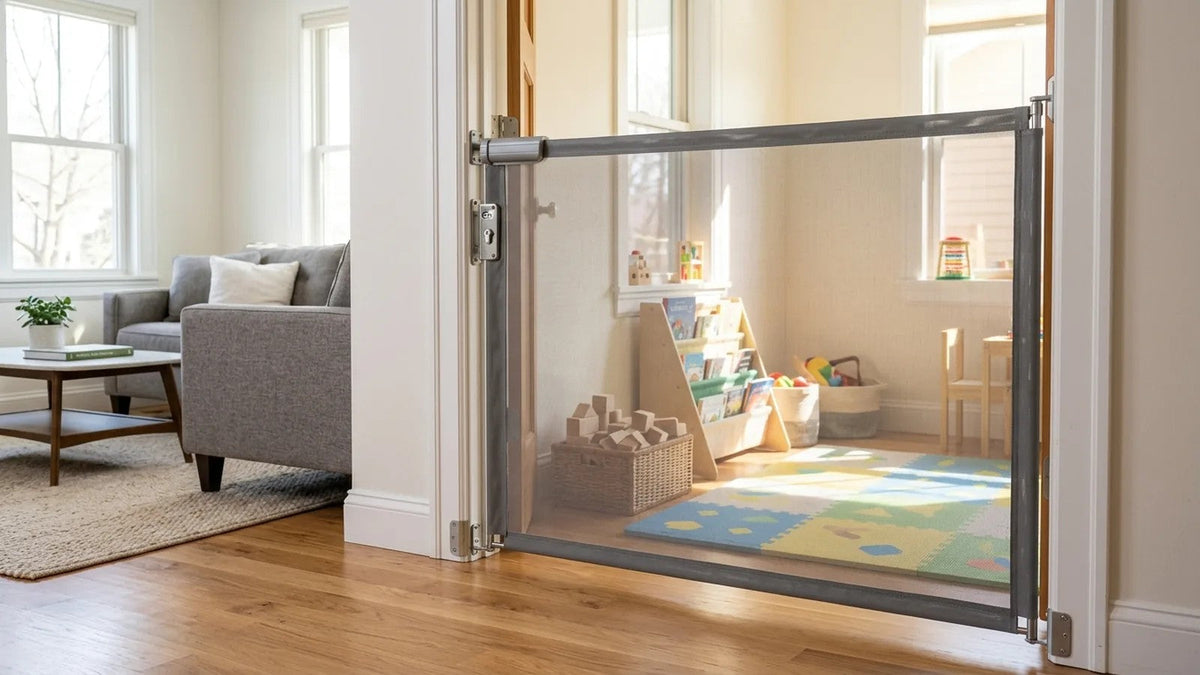
- Stairs: The AAP recommends safety gates at both top and bottom of stairs when your child is learning to crawl and walk. It says to avoid accordion-style gates and use gates firmly mounted to the home’s studs.
- Furniture: The AAP says you can buy cushioned corner and edge protectors that stick onto furniture.
These items add a layer of protection. They do not replace supervision, and no product makes a home risk-free. If you are building a registry, a safety-first baby registry checklist puts these items next to the bigger gear so they are not an afterthought.
Whatever your plan decides, the AAP list is a sound place to start. Pick the hazards in your home that match your child’s stage, and check each item’s installation instructions.
Shop the Kits
Baby Proof Me kits bundle several of the items above. Baby Bunch has 12 corner protectors, 6 safety strap locks and 12 magnetic cabinet locks. Zap Saver has 24 outlet plug covers, 12 magnetic cabinet locks and 6 safety strap locks. Bump Defender has 12 corner protectors, 6 safety strap locks and 24 outlet covers. Full House has 24 outlet plug covers, 12 corner protectors and 12 magnetic cabinet locks.