Door Slam Stopper for Baby: Finger Pinch Guards That Actually Work

Nearly 1.4 million pediatric door-injury emergency department visits were recorded over a single decade in the U.S. (NEISS, 1999–2008). In my experience, this statistic hit home because my older daughter, at 22 months, got two fingers caught in the hinge side of our bathroom door while I was standing three feet away. Nothing was broken, but the scream is not something I’ve forgotten.
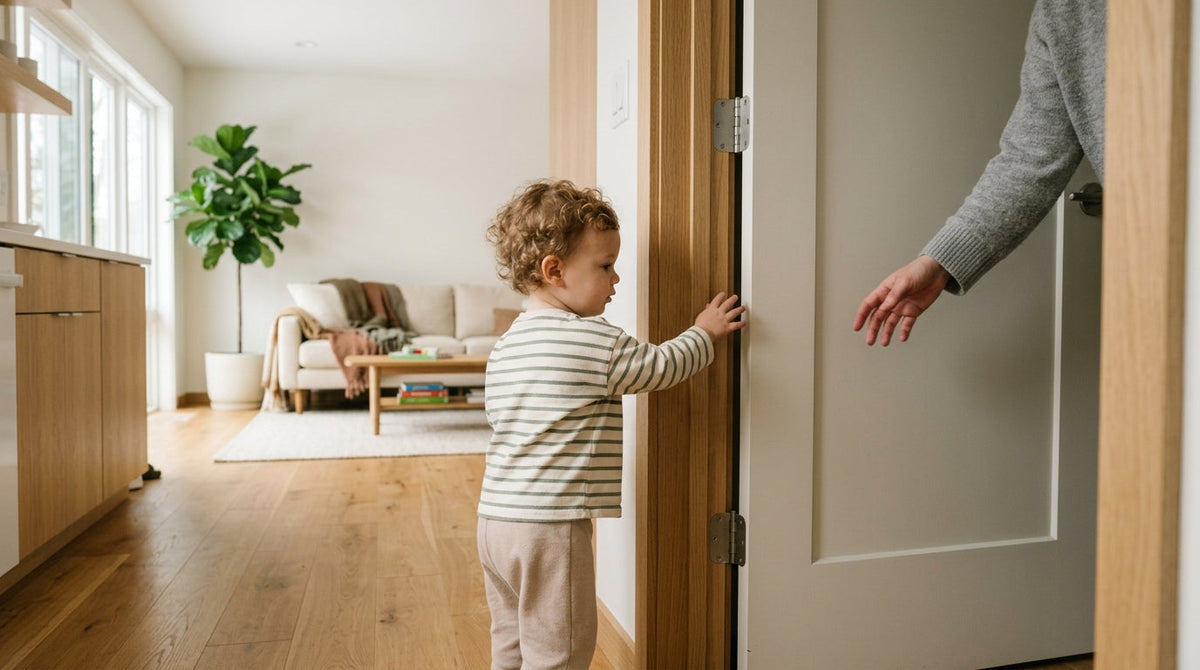
The injuries aren’t random. Pinching, not impact, is the leading mechanism of pediatric door-related ED visits, accounting for 54.8% of cases (NEISS, 1999–2008). And roughly 4 in 10 of those visits involve children age 4 or younger. These are toddlers who are fascinated by the way doors swing, who don’t yet have the coordination to pull their hands back in time, and who are exactly the right height for the hinge gap to be at eye level.
The good news: the hardware to address this is inexpensive, widely available, and effective when you choose the right type for each door. Here’s how to do that.
Why the Hinge Side Is the Real Danger
Most parents instinctively protect the latch edge of a door, where the door meets the frame and a slam could crush fingers. That’s a real risk. But the hinge side is where the more serious injuries happen. As a door closes, the gap between the hinge edge and the door frame decreases to almost nothing, and a small hand caught in that gap has nowhere to go.
When a door injury is bad enough to require hospitalization, amputation is the single most common diagnosis, accounting for roughly 1 in 3 hospitalized pediatric door-injury cases. These are typically fingertip amputations. Doors cause nearly 60% of all pediatric finger amputations in children under 10 (NEISS, 2010–2019). That context matters when you’re deciding whether to skip the hinge guard because installation looks fiddly.
Guards sold as "door slam stoppers" that only cover the latch edge, or that mount at the top of the door, provide incomplete protection for children under three who can’t reach that height. Cover the hinge side first.
Wedge-Style Stoppers: Simple, Portable, Imperfect
Foam or rubber door wedges are the most common first purchase, and they work well in the right context. Placed under the door, they prevent the door from closing at all, which eliminates the slam and the pinch simultaneously. No installation required.
The limitations are real, though. A wedge only works if someone places it before a child is near the door. Leave it on the floor and it becomes a tripping hazard, particularly in hallways and bathrooms where adults move quickly at night. Lightweight plastic wedges also migrate. In my experience, my younger daughter, at around 18 months, figured out that kicking the wedge was satisfying and did it repeatedly until the door was free to swing. Rubberized wedges with a low profile and high-friction base hold position far better than thin plastic ones.
Use wedges on doors that don’t need to close fully: playroom doors, kitchen doors, interior office doors. Don’t rely on them for bathrooms or exterior doors where a seal matters.


Hinge-Side Foam Guards: The Permanent Fix
Foam hinge guards are long strips that attach to the hinge side of a door frame and fill the gap as the door closes. They compress on contact, preventing a finger from being trapped. Because they’re mounted directly to the frame or door, they stay in place regardless of what a toddler does to the door itself.
These are the product type I recommend most consistently for children in the one-to-three age range. Installation takes about ten minutes with adhesive backing or small screws, depending on the product. The adhesive versions work on most painted wood frames; if your frames are textured or have been painted many times, test a corner first before committing the full strip.
A few things to verify before buying:
- Material: The foam should be non-toxic and flame-resistant. Check the product specifications. If the listing doesn’t mention material composition, contact the manufacturer or skip it.
- Attachment security: Foam that can be peeled off becomes a choking hazard. Press firmly along the full length after installation, and check weekly for the first month. The first inch or two near the hinge hardware tends to lift first.
- Coverage length: The guard should run the full height of the door gap, from top hinge to bottom. Short guards leave the lower portion of the gap exposed, which is exactly where a toddler’s fingers will be.
Inspect these monthly. Foam compresses over time, especially on high-use doors, and a flattened guard offers less protection than a fresh one.
| Product Type | Best For | Latches? | Installation | Approx. Cost |
|---|---|---|---|---|
| Rubber Wedge | Playroom, kitchen doors | No | None | Under $10 |
| Hinge-Side Foam Strip | Bathroom, laundry doors | Yes | Adhesive or screws | $10–$20 |
| Wrap-Around Guard | Child’s bedroom door | No | Adhesive | $15–$25 |
| Soft-Close Hinges | Any interior door | Yes | Hinge swap | $15–$40 each |
| Door Closer | Exterior, heavy doors | Yes | Mounted arm | $30–$80 |
Wrap-Around Door Frame Guards
A step up from foam strips, wrap-around guards cover both the hinge side and the latch edge of a door in a single U-shaped piece of foam or rubber. They’re particularly useful on bedroom doors where children might push or pull from either side.
The trade-off is that wrap-around guards prevent the door from latching fully. For a child’s bedroom door, that’s usually fine. For a bathroom or any door where you need a complete seal, it’s a problem. Know which doors need to latch before you buy.
Soft-Close Hinges and Door Closers
If you’re willing to invest more time and money upfront, replacing standard hinges with soft-close hinges is the most seamless solution available. These hinges use a hydraulic mechanism to slow the door’s movement in the final 15–20° of travel, preventing a slam entirely. The door still closes and latches. It just does so slowly enough that a child has time to move.
Soft-close hinges typically run $15–40 per hinge, and most interior doors have two or three hinges. Installation requires removing the existing hinges and fitting the new hardware, which is straightforward if you’re comfortable with basic tools. If the existing screw holes are stripped, you’ll need to fill and redrill, which adds time.
Door closers with adjustable speed settings are an alternative for heavier doors or exterior doors. These mount at the top of the door and use a pneumatic or hydraulic arm to control closing speed. They’re more visible than hinge replacements and require more precise adjustment, but they’re effective and durable.
Neither option requires foam inspection or repositioning. Once installed, they work passively on every door cycle. For families who find themselves forgetting to replace wedges or who have children that pull foam guards off frames, this is worth the higher upfront cost.
Checking for Safety Standards
The finger guard market is not uniformly regulated. When reviewing products, keep in mind that no ASTM or federal safety standard is written for door finger guards (ASTM F1004 covers baby gates and enclosures, not door guards), so a listing that cites one is not telling you much. Look instead for documented third-party testing of the materials and the attachment.
For products that don’t reference any standard, check whether the manufacturer provides independent testing documentation. If a listing offers no safety certification information and the manufacturer doesn’t respond to a direct inquiry, move on. There are enough tested options available that you don’t need to guess.
Door Guard Installation Checklist
Matching the Product to the Door
After installing guards on every door in two houses, here’s the framework I use:
Doors that don’t need to close fully (playroom, kitchen, home office): rubber wedge or doorstop. Simple, cheap, effective.
Interior doors that need to close but not latch (child’s bedroom, hallway): wrap-around foam frame guard. Covers both pinch points, easy installation.
Interior doors that must latch (bathroom, laundry room): hinge-side foam strip on the frame, plus a soft-close hinge if budget allows. The foam strip handles the hinge gap; the soft-close hinge eliminates the slam at the latch edge.
Exterior doors: soft-close door closer with adjustable speed. These doors are heavier and see more use, so passive hardware outperforms any foam product over time.
Supervision and Behavioral Strategies
Hardware helps. It doesn’t replace watching your child. Children ages one to three are in a developmental phase where opening and closing doors is endlessly interesting, and no guard prevents every scenario. My younger daughter went through a period at 20 months of standing at the bathroom door and swinging it back and forth while I was nearby, which the foam guard handled fine, but which also told me she needed more active redirection.
Teach children, starting around age two and a half, that doors are not toys. Keep doors to hazardous areas, including bathrooms, garages, and utility rooms, locked or latched above reach. Supervise play in rooms with multiple doors, where a child can get between a door and a wall without you seeing it happen.
As children grow, reassess. A guard that stopped a two-year-old from accessing a door gap may not slow down a four-year-old who’s learned to push harder. The goal at older ages shifts from hardware to habits: children who understand why doors are dangerous are safer than children who’ve only ever encountered barriers.
A Note on Regular Inspection
Set a monthly reminder to check every installed guard. Look for foam compression, adhesive separation, and any pieces that have started to peel. Check that wedges are still positioned correctly on the doors where you use them. If a hinge-side strip has lifted at one end, press it back and add a small screw if the adhesive is no longer holding.
Door guards are not a set-and-forget solution. They’re a layer of protection that requires maintenance to stay effective. The time investment is small. The alternative is a trip to the emergency department that a few minutes of inspection could have prevented.