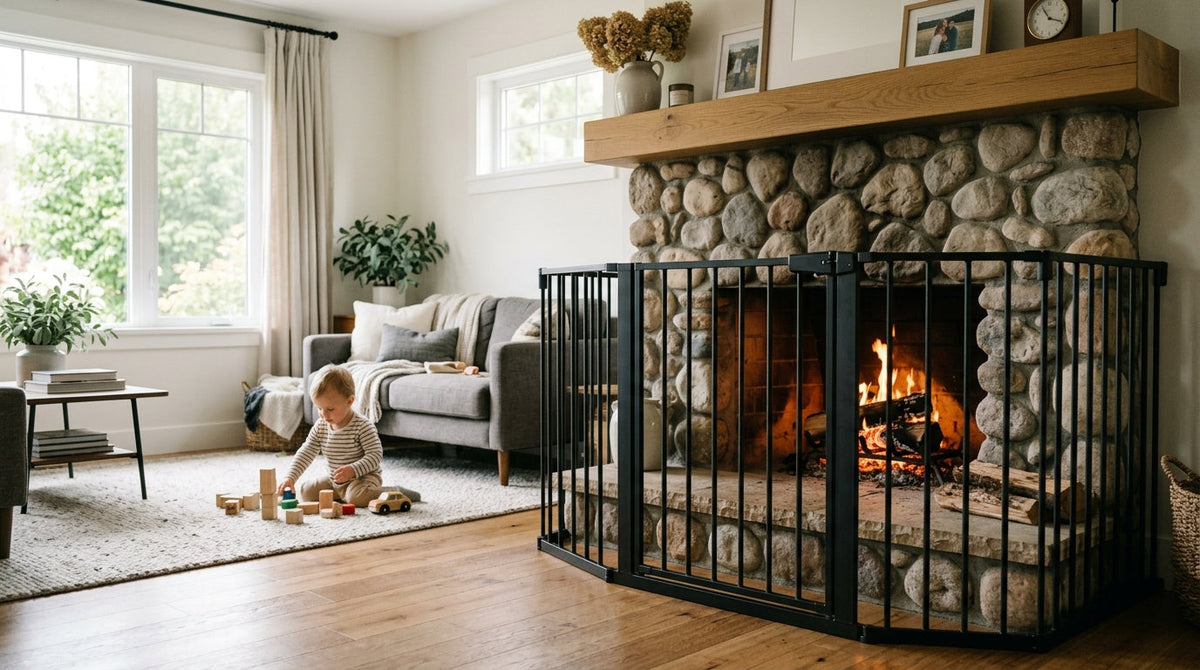
Expert Roundup: 15 Child Safety Experts Share Their Top Baby Proofing Tips

Every parent has a version of the same story. You turned around for thirty seconds. Maybe you answered the phone, or grabbed a dish towel, or just walked to the other room. And in that thirty seconds, something happened. A cabinet opened. A bookshelf wobbled. A small hand found something it shouldn’t have.
This roundup compresses what fifteen child safety experts shared into actionable guidance. Some of it you’ve heard before. Some of it may surprise you.
Falls Are the First Thing to Fix
Falls are the leading cause of nonfatal injury in young children, and the home is where most of them happen. Stairs are the obvious culprit. About 93,000 children under 5 are treated in U.S. emergency rooms each year for stair-related injuries, according to a Nationwide Children’s Hospital analysis of CPSC NEISS data. That works out to roughly one child every six minutes.
Every expert consulted recommended the same priority: gate the stairs before you do anything else. Not a pressure-mounted gate at the top of the stairs. A hardware-mounted gate, screwed into wall studs, that won’t give way if a toddler leans on it hard. ASTM F1004 is the federal safety standard for expansion gates and expandable enclosures, made mandatory under 16 CFR Part 1239 effective 2021. Look for that compliance mark on any gate you buy.
Windows are the second fall hazard most parents underestimate. About 3,300 children age 5 and younger are treated in U.S. emergency rooms each year for window fall injuries, per CPSC data. Windows in homes with young children should not open more than 4 inches, per CPSC and AAP guidance. Window guards and stops that limit the opening are inexpensive and install in minutes.
Furniture Tip-Overs Kill, and Anchoring Prevents Them
CPSC received reports of 155 child deaths from furniture, TV, or appliance tip-overs between 2013 and mid-2023.
The physics are straightforward. A toddler pulls open a dresser drawer and uses it as a step. The center of gravity shifts. The dresser comes forward. It weighs 80 or 150 or 200 pounds. A two-year-old does not survive that.
Every tall piece in your home needs a wall anchor: dressers, bookshelves, wardrobes, televisions on stands. Anti-tip straps are inexpensive and most come with hardware. The bracket needs to go into a wall stud, not just drywall. If you’re not sure where your studs are, use a stud finder before you start.
Experts specifically flagged children’s rooms and play areas as the highest-priority zones, because that’s where kids spend unsupervised time. Anchor the furniture in those rooms first.
Safe Sleep Is a Short List of Things to Remove
About 3,500 infants die each year from sleep-related causes in the United States, per CDC SUID data. Unintentional suffocation kills roughly 1,000 infants under age 1 each year in the United States, per CDC. These numbers have come down over the decades, but they haven’t reached zero, and most of the remaining deaths are preventable.
The CPSC standard for crib safety is specific: a firm mattress, a fitted sheet, slats no more than 2 3/8 inches apart, and nothing else in the sleep space. No pillows. No bumpers. No positioners. No loose blankets. The AAP’s guidance is consistent with this: the sleep surface should be flat, firm, and bare.
The experts I spoke with added a few things worth noting. Mesh-sided play yards can be used for sleep, but only if the mattress pad that came with the unit is in place. After-market mattresses don’t always fit correctly, and a gap between the mattress and the side is an entrapment risk. And once a baby can push up on hands and knees, usually around 5 months, crib mobiles need to come down. That’s also the point at which a baby can begin to reach and grasp, which makes any hanging cord a strangulation hazard.
Poisoning Is More Common Than Most Parents Expect
According to the AAP, about 3 million people are exposed to a poisonous substance every year, and many are children under 5. In 2024, 99.2% of poison center cases involving children under 6 were accidental, per America’s Poison Centers. The risk isn’t malice or curiosity about danger. It’s that children explore with their mouths and have no concept of what "toxic" means.
The AAP recommends keeping all medications, cleaning supplies, and personal care products in their original containers, locked, and out of reach and sight. The "original container" part matters more than it sounds. Poisoning incidents spike when products are transferred into food or drink containers, because children (and sometimes adults) don’t recognize the danger.
Many of the products parents store in cabinets, from acetaminophen to furniture polish, are required by 16 CFR 1700.14 to ship in child-resistant packaging. But child-resistant does not mean child-proof. Under 16 CFR 1700.15, packaging passes the "child-resistant" bar if at least 85% of tested children (ages 42–51 months) can’t open it within 10 minutes, or 80% after an adult demonstrates how. That means roughly 15–20% of children in that age range can get in. Cabinet locks provide a second layer of protection.
ASTM F3492–21 is the voluntary consumer safety standard that applies to cabinet locks and latches in the U.S. When shopping for locks, look for products tested to this standard. Pay attention to installation surface. A CPSC recall pulled 900,000 Safety 1st Push 'N Snap cabinet locks in 2012 after 140 children defeated them, with three reaching toxic cleaning products. The failure was that adhesive mounting didn’t hold on certain cabinet surfaces. Screw-mounted locks are more reliable on most cabinet types.


Water Safety Requires Your Full Attention, Every Time
Drowning is the leading cause of unintentional injury death in children ages 1–4, per CDC data. A child can drown in as little as one to two inches of water, per the AAP. Those two facts together mean that bathtubs, buckets, wading pools, and toilets are all serious hazards for children who are mobile but not yet coordinated.
Every water safety expert I interviewed used the same phrase: "touch supervision." Not visual supervision from across the room. Not supervision while scrolling your phone. Your hand within reach of the child, every moment they are near water. If the doorbell rings during bath time, you take the child with you or you don’t answer.
For pools, four-sided fencing with a self-closing, self-latching gate is the standard recommendation. The latch should be on the pool side of the gate, out of a child’s reach. A pool alarm adds a layer, but it doesn’t replace the fence.
Drowning is silent. There is no splashing, no calling out. A child who is in distress in water typically cannot make noise or signal for help. This is why proximity matters more than any device.
Choking: Know the Difference Between a Weak Cough and a Strong One
The AAP’s 2010 policy statement on choking prevention notes that, on average, a U.S. child dies every 5 days from choking on food. The highest-risk group is children younger than 4. The foods that appear most often in choking incidents are grapes, hot dogs, hard candies, raw carrots, nuts, and large pieces of meat.
The rule on grapes and hot dogs is to cut them lengthwise, not in rounds. A round slice of hot dog is almost exactly the diameter of a toddler’s airway. Cut grapes lengthwise into quarters and hot dogs lengthwise into short, thin strips, with no piece larger than half an inch.
For toys, the CPSC small parts test cylinder, about 1.25 inches wide, is the standard reference. If a toy or toy component fits entirely inside that cylinder, it’s a choking hazard for children under 3. Check the age labels, but also check the actual toy. Small parts can detach from larger ones.
Every parent should know CPR. The distinction that matters in a choking situation is whether the cough is strong or weak. A child with a strong cough, meaning they’re crying, coughing forcefully, or getting air, should be allowed to keep coughing. Intervening can make things worse. A child with a weak or silent cough, who cannot cry or breathe effectively, needs help immediately: have someone call 911 while you give 5 back blows and 5 chest thrusts to a baby under 1, or 5 back blows and 5 abdominal thrusts to a child over 1, repeating until the object comes out. The Red Cross and American Heart Association both offer infant and child CPR courses.
Carbon Monoxide and Smoke Detectors Are Not Optional
CO poisoning kills more than 400 people each year and sends more than 100,000 to U.S. emergency rooms, per CDC data. Three out of five home fire deaths occur in homes with no smoke alarms or non-functioning ones, per NFPA. Both of these are preventable with hardware that costs less than $30.
Experts recommend installing detectors on every level of the home, including the basement, and inside every bedroom or just outside the bedroom door. Combination smoke and CO detectors simplify the setup and ensure you’re covered for both hazards. Test every detector monthly. Replace batteries twice a year, or immediately when the low-battery alarm sounds. Most manufacturers recommend replacing the entire unit every 7–10 years, because the sensors degrade over time even when the alarm still sounds during tests.
Carbon monoxide is colorless and odorless. Children are more vulnerable to it than adults because their respiratory rates are faster. A CO alarm is the only way to know it’s present.
Hot Water Scalds Happen Fast
Among children ages 4 and under hospitalized for burns, an estimated 65% are scald burns, according to figures reproduced in the ABA Scald Injury Prevention Educator’s Guide. Tap water scalds are a significant share of those. At 140°F (60°C), a scald can occur in 5 seconds. At 120°F (49°C), it takes several minutes, which is enough time for most people to react.
Set your water heater thermostat to 120°F (49°C) or lower. This is the single most effective step you can take against tap water scalds, and it costs nothing. Then test bath water with your elbow or a bath thermometer before placing a child in the tub. The elbow is more sensitive to heat than the palm of your hand and gives you a better read.
Anti-scald devices for faucets and showerheads are also available and worth considering if you have older plumbing where the water heater setting is hard to access or unreliable.
Cords, Strings, and Strangulation Hazards
Strangulation from window blind cords is underestimated because it’s not intuitive. A looped cord at the right height is a hazard for a child who is standing, cruising, or climbing. It requires only that a cord be accessible.
The fix is cordless window coverings. If you have corded blinds, cord wind-ups and cord cleats can reduce the accessible loop length, but replacement with cordless designs is the more reliable solution. Keep cribs, beds, and furniture away from windows with any corded covering.
Clothing drawstrings on hoods and necks are a separate hazard. The CPSC has issued guidance on drawstrings in children’s outerwear for years. For children’s clothing, hood and neck drawstrings should be absent entirely. Waist and bottom drawstrings should not extend more than 3 inches outside the garment when fully extended.
Crib mobiles should be removed by 5 months, when babies begin to push up and reach. Any cord or string within reach of a baby in a crib is a strangulation risk.
High-Priority Babyproofing Checklist
Electrical Safety Goes Beyond Outlet Covers
Outlet covers are the most visible piece of electrical safety, but experts flagged cord management as the more significant ongoing hazard. Cords are both a strangulation risk and an electrical one. A child who chews on a damaged cord, or pulls a plugged-in appliance into a bathtub, faces serious injury.
Tamper-resistant outlets, which are now required in new construction under the National Electrical Code, are more effective than plug-in covers because they can’t be removed and lost. If your home has older outlets, cover plates with spring-loaded shutters are the better retrofit option.
Keep appliances away from water sources. A hair dryer or phone charger near a sink or tub is a hazard even when it’s not in use, because a child can pull it in. Cord shorteners and cord management boxes keep excess cord length out of reach and reduce the temptation to pull.
Firearm Storage Is a Safety Issue, Not a Political One
Per CDC injury prevention guidance, access to firearms in the home increases the risk of injury and death in children and adolescents. The standard recommendation from every expert I spoke with is consistent: guns stored unloaded, in a locked container, with ammunition stored separately in a second locked container.
This applies whether you have a toddler or a teenager. Adolescents are at risk too, and the same secure storage that prevents a curious two-year-old from accessing a firearm also reduces access during a mental health crisis.
Biometric safes have come down in price significantly and open quickly enough that access in an emergency is not a meaningful argument against them. The lock is the point.
Secondhand Smoke Harms Developing Lungs
Secondhand smoke exposure increases respiratory infections, ear infections, and asthma in children. The developing respiratory system is more vulnerable than an adult’s, and the effects accumulate over time.
The standard recommendation is a smoke-free home, a smoke-free car, and smoke-free childcare. "Outside only" policies reduce but don’t eliminate exposure, because smoke residue on clothing and surfaces, sometimes called thirdhand smoke, still poses a risk to infants and young children who mouth surfaces and objects.
If you or someone in your household smokes and wants to reduce the child’s exposure, changing clothes and washing hands before contact with the child reduces the residue transfer. But a fully smoke-free environment is the goal.
Start With the Highest-Risk Rooms
If this list feels overwhelming, that’s reasonable. Start with the spaces where your child spends the most unsupervised time, and prioritize the hazards that cause the most severe injuries.
That means stairs and windows first. Furniture anchoring in bedrooms and play areas next. Then safe sleep, water supervision, and poison storage. Carbon monoxide and smoke detectors if you don’t have them already. Everything else follows.
You don’t have to do it all in a weekend. But you do have to start, and the highest-risk items don’t wait.