Are Crib Tents Safe? What Safety Agencies Say and What to Use Instead
What CPSC recalls and warnings and the AAP say about crib tents, canopies and covers, and what belongs in a crib instead.

Picture this: it’s 5 a.m., your toddler has started testing the crib rail, and you’re scrolling through listings for a crib tent. The product photos look reassuring. CPSC has been far less reassured for more than a decade.
CPSC has warned about crib and play yard tents since 2010, and the American Academy of Pediatrics (AAP) lists baby tents among sleep products that are safe only if they meet federal standards. Here is what each source says, with dates and scope, and what belongs in a crib instead.
What CPSC Has Said About Crib Tents
This page covers three CPSC statements about crib tents and baby tents. Each one has a different scope.
- July 15, 2010: CPSC safety blog on crib and play yard tents. The page is now archived as a historic resource and marked as containing outdated information.
- May 16, 2012: Recall of about 330,000 Tots in Mind crib tents and play yard tents.
- June 15, 2023: Warning to stop using CCATTO baby tents immediately.
In the 2010 blog, CPSC said that over time, and with children pulling on them, crib and play yard tents can wear. It said children have become tangled and trapped in damaged tents used to try to keep them in. CPSC reported that since late 2007 it had received at least 10 reports of incidents involving tents used on cribs and play yards, including one death and one near death.
The same archived blog gave advice for parents already using a tent. It said to use only the attachment equipment that comes with the tent and not to tie a tent in place. It also said a tent that is torn, ripped, missing pieces or in any disrepair is dangerous for a child.
The 2012 recall was specific to Tots in Mind products. CPSC said those tents can present an entrapment and strangulation hazard to infants and toddlers because the dome can invert or the tent can partly detach. It said it was aware of 27 tent failures between January 1997 and April 2012, including one fatality and one serious injury.
CPSC staff urged parents and caregivers to stop using the recalled tents immediately. The recall notice added: "Do not attempt to repair these products."
That recall does not describe every tent on the market.
The 2023 CCATTO Warning on Baby Tents
The 2023 warning is a different kind of statement about a different kind of product. On June 15, 2023, CPSC told consumers to stop using CCATTO baby tents immediately. CPSC said the tents were advertised as a "Portable Baby Tent" and a "Baby Camping Bed with Mosquito Net," not as something fitted over a crib. The reason was not a single broken part. CPSC said the tents fail to meet the safety requirements of its Infant Sleep Products Rule, and that this creates an unsafe sleeping environment with a fall hazard and a risk of suffocation to infants.
CPSC gave specifics. The tents are not supported by free-standing legs, they lack the required markings, labeling and instructional literature, and they include an infant pillow that CPSC has banned. CPSC noted the tents were sold online, including on Amazon.
CPSC urged consumers to stop using those tents, cut the fabric, and dispose of the fabric and the pillow. That instruction applies only to the CCATTO tents named in the warning.
Crib Tent Safety: What the AAP Says About Baby Tents
The AAP’s safe sleep guide on HealthyChildren.org takes a product-category approach. It lists "baby tents" among alternative sleep surfaces, alongside inclined sleep products, hammocks, baby boxes, in-bed sleepers, baby nests and pods, and compact and travel bassinets.
The AAP says these products are only considered a safe option if they comply with the June 2021 CPSC rule requiring all infant sleep products to meet existing federal safety standards. Those standards cover cribs, bassinets, portable cribs and play yards. The AAP’s bottom line is plain: if a product doesn’t meet federal safety standards, don’t use it.
The AAP lists baby tents as a sleep surface; its guide does not mention tents fitted over a crib. If you’re searching for sleep tent over crib safety information, the closest test the AAP gives is the same question: does the product meet the federal safety standards for infant sleep products? A product page that cannot answer that leaves the question open.
The AAP’s guidance names the product category and sets the compliance requirement. It does not say a tent is safe because it is sold by a large retailer or because the listing calls it a "safety" product.
Do Crib Tents Work for Climbing Toddlers?
Using a crib tent to prevent climbing out is the use CPSC’s 2010 blog describes: tents "used to try to keep them in."
So do crib tents really work? The same blog describes what can happen when they are used this way: with children pulling on them, tents can wear, and children have become tangled and trapped in damaged ones.
Age-based next steps for a climbing toddler live on a separate page about toddlers climbing out of the crib.
Are Crib Canopies and Crib Covers Safe?
This is a fair question, because canopies and covers look similar to tents and sit over the same crib. Neither the AAP safe sleep guide nor the CPSC crib page used here names canopies or crib covers.
What the sources do give is a set of checks that apply to anything added to a crib:
- Does it meet the federal safety standards for infant sleep products? This is the AAP’s test for products in the alternative-surface category.
- Does it add anything beyond a fitted sheet? The AAP says "nothing else should be in the crib with your baby." CPSC’s crib page says "Bare is Best."
There is also a third pointer in the AAP’s keep-out list, which names "bumper pads or related products that attach to crib slats or sides." The Safe Sleep for Babies Act bans padded crib bumpers. If you are also worried about babies bumping their head on the crib, that concern has its own page of practical tips.
If you apply those checks to a specific product and the answer is unclear, treat it as unconfirmed rather than assuming it is fine. CPSC’s 2023 warning shows what missing markings and instructions can signal.
What to Use Instead: A Fitted Sheet and Nothing Else
The AAP’s advice for the crib is short: use a fitted sheet only, and "nothing else should be in the crib with your baby." The AAP says soft objects and loose bedding can increase a baby’s risk of entrapment, suffocation or strangulation. Its list includes:
- Pillows and pillow-like toys
- Quilts and comforters
- Mattress toppers
- Non-fitted sheets
- Blankets and toys
- Bumper pads and related products that attach to crib slats or sides
CPSC’s crib page says the same thing in three words, "Bare is Best," meaning nothing but a fitted sheet in a crib, bassinet or play yard. CPSC notes that many young babies cannot lift their heads to pull away from soft objects that can pose a suffocation risk.
The CDC’s safe sleep advice covers the surface itself. It recommends a firm, flat sleep surface, not at an angle or inclined, for example a mattress in a safety-approved crib covered by a fitted sheet. It also advises putting the baby on their back for all sleep times, naps and at night, and keeping soft bedding out of the sleep area. The AAP adds that a firm surface shouldn’t indent when the baby is lying on it.
Since 2022, crib mattresses have had to meet a federal CPSC safety standard that includes a test for mattress firmness. The CDC reports that accidental suffocation and strangulation in bed accounted for 28% of sudden unexpected infant deaths in 2024, with SIDS at 40% and unknown causes at 32%.
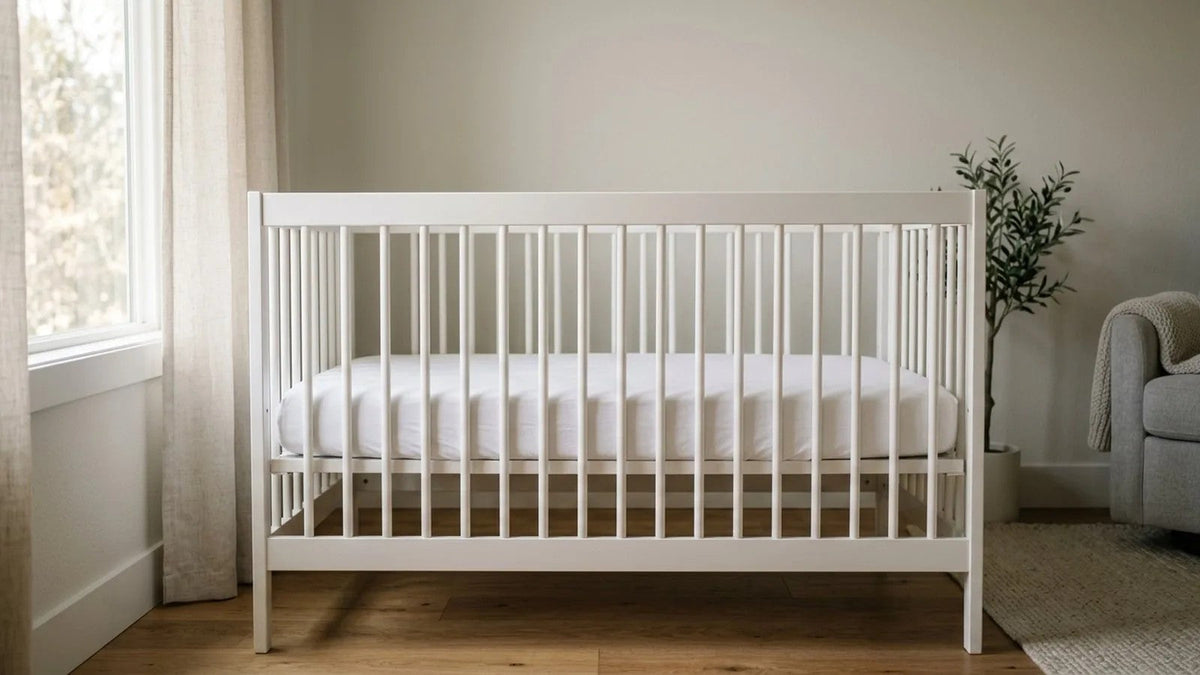
Picture a baby’s crib the way these sources describe it: a firm mattress, a fitted sheet, and an otherwise bare space. For the wider room, a safe nursery setup extends the same logic to the furniture and cords around the crib.
Checking Your Crib for Recalls and Reporting Problems
The AAP says to check the CPSC website to make sure your crib hasn’t been recalled. Do the same for any other sleep product in your home. If a recall notice applies, follow the instructions in that notice.


Two quick checks help when you’re evaluating any sleep product:
- Labels and instructions. CPSC’s 2023 warning named missing markings, labeling and instructional literature as failures. CPSC’s Infant Sleep Products Rule requires them.
- Whether it was built to the rules. If you are weighing a hand-me-down crib or a second-hand sleep product, the crib placement and mattress guidelines and the current crib safety standards describe what to look for.
If a product injures a child or fails in use, CPSC asks consumers to report it at SaferProducts.gov. Call 911 in an emergency. Call your pediatrician with questions about your baby’s sleep or development.
A tent, canopy or cover adds something to the crib, and the sources give you two questions to ask before it goes in: does it meet the federal safety standards, and is it more than a fitted sheet? For the full list of safe sleep rules, read our guide to the AAP safe sleep guidelines, or the AAP’s own guide on HealthyChildren.org.