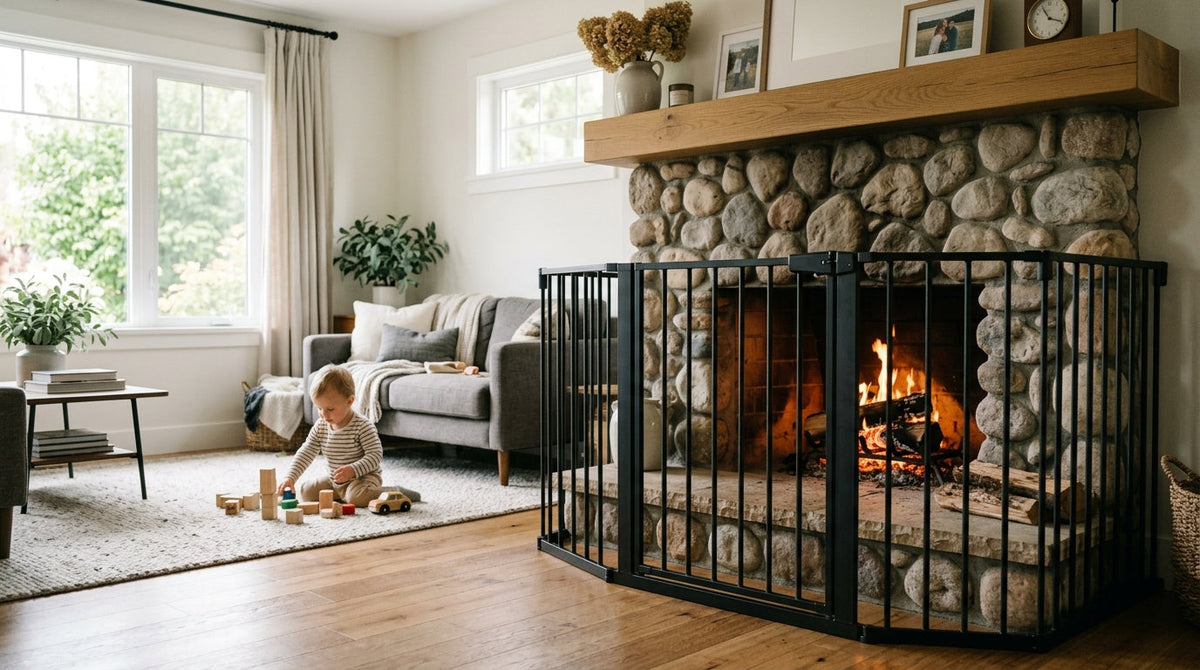
How to Baby Proof a Fireplace Insert vs. Open Hearth

Every fireplace in a home with young children is a burn hazard. The question is which kind of burn hazard you’re dealing with, because an open hearth and a fireplace insert fail in different ways, and they need different fixes.
I learned this the hard way when we moved into our current house. It came with a gas insert, and I assumed the glass door made it safer than the open wood-burning fireplace I’d grown up with. Then I watched my younger daughter, 14 months old, pull herself upright on the hearth ledge and press both palms flat against the glass. The unit had been off for 40 minutes. The glass was still hot enough to redden her skin in seconds.
The Core Difference in Risk
Open hearths and fireplace inserts are not the same problem wearing different clothes. They share some hazards and diverge sharply on others.
An open hearth exposes children to active flames, glowing embers, and radiant heat from an accessible firebox. Traditional spark screens and decorative fire guards look protective, but they are not. Most are freestanding, not anchored, and a determined toddler can push one aside or pull it over. The hazard zone also extends outward: embers and ash can scatter onto the hearth floor and the surrounding area, creating a contamination zone that children may contact or inhale long after the fire is out.
A fireplace insert contains the fire behind a sealed glass door, which reduces access to active flames. But that containment creates its own problem. Glass-front gas fireplace surfaces can reach 500°F minimum and up to 1,328°F, causing third-degree burns in seconds (AAP). The glass looks inert. It does not glow red. It does not flicker. To a toddler, it looks like any other surface worth touching. Unlike an open hearth, where the heat source is visually obvious, insert glass gives no intuitive warning.
Inserts also contain debris inside the unit, which is a real advantage. You are not managing scattered ash and embers on the hearth floor. But the tradeoff is a concentrated, invisible heat source that stays dangerous for a long time after the fire is extinguished.
Why a Gate Is Non-Negotiable for Both
CPSC guidance is clear: any fireplace accessible to crawling or walking children needs a safety gate positioned at least 3 feet from the hearth opening. That distance applies whether you have an insert or an open hearth, and it exists for a specific reason. A child can receive a burn from radiant heat before they ever make contact with the surface. Three feet creates a buffer that accounts for both radiant exposure and the time it takes a toddler to close the distance between standing and touching.
The gate itself matters as much as the placement. ASTM F1004 is the federal safety standard for expansion gates and expandable enclosures, made mandatory under 16 CFR Part 1239 (effective 2021). For fireplace use specifically, hardware-mounted gates are the only acceptable option. Pressure-mounted gates rely on friction against the wall. A child leaning, climbing, or pushing against one can dislodge it. Hardware mounting means screws into wall studs or the hearth structure itself. It is not optional, and it is not interchangeable with a pressure gate from the nursery doorway.
When I installed our hearth gate, I used a freestanding model rated for fireplace use that anchored to the wall on both sides. It took about 45 minutes and required a stud finder. Every minute of that was worth it.


Protecting Against Insert Glass
For fireplace inserts, a perimeter gate addresses the approach problem but not the contact problem. Children can reach through some gate designs, and even with a solid gate, the glass remains dangerous if the gate is ever opened or bypassed.
ANSI Z21.50–2014/CSA 2.22–2014 took effect January 1, 2015, requiring a protective barrier on new gas fireplaces whose glass can exceed 172°F. If your insert was manufactured after that date, it should have come with a mesh or metal barrier designed to mount directly in front of the glass. If you have an older unit, you can purchase aftermarket barriers. Check that any barrier you install does not itself become a contact burn hazard; some metal screens conduct heat readily.
Child locks on the door handle add another layer. They prevent a curious toddler from opening the glass door while the unit is hot or cooling down. They are not a substitute for a perimeter gate, but they close a specific gap: the scenario where a child bypasses the gate and reaches the door handle.
Before each heating season, check the glass door seal. A damaged or deteriorating seal allows heat to escape unpredictably and increases the risk if the door is accidentally opened. This is also the time to verify the unit is UL-listed and that nothing has shifted in the firebox or venting since last use.
Open Hearth: The Combination Approach
Open hearths require layered protection because the hazard is more diffuse. No single measure covers all of it.
Start with the hardware-mounted gate at 3 feet. Then address the hearth itself. Most raised hearths have a hard tile or stone edge at floor level. That edge is a head and face injury risk independent of the fire. Hearth pads and foam corner guards designed for fireplace use soften the edge without creating a fire hazard. Make sure any product you use is rated for proximity to heat.
Keep the area around the hearth clear of furniture, toys, and anything a child could use as a step stool to climb over the gate.
Traditional spark screens stay in place during a fire, but they are not a child safety device. They tip. They can be pushed aside. They are not rated for child contact. Use one if you want to contain sparks, but do not count it toward your child safety plan.
After a fire in an open hearth, treat the ash and hearth floor as a contamination zone until it has been cleaned. Fine ash particles are a respiratory irritant, and children who crawl or sit near the hearth can contact residue that lingers for days.
Carbon Monoxide: The Invisible Hazard in Both
CO poisoning kills more than 400 people each year and sends more than 100,000 to U.S. emergency rooms (CDC). Both open hearths and fireplace inserts can contribute to CO exposure if ventilation is inadequate, but inserts carry a specific risk: a unit that is not properly vented or sealed can leak combustion gases directly into the living space. Unlike a traditional fireplace where the flue is open to the room, an insert is designed to be airtight. When that seal degrades or the venting is improperly installed, CO has nowhere to go but inward.
Annual inspection by a certified chimney technician covers both the flue and the insert seal. This is not a DIY item. Install a CO detector on every level of the home and outside each sleeping area, following the detector maker’s distance guidance for fuel-burning appliances. Test it monthly.
Start-of-Season Fireplace Safety Checklist
Teaching Children Without Relying on Words
Verbal instruction has a role, but it has limits. A two-year-old who understands "hot" will still reach for the glass. A three-year-old who knows the fireplace is off-limits will test that boundary the moment your attention shifts.
The AAP is direct on this: physical barriers are the only reliable safeguard for children under age 5. Teach the rule, use the word "hot" consistently, and make the fireplace visually associated with limits. But build your safety plan around hardware, not conversation.
For children 4 and up, you can begin to teach the 3-foot rule as a concept they understand and can apply. Consistent reinforcement over time helps make this automatic.
A Checklist Before the First Fire of the Season
For inserts: confirm the glass door seal is intact, verify the unit is UL-listed, check that the manufacturer-supplied glass barrier is in place, test the door child lock, and schedule a professional inspection of the venting and firebox. Mount your perimeter gate at 3 feet.
For open hearths: inspect the flue and damper, remove the spark screen and confirm it is not your primary safety device, install or check your hardware-mounted gate at 3 feet, pad the hearth edge, clear the surrounding area of climbable furniture, and confirm your CO detector is functional.
Both types: test your CO detector, check the gate hardware for any loosening from last season, and walk the space from a toddler’s eye level. You will see things standing up that you miss entirely from adult height.