How to Clean and Sanitize Baby Toys: Plastic, Plush, Wooden and Bath
How to wash, sanitize and dry plastic, plush, wooden and bath toys, using what the CDC, AAP and EPA say about methods, bleach and mold.

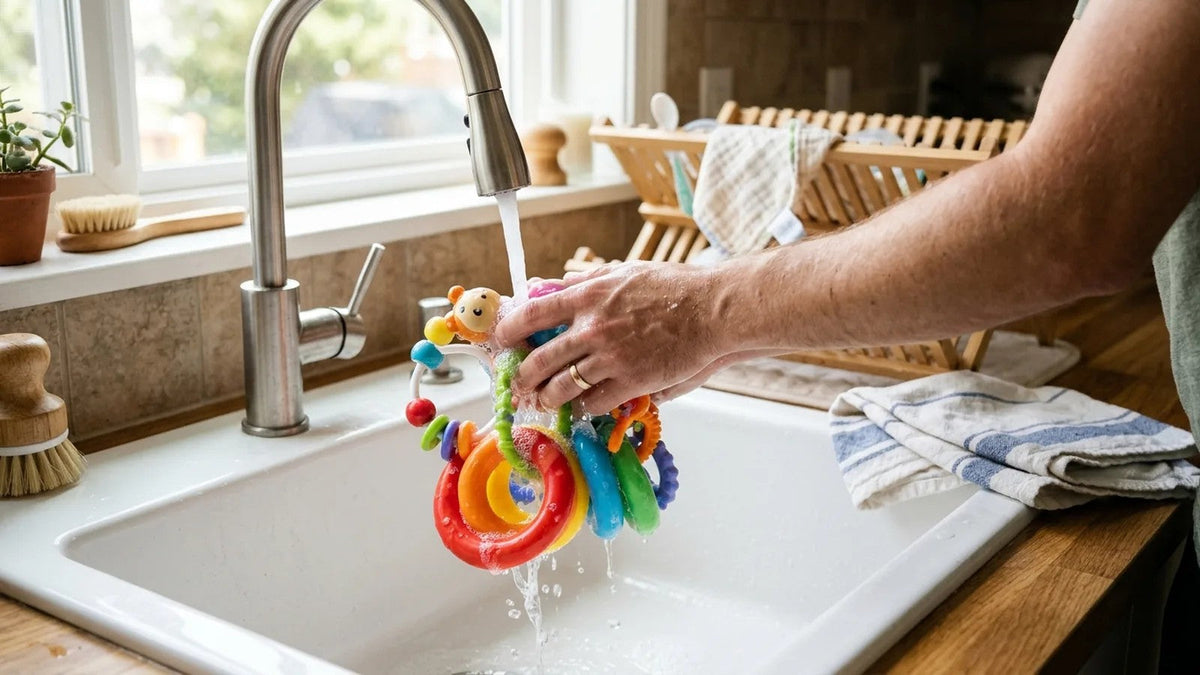
Wash with soap or detergent and water first, then sanitize the toys your baby mouths. That order comes from both the AAP and the CDC. Knowing how to clean baby toys means matching the method to the material. A method that suits a hard plastic rattle may not suit a plush bunny or a wooden block.
How to Clean Baby Toys: Wash First, Then Sanitize
The AAP separates cleaning into three jobs, and the words are not interchangeable.
- Cleaning uses detergent or soap and water to remove dirt and grime from surfaces.
- Sanitizing removes dirt and small amounts of germs.
- Disinfecting is an added step after cleaning, to kill germs on a surface.
The AAP lists toys among the items that are cleaned to remove dirt and then sanitized. The CDC adds that sanitizing reduces the number of germs on surfaces to levels that public health codes or regulations consider safe.
The CDC’s early care and education guide says to sanitize surfaces that come in contact with children’s mouths, such as infant feeding items and toys. Put the AAP’s order and the CDC’s rule together and how to clean baby toys that go in mouth is: wash, rinse, sanitize, dry.
Order matters. The CDC says to clean surfaces before you disinfect them. The AAP says the surface must be cleaned with soap or detergent and a water rinse before disinfecting or sanitizing. The AAP explains that soiled surfaces block the effects of a disinfectant or sanitizer.
If you are creating a yes space, with a low basket your baby can crawl to, assume everything in it will end up in a mouth. Those are the toys that get the full wash-then-sanitize order.
Picture this: a teether hits the kitchen floor, and before you can reach it, it is back in your baby’s mouth. A quick wipe is not the same as washing with soap or detergent, rinsing with water and sanitizing. The next section shows how to do the sanitizing part.
How to Sanitize Baby Toys: Methods the CDC Lists
Not every toy suits every method. The CDC’s early care guide lists certain toys among the nonporous objects it says to sanitize by boiling, steaming, or using a weakened bleach solution. A dishwasher with a sanitizing cycle can be used for some items. The CDC also says to check the item manufacturer’s guidance. The AAP notes that bleach can be corrosive to some metal, rubber and plastic materials, so read the maker’s care label before you choose.
Which Method Fits
| Method | Source | What it suits |
|---|---|---|
| Soap or detergent wash, water rinse | AAP | First step, every toy |
| Boiling or steaming | CDC | Nonporous toys, if allowed |
| Dishwasher sanitizing cycle | CDC | Some items, per maker |
| Weakened bleach solution | CDC | Nonporous toys, if allowed |
| Laundering, warmest appropriate water | CDC | Cloth toys, per care tag |
| Store-bought sanitizer or disinfectant | AAP, CDC | Whatever the label lists |
The CDC’s bleach soak
If you choose the weakened bleach solution, the CDC’s early care guide gives these directions:
CDC Bleach Soak
-
Mix
Prepare 1 tablespoon of unscented bleach per gallon (16 cups) of water in a clean wash basin. -
Submerge
Submerge the items completely. -
Soak
Soak them for at least 2 minutes. -
Do not rinse
The CDC says rinsing could let germs get back onto the sanitized items. -
Air dry
Let the items air dry completely before storing or using them.
The AAP says bleach solutions gradually lose strength, so a fresh solution must be prepared daily. It also says a bleach solution can be left to dry because it leaves no residue.
Store-bought sanitizers and disinfectants
If you use a store-bought product instead, the AAP says to read the label and follow its safety precautions, whatever the product. It also says to open windows and turn on a fan while you work. For disinfectants, the CDC says to leave the product on the surface long enough to kill the germs, and the surface should stay wet for the entire contact time. Follow the label for the contact time and any rinse step.
When routine cleaning is not enough
The AAP says that sometimes, like when someone in your home is sick, a step beyond routine cleaning is needed: sanitizing or disinfecting. Toys are one piece of keeping a clean home with kids.
When to Rinse and When Not To
The sources look like they conflict on rinsing, but they describe two different moments.
- After washing, before sanitizing: rinse with water (AAP).
- After the CDC bleach soak: do not rinse. Air dry completely (CDC).
- After any other sanitizer: follow the product label.
The first rinse removes soap and loosened grime. The second skips the rinse so that germs do not get back onto a sanitized toy.
Bleach Safety
Bleach is a sanitizer you have to handle carefully. The CDC says never to mix bleach with ammonia or any other cleaner. It also says not to mix cleaners and disinfectants unless the labels indicate it is safe to do so. The AAP explains why: bleach and ammonia mixed together produce a poisonous gas.
Ventilate. The CDC says to ensure good ventilation when using products indoors. The AAP says not to spray solutions when children are nearby.
If you keep a diluted solution or sanitizer in a spray bottle, the AAP says it must be labeled and stored out of reach of children. It also says to store cleaning products in their original labeled containers, in places children cannot get to.
If a child swallows or gets into a cleaning product, call Poison Help at 1-800-222-1222 (America’s Poison Centers). If your child is not breathing, is having a seizure or is unresponsive, call 911. For more on cleaning products and families, the AAP’s HealthyChildren.org has pages on cleaners, sanitizers and disinfectants.


Hard Plastic Toys
The AAP says a surface is cleaned with soap or detergent and a water rinse before it is sanitized, so the steps run in this order:
- Wash the toy with soap or detergent and water.
- Rinse it with water.
- Sanitize it by a method the CDC lists and the maker’s guidance allows.
- Let it air dry completely before it goes back in the toy bin (CDC).
Check the label first. The maker’s guidance decides which method a toy tolerates.
Washing is a good moment to look the toy over for cracks, loose pieces and small parts that have come off before it goes back in the basket. CPSC rules ban toys meant for children under 3 that are a choking hazard because of small parts, including pieces that can break off in normal use. Sorting toys by age for small parts is a separate job from cleaning them.
Plush and Cloth Toys
Soft toys follow different rules. The CDC’s early care guide groups cloth toys with soft surfaces, like clothing and rugs, under cleaning. It says to launder items if possible, using the warmest appropriate water setting, and to dry items completely.
Read the toy’s care tag to see what water setting is appropriate. The CDC does not call laundering a sanitizing step for toys, so a plush toy that went through the wash counts as cleaned.
Picture this: your baby has just gotten over a cold, and the stuffed elephant has been chewed on and cuddled through every day of it. Check the tag, wash it in the warmest water the tag allows, and dry it completely before it goes back in the toy basket.
When you are choosing age-appropriate baby toys, a clear care tag on a plush toy tells you up front whether it can be laundered.
Wooden Toys
The maker’s care instructions decide how to clean a wooden toy. Follow what the maker prints on the label or the box.
The CDC and AAP pages on cleaning and sanitizing do not give a wood-specific method. What the AAP does say applies broadly: routine cleaning with detergent or soap and water removes dirt and grime, and bleach can be corrosive to some materials. Soaking is a method that suits some materials and not others, so skip it unless the maker says it is fine.
If the instructions are gone, the CDC’s advice still applies: check with the item’s manufacturer about which method to use.
Bath Toys and Mold
Bath toys sit in moisture, so they can turn moldy. The primary sources used here give no bath-toy method, so what follows is general home mold guidance from the EPA, not toy-specific advice.
The EPA says to dry all items completely. It says to scrub mold off hard surfaces with detergent and water, then dry completely. It also says absorbent or porous materials may have to be thrown away if they become moldy.
Picture this: a squeeze toy sits on the edge of the tub after bath time, still holding water. By the time you pick it up again, it has been damp for days. Drying it completely is the step that matches what the EPA recommends.
The stronger bleach mixes on the CDC’s floodwater and mold cleanup page are for those situations, not for routine toy sanitizing.
The Short Version
Wash with soap or detergent and water, rinse, sanitize by a method the maker allows, and dry everything completely. Keep every cleaner in its labeled container, out of reach.