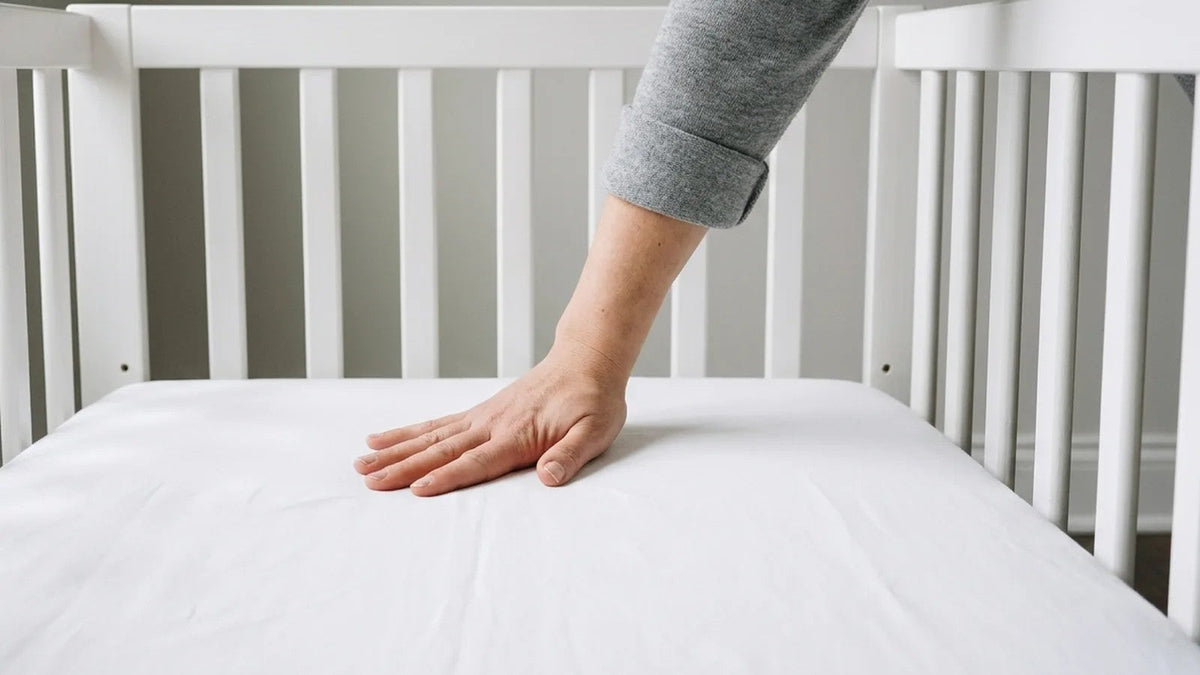
Mini Cribs vs Full-Size Cribs: Safety Standards, Mattress Fit and How Long a Mini Crib Lasts
What CPSC and the AAP say about mini (non-full-size) cribs: the federal standard, mattress fit and what is not sourced.

Are mini cribs safe? “Mini crib” is a shopper’s word. CPSC’s rule covers non-full-size baby cribs. The answer starts with that rule, not with the size. CPSC’s page does not use the word "mini" at all, so a product sold as a mini crib falls under that rule only if its interior dimensions are outside the full-size range.
Here is how the two kinds line up, using CPSC and AAP wording.
Mini Crib vs Full-Size Crib
| Feature | Mini crib (non-full-size) | Full-size crib |
|---|---|---|
| Interior width | Non-full-size if over 30 5/8 or under 25 3/8 in. | 28 ± 5/8 in. |
| Interior length | Non-full-size if over 55 or under 49 3/4 in. | 52 3/8 ± 5/8 in. |
| Federal rule | 16 CFR part 1220 | 16 CFR part 1219 |
| Standard | ASTM F406, CPSC-modified | Its own rule |
| Mattress fit (AAP) | Designed for that crib | Same wording |
| Mattress rule (CPSC) | 16 CFR part 1241 | 16 CFR part 1241 |
| AAP sleep rules | Same for both sizes | Same for both sizes |
| Time limit | Not set by sources; maker’s instructions apply | Not set by sources; maker’s instructions apply |
What CPSC Calls a Mini Crib
CPSC defines a non-full-size baby crib as a bed designed to provide sleeping accommodations for an infant, with interior dimensions outside the full-size range. That can mean a length greater than 55 in. or smaller than 49 3/4 in. It can mean a width greater than 30 5/8 in. or smaller than 25 3/8 in. Or both.
The category is wider than the shopper’s word suggests. CPSC’s page lists portable cribs, which are designed so they may be folded or collapsed without disassembly. It lists crib pens, which have rigid sides and legs that may be removed or adjusted. It lists specialty cribs with unconventional shapes, such as circular or hexagonal, and undersize or oversize cribs.
The name on the box does not decide which rule applies. CPSC’s definitions do.
Some products that look similar are outside the rule. CPSC says mesh, net and screen cribs, nonrigidly constructed cribs, cradles, car beds, baby baskets and bassinets (also known as junior cribs) are not within the scope of the non-full-size crib rule. A bassinet is a different product from a mini crib. Choosing between a bassinet and crib is its own decision.
Mini Crib vs Standard Crib Size: CPSC’s Dimensions
The full-size crib is the benchmark. CPSC’s full-size crib rule sets interior dimensions of 28 ± 5/8 inches in width and 52 3/8 ± 5/8 inches in length. A crib is non-full-size in CPSC’s terms only past the wider limits given above: an interior longer than 55 in. or shorter than 49 3/4 in., or wider than 30 5/8 in. or narrower than 25 3/8 in.
That is all CPSC says about mini crib vs standard crib size. CPSC gives ranges, not a single "mini" measurement, so a product sold as a mini crib has no set size in CPSC’s terms. Check the maker’s stated interior dimensions instead of assuming. If a listing says only "mini" and gives no interior dimensions, ask the maker where the product falls.
The two kinds also fall under different rules. CPSC regulates full-size cribs under 16 CFR part 1219 and non-full-size cribs under 16 CFR part 1220. In the mini crib vs full size crib comparison, the part numbers differ, but each size has a federal safety standard written for it.


Are Mini Cribs Safe? The Federal Standard Behind Them
Both kinds sit under a federal safety standard, so the question starts there. The text of 16 CFR 1220.1 says the part "establishes a consumer product safety standard" for new and used non-full-size cribs. That covers used cribs too, a point that matters for the secondhand section below.
CPSC’s business guidance says the rule incorporates by reference ASTM F406, with any modifications by CPSC. It also says manufacturers and importers must certify compliance by issuing a Children’s Product Certificate that cites 16 CFR part 1220. So a compliant mini crib should come from a maker or importer that has certified it to that rule.
On the parent’s side, the AAP says to place your baby in a crib, bassinet, portable crib or play yard that meets the safety standards. That is the test for any size.
When parents ask "are mini cribs safe for newborns," the AAP’s guidance says the product must meet the standards and the sleep setup must follow the AAP’s rules. Neither CPSC’s nor the AAP’s guidance ranks one size above the other. The AAP also says not to use products for sleep that are not specifically marketed for infant sleep.
Certification covers the crib itself. The rest of the room needs the same attention, and a nursery baby-proofing guide can help you work through the furniture, cords and everything else around the crib.
Mattress Fit Is the Heart of the Comparison
If one rule decides how a mini crib compares with a full-size crib, it is mattress fit. The AAP says to make sure your crib mattress is designed for your specific crib and that it fits tightly. CPSC’s crib safety tips call for a firm, tight-fitting mattress so a baby cannot get trapped between the mattress and the crib. Both statements apply to a mini crib exactly as they do to a full-size one.
Separately sold mattresses are where this gets tricky. The AAP says mattresses sold separately from cribs, bassinets and play yards are usually not tight enough. CPSC’s crib mattress guidance says an after-market mattress for a non-full-size crib or play yard must meet compatibility requirements, including being tested with each intended crib or play yard.
CPSC adds that "generic compatibility based on a size measurement cannot meet these requirements." The rule to follow is the AAP’s: a mattress designed for that specific crib.
Picture this: you find a mattress listing that says it fits "most mini cribs," and the price looks right. CPSC’s wording says a claim built on a size measurement alone cannot meet its requirements. If the box or instructions do not name your crib, treat that as an unanswered question and go back to the maker.
Mattresses have their own federal rule too. CPSC published 16 CFR part 1241, which incorporates ASTM F2933 with CPSC modifications. CPSC’s 2022 release says the rule covers crib mattresses of all sizes and after-market mattresses used in play yards and cribs. It adds a firmness test and requires improved marking, labeling and instructions. The labels and instructions that come with a mattress are part of how you confirm what it was made for.
Do not add a second mattress or pad. For play yards, CPSC staff advises consumers not to use supplemental mattresses because they may create a gap and lead to an entrapment hazard.
For cribs, the AAP and CPSC fit rules apply, and the AAP’s bare-crib rule leaves no place for extra padding. The crib mattress and bumper rules go into placement and padding in more depth.
A Bare Sleep Space in Either Size
Picture this: it is 3 a.m., the crib looks a little empty, and a soft blanket and a plush toy seem like a kind addition. The AAP’s guidance says otherwise. It says to use a fitted sheet only, with nothing else in the crib with your baby, and no blankets, pillows, stuffed toys or bumper pads.
CPSC says the same thing in its own words. Do not put pillows, quilts, comforters, sheepskins, pillow-like bumper pads or pillow-like stuffed toys in the crib. A smaller crib does not change that list, and a larger one does not relax it.
The position and location rules are also the same for both sizes. The AAP says to place your baby on their back for all naps and at night. It says to share a room with your baby for at least the first 6 months of life.
Those are core safe sleep practices, and they apply whether the crib is full-size, folds up, or is shaped like a hexagon. A bare crib, a fitted sheet and a baby on their back is the setup the AAP describes, in any size.
Secondhand Mini Cribs and Hardware Checks
Picture this: a friend offers you a crib that has been sitting in a garage. It looks sturdy, and it is free. The AAP’s registry guidance lists vintage cribs among baby products to avoid. It says older cribs and cradles do not meet current U.S. safety standards, which include a full ban on drop-side cribs.
The AAP also says unsafe products can turn up in thrift, consignment and resale shops, garage sales and open-air markets. It notes that friends and family might offer gently used or homemade versions. A used mini crib is covered by 16 CFR 1220 too, since the rule applies to new and used non-full-size cribs. That makes the standard and its paperwork the first thing to look for.
Two checks apply to either size. The AAP says not to use a crib that does not have instructions, so ask for them along with the crib. If the owner cannot produce them, the AAP’s rule says the crib should not be used.
CPSC’s crib checklist says there should be no missing, loose, broken or improperly installed screws, brackets or other hardware on the crib or mattress support. Look at the mattress support as well as the crib itself, since CPSC’s checklist names both. A short list of what to check on a crib turns those two rules into something you can run through before the first night.
How Long Can a Baby Stay in a Mini Crib?
This is the part where the sources are quiet. The CPSC and AAP pages used here do not set an age, height, weight or number of months for a non-full-size crib. There is no sourced limit and no "outgrown by" date, and a number from a retailer or a forum is not a regulatory number.
Limits for a specific product live with its maker. The instructions and the crib’s own labeling are where they appear. Keep the instructions with the crib and read the labeling on the crib itself. That is one more reason for the AAP’s rule: do not use a crib that has no instructions. A crib without its paperwork leaves you with no way to find out what the maker intended.
This holds for full-size cribs as well. None of these CPSC or AAP pages gives a duration for either size, so the comparison is a tie on this point. For questions about your own baby, ask your pediatrician.
Frequently Asked Questions
Where do mini cribs fit in CPSC’s rules?
Is a mattress that fits “most mini cribs” acceptable?
Can I use a secondhand mini crib?
What can go in the crib with my baby?
How long can a baby stay in a mini crib?
Also sold at