Montessori Floor Bed Safety: Room Setup, Age and Safe-Sleep Rules
What the AAP and CPSC say about floor beds by age, and how to set up the room: anchors, cords, outlets and a gate at the door.

For a baby under 12 months, Montessori floor bed safety starts with the AAP’s list, and a floor bed is not on it. The AAP says to place a baby in a crib, bassinet, portable crib or play yard that meets the safety standards of the Consumer Product Safety Commission (CPSC). For toddlers, the picture changes. The AAP says that once a child can climb out of the crib, it may be time for a big-kid bed. The CPSC describes toddler beds for children not less than 15 months of age. Neither agency names a Montessori start age.
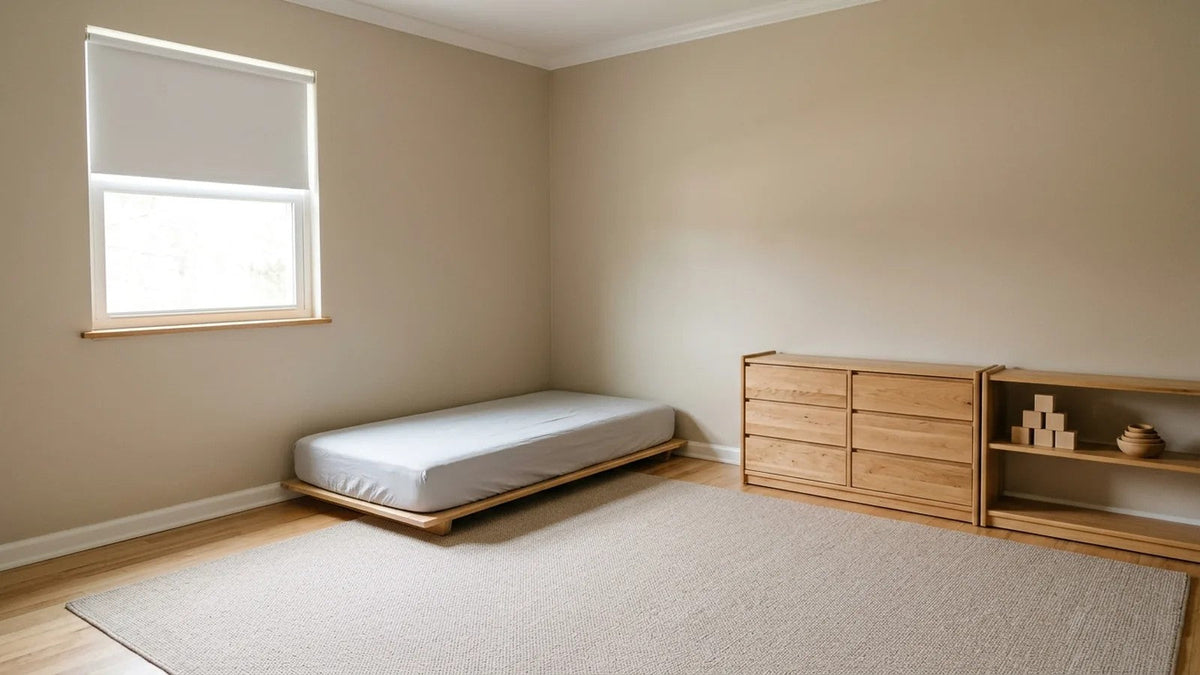
A floor bed is a mattress on or near the floor, in a room set up so a child can get in and out alone. What matters is who is sleeping on it, and what surrounds it.
Montessori Floor Bed Safety for Babies: Start With the AAP’s List
The AAP writes its safe-sleep guidance for babies up to 1 year of age. Its list of sleep spaces is short: a crib, bassinet, portable crib or play yard that meets CPSC safety standards. A mattress on the floor does not appear on it. So for a baby under 12 months, a floor bed is not a sleep surface the AAP names, and Montessori advice does not change that. When your child is ready to leave the crib, toddler bed vs twin bed compares the next options.
The stakes explain the narrow list. The AAP notes that around 3,500 U.S. babies die suddenly and unexpectedly while sleeping each year. It says most of these deaths are due to sudden infant death syndrome (SIDS) or accidental deaths from suffocation or strangulation. The AAP adds that no step can remove the risk of SIDS entirely.
Location matters too. The AAP recommends sharing a room with your baby, but never a bed, for at least the first 6 months. It advises room sharing without bed sharing because it can decrease the risk of SIDS by as much as 50%. For the rest of the AAP’s guidance on the early months, see our guide to safe sleep basics.
Age and Surface: What Each Stage Calls For
The surface rules for a baby
The AAP says to choose a firm, flat sleep surface. It explains that firm means the surface does not indent when the baby is lying on it. It says to use a fitted sheet only, with nothing else in the crib.
The AAP also says any surface that inclines more than 10° is not safe for a baby to sleep on.
The AAP says to keep soft objects and loose bedding out of a baby’s sleep area, because they can increase the risk of entrapment, suffocation or strangulation. Its list includes:
- Pillows and pillow-like toys
- Quilts and comforters
- Mattress toppers
- Non-fitted sheets and blankets
- Toys
- Bumper pads
For a baby under 1, that means a bare, firm surface with a fitted sheet, not a nest of soft layers.
The AAP also addresses alternative sleep surfaces, which it says include in-bed sleepers, baby nests and pods, and baby tents. It considers them a safe option only if they comply with the CPSC rule that infant sleep products meet the federal safety standards for cribs, bassinets, portable cribs or play yards. Its direction is plain: if a product does not meet federal safety standards, do not use it.


The toddler line
The AAP’s big-kid-bed guidance covers a different moment. Once a toddler can climb out of the crib, it may be time to move to a big-kid bed. While you wait for the new bed, the AAP tells parents to place the crib mattress on the floor. It also says to clear away furniture and large toys the child could fall against.
Picture this: it is early morning, you are still asleep, and your toddler has already walked out of the bedroom. The AAP’s answer to that morning is a gate across the bedroom door, covered below. For the rest of the switch, see our checklist for moving from crib to toddler bed.
The CPSC gives one federal reference point for size and age. It describes a toddler bed as sized to accommodate a full-size crib mattress and intended for a child not less than 15 months of age who weighs no more than 50 pounds. The CPSC says the regulation attempts to minimize entrapment incidents. Its toddler-bed page does not mention floor beds.
No AAP or CPSC page sets a Montessori start age. If a source gives you a month on the calendar for a floor bed, it is not coming from these two agencies.
Rails and the Floor Bed Question
Parents often wonder whether to add a rail. The CPSC’s own description is the place to begin. It says a portable bed rail is a device intended to be installed on an adult bed to keep children from falling out. It says portable bed rails are intended for children who can get in and out of bed unassisted, typically 2–5 years of age.
Its requirements cover the openings between bedposts and the ends of portable bed rails. On its toddler-bed page, the CPSC says entrapment of a child’s head or neck can result in asphyxiation.
Rails are described for an adult bed and for children of about 2–5. Nothing on the CPSC page makes them a fit for a baby’s sleep space. If you are weighing a rail for an older child, our guide to toddler bed rail safety covers rail types and gaps.
Room Setup: Once a Child Can Leave the Bed, the Room Is the Crib
A floor bed lets a child walk out of bed without help. Everything within reach is now part of the sleep space.
The AAP says to make the room as safe and hazard-free as you can.
Anchor the furniture
The AAP says to take steps to keep dressers and other furniture from tipping over and injuring your child. The CPSC says furniture, TVs and ranges can tip over and crush young children. It reports that deaths and injuries occur when children climb onto, fall against or pull themselves up on dressers, shelves, bookcases and similar furniture. Its advice is to anchor them to the floor or attach them to a wall.
Picture this: you wake up to find the bottom drawers open like steps. That is the motion the CPSC describes. For the how-to, dresser and nightstand anchoring is the next step.
Remove cords
The CPSC says to use cordless window coverings in homes with young children, to help prevent strangulation. Children can wrap cords around their neck, or pull cords and become entangled in the loops. A window beside a low bed is within a toddler’s reach.
Cover outlets
The CPSC advises outlet protectors that children cannot easily remove and that are large enough that children cannot choke on them. When replacing receptacles, it advises tamper-resistant ones. Any outlet beside the mattress is one a toddler can reach from bed.
Add a gate at the doorway
The AAP says you may need a safety gate across your toddler’s bedroom door to keep them from wandering when you are not awake. It also says to add a gate at the top of the stairs. The CPSC says safety gates help keep children from falling down stairs and keep them out of rooms with possible dangers. It adds that pet gates should never be used as a child safety gate. For the top of stairs, it says to use only gates that screw to the wall.
Baby Proof Me’s Mesh Retractable Baby Safety Gate is one option for the doorway layer. It is hardware-mounted, with brackets and screws in the box. It is 34 inches high, and its dual-rotation locking system offers one-hand operation. The product page says it is not a substitute for adult supervision, and the CPSC says no safety device offers complete protection. A gate or an anchor adds a layer. It does not replace watching your child.

Floor Bed Room Checklist
Talk With Your Pediatrician
The AAP says to talk with your pediatrician about any questions on your child’s sleep space. Your pediatrician knows your child. No general guide does.
Putting the Room Together
Start with the sleeper’s age. The AAP says to place a baby under 12 months in a crib, bassinet, portable crib or play yard that meets CPSC standards, on a bare, firm surface, and to share a room for at least the first 6 months. A toddler who climbs out of the crib needs a room checked from the floor up: anchored furniture, cordless window coverings, outlet protection and a gate at the door. A nursery baby-proofing guide can help with the rest of the room. Then bring your questions about the sleep space to your pediatrician.