Baby Proof Fireplace Screen: Top Picks for Hearth Safety
Top Picks for Hearth Safety

Every year, parents spend hours researching cabinet locks and outlet covers, then push a decorative screen in front of the fireplace and call it done. That screen is not baby-proofing. It is furniture.
The distinction matters because a fireplace hearth combines three hazards at once: extreme heat, hard stone or brick edges, and an open flame or superheated glass surface that a curious toddler will reach for without hesitation. Getting the barrier right is one of the more important safety decisions you make for your living room.
Why the Fireplace Demands More Than a Decorative Screen
Glass-front gas fireplace surfaces can reach 500°F minimum and up to 1,328°F, causing third-degree burns in seconds (AAP). My younger daughter, at about 14 months, made a beeline for our gas insert within 30 seconds of me setting her down on the living room floor. The glass looked like nothing. It looked safe. It was not.
ANSI Z21.50–2014/CSA 2.22–2014 took effect January 1, 2015, requiring a protective barrier on new gas fireplaces whose glass can exceed 172°F. If your gas fireplace was manufactured after that date, it should have shipped with a barrier. Many did not include one in practice, and older units have no such requirement at all. Wood-burning fireplaces present a different but equally serious problem: sparks, rolling embers, and a hearth edge that is essentially a concrete curb at head height for a toddler learning to walk.
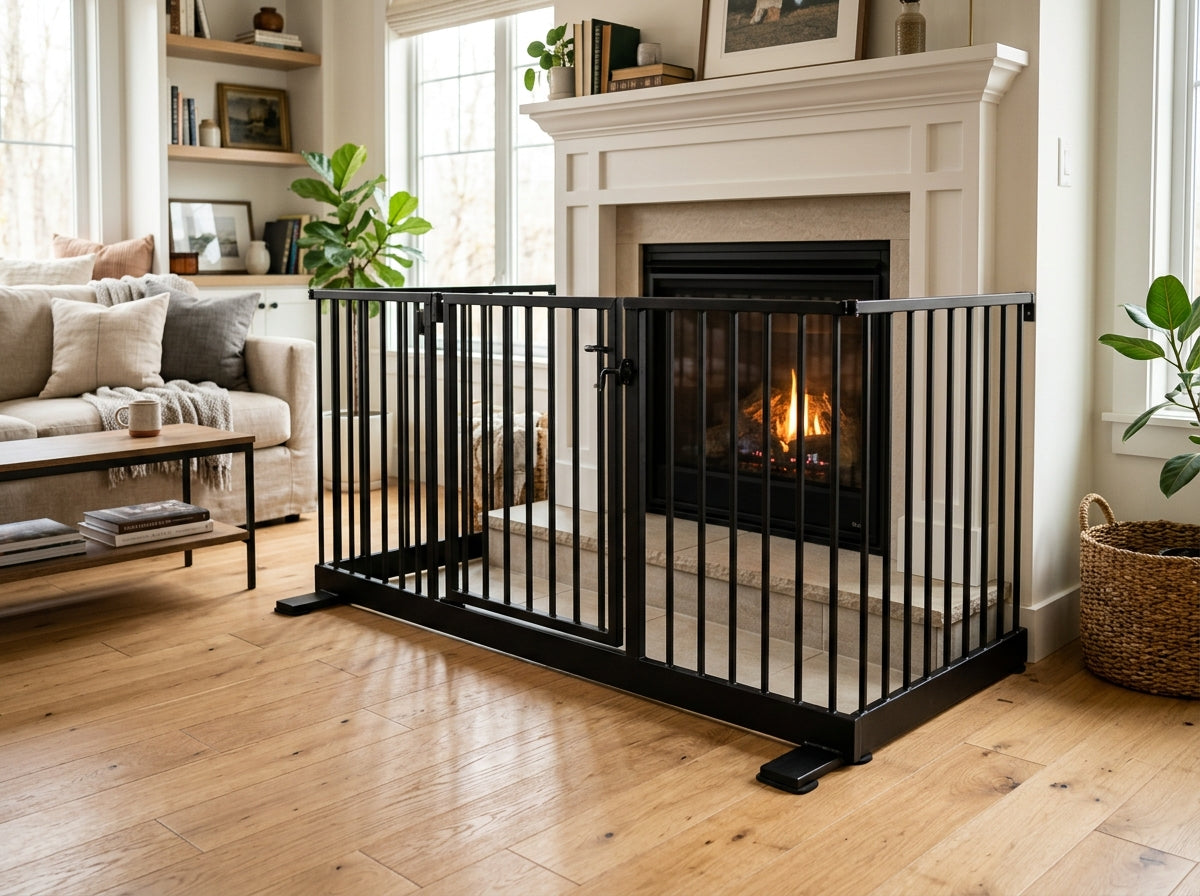
A purpose-built freestanding hearth gate solves all of this. A decorative screen solves none of it.

- Superheated glass front, burns in seconds
- Raised stone hearth, head-height fall risk
- Exposed hearth corner, sharp edge hazard
- Exposed hearth corner, sharp edge hazard
What to Look For Before You Buy
Freestanding vs. wall-mounted. Freestanding gates create a perimeter around the entire hearth, including the raised platform. Wall-mounted barriers attach directly to the surround and work better for fireplaces recessed into the wall without a raised hearth. Most families with young children do better with a freestanding gate because it keeps kids away from the hearth surface itself, not just the firebox opening.
Panel material and heat tolerance. Steel mesh panels are the standard for a reason. They allow airflow so the gate itself does not overheat, they are rigid enough to resist pushing, and they are durable enough to survive a toddler leaning on them repeatedly. Avoid gates with fabric panels or any plastic components near the firebox side.
Gate opening mechanism. You will open and close this thing dozens of times a week. A walk-through gate with a self-closing, self-latching door is worth every extra dollar. The latch should require two distinct actions to open, one of which an adult can do with one hand but a toddler cannot replicate.
Panel count and coverage. Most freestanding hearth gates come in 4-panel, 6-panel, or 8-panel configurations. Measure your hearth width and depth before buying. The gate needs to extend far enough on each side that a child cannot simply walk around the end panel and reach the corner of the hearth.
Hearth pad coverage. If your hearth has a raised stone or tile platform, the gate perimeter should sit on the floor in front of it, not on top of it. Placing the gate on a raised surface reduces its effective height and creates a tipping risk.


Top Picks
Best overall: KidCo Hearth Gate
The KidCo Hearth Gate is the product I have recommended most often, and the one I installed in my own home. It comes in a 6-panel configuration, uses powder-coated steel mesh throughout, and includes a walk-through door with a two-step latch. The panels connect with hinged joints that let you angle the configuration around irregular hearth shapes. At roughly 27 inches tall, it is high enough to stop a climbing 2-year-old. The footprint is adjustable from about 54 inches wide to over 100 inches, which covers most standard fireplace walls.
One thing I noticed during installation: the feet have rubber grips, but on a smooth hardwood floor the gate can shift if a child leans into it hard. I added non-slip furniture pads under each foot, which solved the problem.
Best for large hearths: Dreambaby Chelsea Extra Wide Hearth Gate
If your fireplace wall is wider than 90 inches or your hearth extends significantly into the room, the Dreambaby Chelsea is worth the investment. It comes in configurations up to 8 panels and can be extended further with add-on panels sold separately. The walk-through door is wide enough for an adult to pass through comfortably without stepping over anything. The latch mechanism is solid, and the powder-coat finish holds up well to the heat proximity.
The tradeoff is weight. This gate is heavy, which is a safety feature when a toddler is pushing on it, but makes reconfiguring the layout a two-person job.
Best budget option: Cardinal Gates Stairway Special (configured for hearth)
The Cardinal Gates Stairway Special is primarily marketed as a stair gate, but its rigid steel construction and adjustable width make it a reasonable hearth solution for families with a simple, non-raised fireplace opening. It mounts to the wall, so it works best when your fireplace is flush with the wall and you only need to block the opening itself rather than a full hearth perimeter.
I would not use this as my only barrier if the hearth has a raised stone platform, because it does not address the fall and edge hazard. But for a recessed gas fireplace in a rental where wall-mounting is acceptable, it is a practical choice.
Best for aesthetics without sacrificing safety: Regalo Extra Wide Baby Gate and Play Yard
The Regalo Extra Wide can be configured as a freestanding play yard, which means you can use it to create a full perimeter around the hearth area without anchoring anything to your walls or mantel. It is not as tall as the KidCo (it tops out at about 26 inches), and the mesh is softer fabric rather than steel, so I would not use it with a wood-burning fireplace where embers are a real possibility. For a gas fireplace with a glass front, where the main risks are contact burns and hearth-edge falls, it is a flexible option that also doubles as a play yard in other rooms.
Best for renters: Summer Infant Deluxe Stairway Simple to Secure Gate
Renters face a real constraint: wall anchors are often off the table, or at least complicated. The Summer Infant Deluxe uses a pressure-mount system with wide stabilizer bars that brace against the wall without drilling. It is rated for stair use, which means it meets a higher stability standard than most pressure-mount gates. For a fireplace application, I would pair it with the non-slip pads I mentioned above and check the tension weekly. Pressure-mount gates can loosen over time, especially on painted drywall.
Installation Details That Matter
The most common installation mistake I see is placing the gate too close to the firebox. You want at least 12 inches of clearance between the gate and the glass or mesh of the firebox itself. This keeps the gate surface from heating up and ensures a child who reaches through the gate cannot touch the firebox.
Check every hinge and connection point before you consider the installation done. Hearth gates take more lateral force than stair gates because children push on them from the side rather than straight through. A panel that wobbles at the hinge is a failure point.
If your hearth has corners, angle your panels to cover them. A child who cannot reach the glass will absolutely find the corner of a stone hearth if the gate leaves it exposed.
Installation Checklist
Maintaining the Gate as Your Child Grows
A gate that worked at 10 months needs reassessment at 18 months and again at 24. My older daughter figured out the latch on our cabinet locks at 26 months. Toddlers study mechanisms. They watch you open the gate, and they practice. Check your latch complexity against your child’s current problem-solving ability, not against the age range on the box.
Also check the gate’s structural integrity every few months. Powder coat can chip at hinge points, and exposed metal edges are a cut hazard. Tighten any bolts that have worked loose. If a panel is bent or a hinge is cracked, replace the gate.
When to Remove the Gate
There is no universal age. The right time is when your child reliably understands and follows the rule "we do not touch the fireplace," can open the gate latch themselves (which means it no longer provides security), and is tall and coordinated enough that a fall near the hearth is not a head-height risk. For most children, that is somewhere between 4 and 6 years old, but you know your child.
Until that point, the gate stays. The hearth is not a negotiation.