Baby Proofing Holiday Decorations: Christmas Hanukkah and Beyond

The holidays turn your living room into an obstacle course. Twinkling lights, dangling ornaments, flickering candles, a six-foot tree that your baby is already eyeing like a climbing wall. It’s beautiful. It’s also a hazardous environment for a child who crawls, cruises, or has recently discovered that pulling things is extremely satisfying.
The good news is that you don’t have to choose between a decorated home and a safe one. You just have to be strategic about it.
Anchor the Tree (and the Menorah, and Anything Tall)
A Christmas tree is top-heavy by design. Add water, ornaments, and a curious baby, and you have a real tipping risk. The CPSC recommends anchoring any tall, top-heavy decoration that a child could pull down, and a tree absolutely qualifies. Use a wall anchor strap or a sturdy hook screwed into a stud, and run a length of fishing line or a dedicated tree strap from the trunk to the wall. It takes ten minutes and it holds.
The same logic applies to menorahs placed on low tables or mantels within reach. If it can be grabbed and pulled, it needs to be either anchored or relocated to a surface your child cannot access.
When my older daughter was about 18 months old, she grabbed the base of a decorative ladder shelf I’d staged with holiday candles. The whole thing wobbled. Nothing fell, but it was close enough that I spent the next hour rethinking every surface in the room. Tall and top-heavy is the category to watch.
Rethink the Lower Third of Your Tree
Strip the bottom 18–24 inches of your tree entirely. No ornaments, no tinsel, no garland, no lights. That zone belongs to your baby now.
Small hard ornaments are choking hazards for children under three. Glass ornaments shatter into shards. Ornament hooks are sharp and small enough to swallow. None of these belong at grabbing height.
Replace anything you move with soft alternatives: fabric ornaments, felt shapes, foam balls. They’re lightweight, unbreakable, and if your baby pulls one off and puts it in their mouth, the risk profile is different. Many holiday stores carry these specifically, and they’re easy to find online. Some families do a "baby zone" tree where the lower half is entirely soft and the upper half holds the heirlooms. That works well.
Tinsel and metallic garland deserve a special mention. Both are ingestion hazards that can cause intestinal blockage, and tinsel is fine enough to wrap around small fingers. Skip them entirely this year. The tree will still look good without them.


Manage Every Cord
Holiday lighting means cords, and cords are one of the most consistent hazards in a baby-proofed home. Cords are tripping hazards for adults carrying things, chewing targets for babies, and electrocution risks if the insulation is compromised.
Route all cords behind furniture or along baseboards. Use cord clips or cable management channels to keep them flat against the wall. Tape down any section that crosses a floor or crawling path. A baby who is just starting to pull up will grab anything at arm’s reach, and a dangling light cord is exactly the kind of thing that gets grabbed.
Before you plug anything in, inspect every strand of lights and every extension cord. Look for fraying, cracking, discoloration, or any section where the insulation looks compromised. If you find damage, discard it. Holiday lights are inexpensive. An electrical fire is not a recoverable situation.
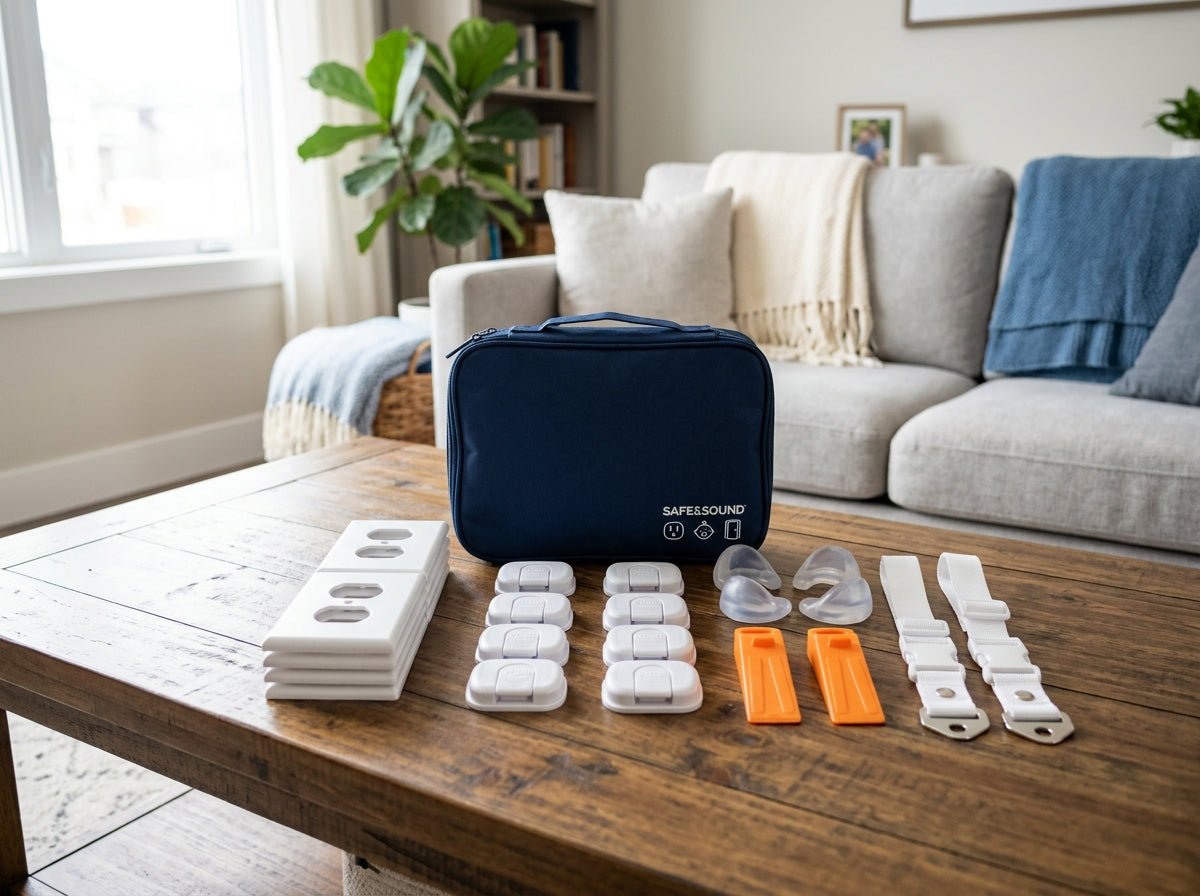
Use outlet covers on any unused outlets near your display, and consider a power strip with a built-in surge protector and a switch you can flip off at night. That single switch eliminates the live-cord problem when you’re not in the room.
Candles: Go Flameless This Year
Hanukkah candles, advent candles, pillar candles in holiday arrangements. They’re everywhere in December, and they’re an obvious burn and fire hazard around babies.
The practical solution is flameless LED candles. Modern versions flicker realistically, come in the right sizes for menorahs and advent wreaths, and some are even remote-controlled so you can observe the timing traditions without an open flame. They’re not a compromise. They work.
For any real candles you do use, the rule is simple: high shelf, locked cabinet, or supervised use only with your baby physically contained elsewhere. "Out of reach" is not enough if your child is climbing. "Out of the room" is the standard.
My younger daughter once pulled a decorative candle holder off a side table when she was about 14 months old. The candle wasn’t lit, but the holder was ceramic and it broke. That was the moment flameless became our permanent holiday policy.
Holiday Plants Are Often Toxic
Poinsettias are the famous one, but they’re not alone. Mistletoe, holly berries, amaryllis, and Christmas rose are all toxic if ingested, with effects ranging from gastrointestinal upset to more serious poisoning depending on the plant and the amount consumed.
The safest approach is to keep these plants out of the home entirely while you have a baby or toddler. If you want them for aesthetic reasons, place them well above standing reach and check them regularly for fallen leaves or berries that could land on the floor. A dropped holly berry at floor level is exactly the kind of thing a crawling baby finds before you do.
If you suspect ingestion of any plant material, contact Poison Control at 1-800-222-1222 immediately. Don’t wait for symptoms.
Wreaths, Garlands, and Small Embellishments
Decorative wreaths and garlands often come loaded with small attached pieces: berries, bells, beads, picks, wire-wrapped ornaments. Any of these can detach. Any of them can become a choking hazard.
Hang wreaths and door garlands at a height above where a standing child can reach, and inspect them weekly throughout the season. Give the wreath a firm shake and see what falls. If anything comes loose easily, remove those elements before hanging. The same goes for garlands draped along mantels or staircases: check the attachment points on every embellishment and remove anything that isn’t firmly secured.
Avoid decorations with small sewn-on beads, jingle bells, or plastic ornament pieces that can be pulled off. If you’re buying new this year, look for items that are simply constructed without small detachable parts.
Gift Wrap, Ribbon, and Bags
The wrapping station is a hazard zone that gets overlooked because it feels temporary. Ribbon and curling ribbon can tangle around fingers and necks. Plastic bags from gift bags are suffocation risks. Tissue paper, while not dangerous on its own, tends to contain small items like gift tags, twist ties, and ornament hooks that fall out during wrapping.
Set up your wrapping station on a table or counter your baby cannot access, and keep it cleared between sessions. Don’t leave ribbon spools, scissors, or tape dispensers at floor level. After gifts are opened, collect all wrapping materials immediately rather than letting them accumulate on the floor where a baby is playing.
Holiday Safety Checklist
Use a Play Yard During Setup and Takedown
The two most dangerous moments of the holiday season are when you’re putting decorations up and when you’re taking them down. Boxes are open, small pieces are everywhere, you’re distracted, and the usual organization of the room is disrupted.
A play yard or portable enclosure gives your baby a safe, contained space during these windows. It’s not a punishment. It’s the practical solution to the problem of divided attention. Set it up before you open the first decoration box, put your baby in it with familiar toys, and work without worrying about what they’ve gotten into behind you.
The same applies when guests are helping decorate or when older children are involved. More people in the room means more distraction, not more supervision.
A Final Check Before the Season Starts
Before anything goes up, do a quick audit of your older decorations. Check for sharp edges on metal or wire pieces. Look for paint that’s chipping or flaking, particularly on vintage ornaments, which may predate modern paint safety standards. Discard anything that’s broken, cracked, or has parts that are no longer secure.
The goal isn’t a sterile holiday. It’s a decorated home where you’re not spending the whole season redirecting your baby away from hazards. A few hours of intentional setup at the start of the season makes the next four weeks considerably calmer.