Baby Registry Must Haves 2026: The Safety-Focused Gift Guide

Every parent building a registry faces the same quiet panic: the lists are infinite, the opinions are loud, and nobody tells you which items matter for your baby’s safety versus which ones are just clever marketing. This guide focuses on one question: what keeps a baby safe in the first year, not what’s popular right now.
These are the items I’d put on every registry, in order of how much they matter.
The Safe Sleep Surface Comes First
Nothing on this list outranks a firm, flat sleep surface that meets current CPSC standards. A crib, bassinet, or play yard that passes federal safety requirements is the foundation of everything else. The CPSC maintains a list of recalled sleep products at cpsc.gov, and it’s worth checking before you buy or accept a hand-me-down.
Newborns sleep 16–17 hours a day. That means the sleep surface is where your baby spends most of their life in those early months. Soft objects, loose bedding, and inclined surfaces all increase suffocation risk. The mattress should be firm and flat. The fitted sheet should be snug enough that you can’t pinch more than an inch of fabric. That’s it. No bumpers, no pillows, no positioners.
In my experience, a bassinet with a slightly inclined "snuggle" insert looked cozy but was exactly the kind of soft, angled surface the AAP guidance warns against. The baseline rule from the American Academy of Pediatrics is simple: babies sleep alone, on their back, on a firm flat surface, every time.
Car Seats: The Item You Can’t Skip
Motor vehicle crashes are a leading cause of unintentional injury in infants. A rear-facing infant seat or convertible seat is non-negotiable. What matters beyond that is fit: the seat must fit your vehicle and your baby’s weight and height at the time of birth.
Every car seat sold in the U.S. must pass NHTSA crash testing. That’s the floor, not a differentiator. Where seats differ is in ease of correct installation, harness adjustability, and how long the rear-facing weight limit extends. A convertible seat with a higher rear-facing limit lets you keep your baby rear-facing longer, which is the safest position.
Register for a seat, but also register for a car seat installation check. Many fire stations and hospitals offer these for free. In my experience, a professionally installed infant seat revealed that the angle was off by enough to matter. Correct installation is part of the product.
Swaddles and Sleep Sacks Instead of Loose Blankets
Loose blankets in the crib are a suffocation hazard. Swaddles and wearable blankets replace them. The AAP recommends against any loose bedding in the sleep space, and sleep sacks are the practical solution that works.
Look for swaddles and sleep sacks that meet ASTM safety standards for secure fit and breathability. A swaddle that comes undone in the night creates loose fabric in the crib, which defeats the purpose. In my experience, when a baby starts showing signs of rolling at around 3 months, switching to a sleep sack is important because a swaddled baby who rolls face-down can’t push up.
The TOG rating on sleep sacks tells you the warmth level. Match it to your room temperature and dress your baby in an appropriate base layer underneath. This is how you keep a baby warm without a blanket.


A Thermometer and a Plan for Fever
Parents consistently underestimate how important a reliable thermometer is in the first weeks home. A rectal thermometer is the most accurate method for infants under 3 months, per AAP guidance. A digital or infrared ear/forehead thermometer is faster and more practical as babies get older.
The reason this matters: in a baby under 3 months, a rectal temperature of 100.4°F (38°C) or higher is a medical emergency requiring immediate evaluation. There is no "wait and see" at that age. Knowing how to take an accurate temperature and having the right tool to do it prevents dangerous delays. Register for both a rectal thermometer and a forehead thermometer. Use the right one for the right age.
Fever-reducing medication appropriate for newborn age is something to discuss with your pediatrician before you need it. Acetaminophen is not recommended for babies under 3 months without a doctor’s guidance. Know the protocol before 2 a.m.
Outlet Covers, Cabinet Locks, and Baby Gates
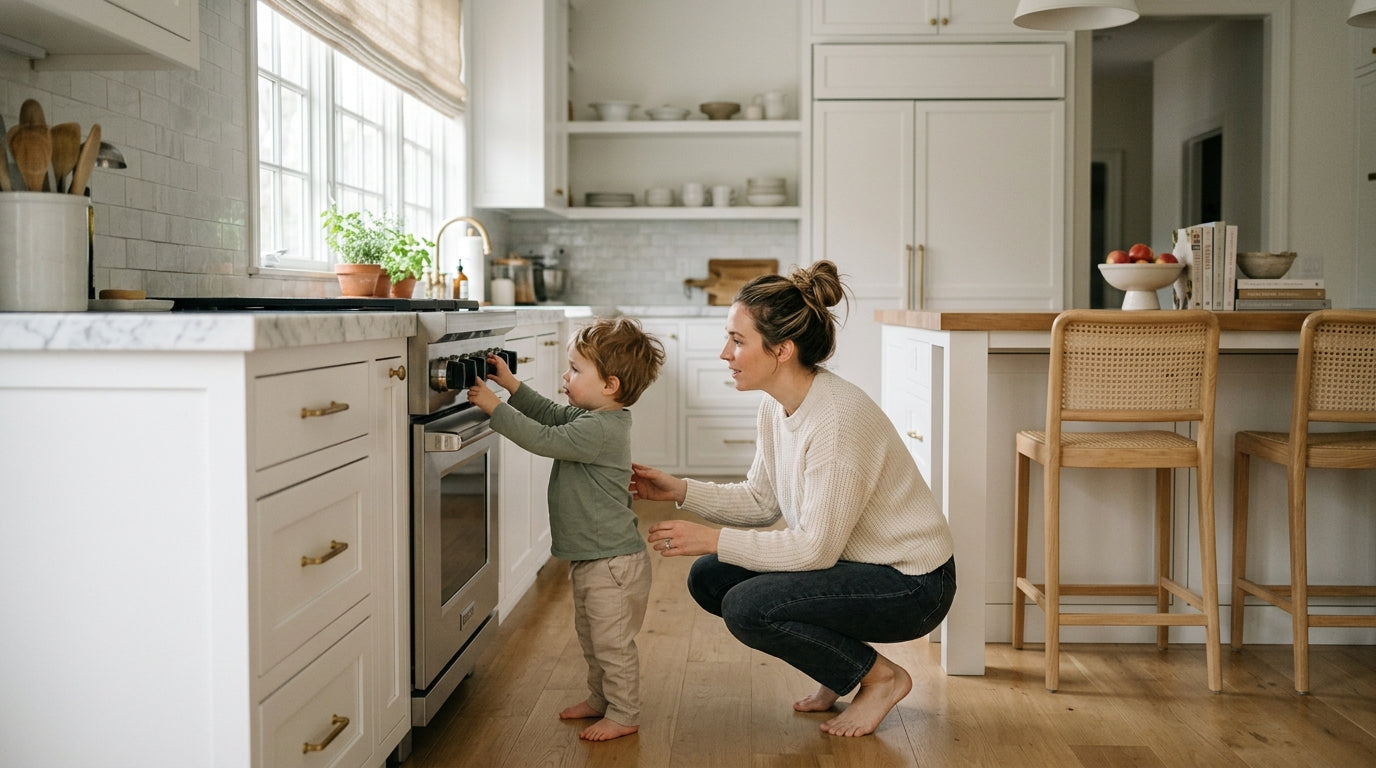
Parents who install safety hardware before their baby starts crawling do it correctly. Parents who wait until their 9-month-old is already pulling at cabinet doors install locks in a hurry, on the wrong surfaces, with a baby underfoot.
Baby gates are worth particular attention. ASTM F1004 is the federal safety standard for expansion gates and expandable enclosures, made mandatory under 16 CFR Part 1239 (effective 2021). For top-of-stair installations, you need a hardware-mounted gate, not a pressure-mounted one. Pressure gates are for doorways and room dividers only.
About 93,000 children under 5 are treated in U.S. emergency rooms each year for stair-related injuries, per a Nationwide Children’s Hospital analysis of CPSC NEISS data. That number is a strong argument for getting the right gate installed correctly before your baby ever approaches a staircase.
Put outlet covers and cabinet locks on your registry now. Your future self, the one chasing a newly mobile 9-month-old, will thank you.
Sterilization Equipment for Bottle Feeding
If you plan to bottle feed, whether with formula or pumped milk, sterilization equipment belongs on your registry. Newborns have immature immune systems, and bottles and pump parts that aren’t properly sanitized can harbor bacteria that cause serious illness.
You have options: a countertop electric sterilizer, microwave sterilizer bags, or boiling. All three work when used correctly. The method matters less than the consistency. Pick one that fits your kitchen and your routine, because you’ll be doing this multiple times a day.
The CDC recommends sanitizing bottle feeding equipment at least once daily for babies under 3 months, premature babies, or babies with weakened immune systems. After sanitizing, let parts air dry on a clean surface rather than towel-drying, which can reintroduce bacteria.
A Changing Table or Dresser-Top Pad With a Safety Strap
Falls are among the most common injuries in infants, and a changing table is one of the most common places they happen. A sturdy changing table or a dresser-top changing pad with a safety strap reduces that risk. The strap is not optional.
And yet: the strap is not a substitute for your hand. You keep one hand on the baby at all times. The strap is backup for the moment you reach for a wipe and your baby decides to demonstrate their rolling ability for the first time. In my experience, a baby can roll off a changing pad even with a strap if it’s unsnapped and you turn away briefly.
Never leave a baby unattended on any elevated surface. That rule doesn’t have exceptions.
Clothing Layers and Temperature Regulation
Newborns cannot regulate their own body temperature. Overheating and chilling both stress their systems, and overheating is associated with increased SIDS risk. The AAP’s general guideline is to dress a baby in one more layer than an adult would wear comfortably in the same environment.
Mittens prevent self-scratching in the first weeks, when newborn nails are sharp and reflexive arm movements are constant. Hats help with temperature regulation immediately after birth and in cold environments, though they’re not needed indoors once a baby is stable.
The practical registry ask: a range of onesies in 0–3 month and 3–6 month sizes, a few sleep sacks at appropriate TOG ratings, and a set of mittens. Avoid clothing with drawstrings, loose buttons, or decorative elements that could detach.
Humidifier, Saline Drops, and Breathing Support
Newborns are obligate nose breathers. They breathe through their noses, and when nasal passages are dry or congested, breathing during sleep becomes harder. A cool-mist humidifier in the nursery helps maintain humidity that supports clear nasal passages. Dry air increases the risk of nasal obstruction, which matters most during sleep.
Saline nasal drops or spray are safe for newborns and effective for loosening congestion without any medication. A bulb syringe or nasal aspirator clears the loosened mucus. This combination handles most newborn congestion without anything that requires a dosing calculation.
Keep the humidifier clean. A dirty humidifier can introduce mold and bacteria into the air. Follow the manufacturer’s cleaning schedule, which is usually every few days.
Safety Registry Checklist
Blackout Curtains, White Noise, and the Baby Monitor
These three items work together to create consistent sleep conditions. Blackout curtains block light that disrupts sleep cycles and early-morning wake-ups. White noise reduces the startle reflex by masking sudden household sounds. Both support longer, more stable sleep stretches.
A video baby monitor with a temperature display lets you check on your baby without entering the room. The temperature display helps catch a room that’s too warm or too cold before it becomes a problem. Overheating is a SIDS risk factor. The AAP recommends keeping the sleep room at a temperature comfortable for a lightly clothed adult, roughly 68–72°F (20–22°C).
Crib Sheets and a Waterproof Mattress Protector
Two fitted crib sheets and a waterproof mattress protector are not glamorous registry items. They are essential ones. A waterproof protector keeps the mattress sanitary through the inevitable diaper leaks and spit-up. Two sheets means you can strip the crib and put on a clean sheet at 3 a.m. without doing laundry first.
The sheets must fit snugly. A sheet that can be pulled loose by a baby’s movements creates loose fabric in the sleep environment, which is a suffocation hazard. Test the fit before you use it: the sheet should stay taut when you pull at the corners.
Register for sheets from the same brand as your mattress when possible. Mattress dimensions vary slightly by manufacturer, and a sheet designed for a different mattress may not fit as tightly as it should.
A registry built around safety doesn’t have to be minimal or joyless. It just has to start with the right priorities. The items above aren’t the most exciting things on any gift guide, but they’re the ones that will matter most in the first year. Get the safe sleep surface, the car seat, and the thermometer right, and build outward from there.