Best Baby Proofing Products on Amazon 2026: Verified Parent Picks

Every year, parents make hundreds of small decisions about which products to buy, which hazards to prioritize, and which corners of the house to tackle first. Most of those decisions happen fast, between nap times and work calls, with a toddler pulling at a cabinet door in the background. This guide cuts through the noise.
What follows is a category-by-category breakdown of the best baby proofing products available on Amazon right now, with honest notes on what works, what looks good in photos but fails in real life, and what the CPSC and ASTM say you should be looking for before you buy.
Cabinet and Drawer Locks: Your First Line of Defense Against Poisoning
In 2024, household cleaning substances topped the list of substances kids under 6 got into, accounting for roughly 1 in 10 (10.1%) of all pediatric poison center cases (America’s Poison Centers). That number is striking, and it makes sense. Under-sink cabinets are low, always accessible, and full of brightly colored bottles.
In my experience, this hazard is real. I answered the doorbell, was gone maybe 90 seconds, and came back to find my younger daughter standing in the kitchen holding a bottle of dish soap with the cap off. The cabinet had no lock. It did after that day.
The locks worth buying require either two-handed operation or a specific sequence to open. Magnetic cabinet locks are the gold standard. You mount a small latch inside the cabinet and use a magnetic key to release it. A child cannot open the cabinet without the key. The latch is invisible from the outside, which means no aesthetic compromise and no plastic hardware your toddler can study and eventually defeat.
Adhesive-mounted locks are a step down. They work on most surfaces, but the adhesive can fail on textured or painted wood over time. I’ve installed dozens of these across two rounds of baby proofing, and one failed on a painted cabinet within three months. Hardware-mounted versions, where you screw the lock into the cabinet frame, are more reliable for high-traffic doors.
What to look for: Two-step release mechanism, compatibility with your cabinet style, and hardware mounting if the cabinet is in a high-risk room (kitchen, bathroom, utility closet).
Safety Gates: The Standard That Matters
About 93,000 children under 5 are treated in U.S. emergency rooms each year for stair-related injuries, per a Nationwide Children’s Hospital analysis of CPSC NEISS data. That’s roughly one child every six minutes.
Gates are the most consequential purchase in this entire category, and also the most misunderstood. ASTM F1004 is the federal safety standard for expansion gates and expandable enclosures, made mandatory under 16 CFR Part 1239 (effective 2021). When you’re shopping on Amazon, look for gates that explicitly state ASTM F1004 compliance. If a listing doesn’t mention it, keep scrolling.
The rule on mounting is simple and non-negotiable. Pressure-mounted gates belong in doorways only, never at the top of stairs. A pressure-mounted gate can dislodge under a child’s weight or if a child leans against it hard. At the top of a staircase, that means a fall. Hardware-mounted gates, bolted into wall studs or a solid door frame, are the only acceptable choice for stair installations.
For play area containment, freestanding panel gates work well. Look for a minimum height of 30 inches and a dual-locking mechanism on the door panel. Single-latch gates are faster to open, which sounds convenient until your toddler figures out the sequence.
In my experience, a single-latch pressure gate is not reliable. My older daughter defeated one at 18 months by simply pushing and lifting simultaneously. We replaced it with a hardware-mounted gate that required pressing a button while lifting a handle. She never got through it.
Outlet Covers and Tamper-Resistant Receptacles
Standard plastic outlet covers, the small plug-in type, are a choking hazard if a child removes them. And children do remove them. Tamper-resistant receptacles (TRRs) are built into the outlet itself, with internal shutters that only open when equal pressure is applied to both slots simultaneously. A child poking at one slot can’t open it. TRRs are required in new residential construction under the National Electrical Code, so if your home was built or renovated recently, you may already have them.
If your home has older outlets, sliding plate covers are a better upgrade than plug-in caps. They replace the existing outlet cover and require a deliberate horizontal slide before the outlet is accessible. They’re not removable, they’re not a choking hazard, and they’re available for under $20 for a multi-pack.
The plug-in caps aren’t useless, but use them only as a backup in rooms where TRRs aren’t installed and you need immediate coverage.


Corner and Edge Guards: Protecting the Height That Matters
Head injuries from falls against furniture corners are most common at child head height, roughly 12–36 inches from the floor. That range covers coffee table corners, fireplace hearth edges, and the sharp metal frames of media consoles.
Soft foam guards work well on furniture corners. Clear rubber guards are less obtrusive and tend to stay put better on hard surfaces. The adhesive is the weak point on all of them. On a coffee table that gets wiped down regularly, adhesive guards may need to be replaced every few months.
Fireplace hearths deserve extra attention. The edge of a raised brick or stone hearth is a hard, fixed surface at exactly the wrong height. Full-length hearth pads, which cushion the entire raised edge and surrounding floor, are worth the investment if you have an active crawler or new walker in the house. Standalone corner bumpers on a hearth edge are better than nothing, but a continuous pad eliminates the gap problem.
Measure your hearth before ordering. Hearth pads come in standard sizes and custom lengths, and a pad that doesn’t cover the full edge leaves exposed corners.
-
Stairs and Windows
Install hardware-mounted gates at stair tops and window stops on all upper-floor windows before anything else. -
Chemical Cabinets
Add magnetic locks to under-sink cabinets, medicine cabinets, and utility closets storing cleaning products. -
Furniture Anchors
Strap all dressers, bookcases, and TV stands to wall studs, especially in the bedroom. -
Outlets and Corners
Install sliding plate covers on older outlets and foam or rubber guards on furniture corners at head height. -
Kitchen and Bathroom
Add stove knob covers, oven locks, and toilet seat locks once your child is mobile and reaching countertop height.
Window Locks and Safety Stops
Window falls are a serious and preventable hazard. Locks should allow the window to open no more than 4 inches, the maximum width that prevents a child’s head from passing through. Window stops and sash locks that enforce this limit are inexpensive and install in minutes on most double-hung windows.
For casement and sliding windows, the hardware is slightly different, but the principle is the same. The window should not be able to open wide enough for a child to fit through. Check every window on the second floor and above, including windows in rooms you don’t think of as child spaces. Children move.
Window screens are not a safety device. They are not designed to hold a child’s weight and will not prevent a fall.
Furniture Anchors: The Tip-Over Problem
Furniture tip-overs kill and injure children every year in the US. Dressers, bookcases, and televisions are the most common culprits. Children climb, pull on drawers, and hang on open doors in ways that shift the center of gravity forward. A dresser with a few drawers open can tip with very little additional force.
CPSC recommends anchoring all furniture taller than 30 inches or weighing more than 10 pounds in children’s rooms. Anti-tip straps are the standard solution. They connect the back of the furniture piece to a wall stud with a short strap that prevents forward tipping. Most kits include two straps per piece of furniture.
Installation matters. The strap needs to go into a stud, not just drywall. A screw in drywall alone will pull out under load. Use a stud finder, and if you’re anchoring a heavy bookcase or a large dresser, use two anchor points.
Televisions mounted on stands are a separate problem. A TV on a low media console at toddler height is both climbable and pullable. Wall-mounting the TV removes the tip-over risk entirely. If wall mounting isn’t possible, anchor the TV stand to the wall and use an anti-tip strap on the TV itself.
Door Locks, Lever Covers, and Knob Covers
Bathroom doors, exterior doors, and any door that leads to a pool or elevated deck need a secondary lock above a child’s reach, or a cover that requires fine motor control the child doesn’t yet have.
Lever handle covers are underrated. They fit over the lever and require a specific squeeze-and-turn motion that most children under three cannot coordinate. They don’t look like locks, which means guests don’t immediately try to defeat them, and they’re easy for adults to operate once you know the motion.
Round doorknob covers work on the same principle. The cover spins freely unless you squeeze it at specific points. They’re effective through about age three, after which some children figure them out. For exterior doors and pool gates, a sliding bolt or chain lock mounted at adult height is a better long-term solution.
Stove Guards, Oven Locks, and Kitchen Safety
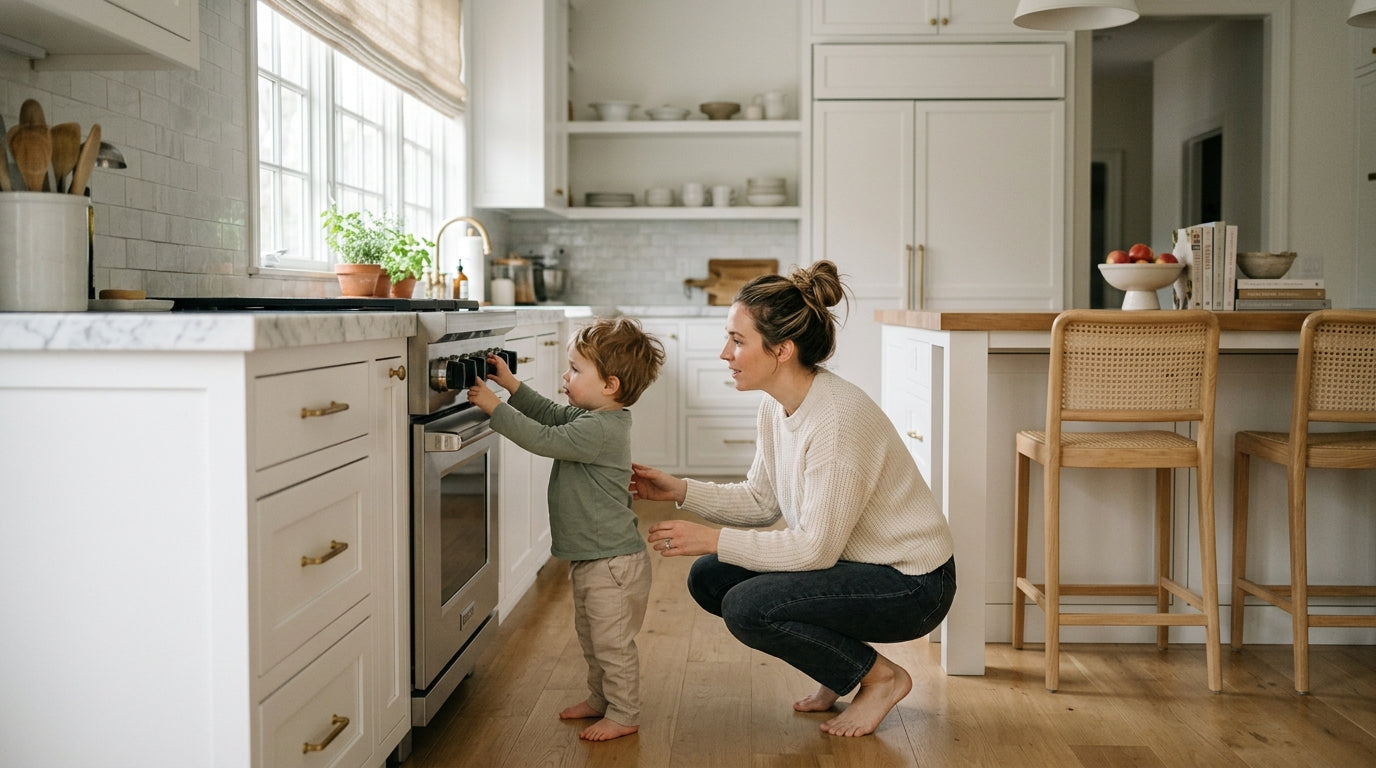
Burns are one of the most common kitchen injuries in young children. Stove knob covers prevent a child from turning on a burner, and they’re a good first step. But the more serious hazard is a child reaching up to a hot burner or pulling a pot handle.
Stove guards mount along the front edge of the stovetop and create a barrier that blocks a child’s reach. They should extend at least 8 inches from the stovetop edge and be secured firmly enough that a child pulling on them cannot dislodge them. Test this before you consider the installation complete.
Oven locks work like cabinet locks, requiring a two-step release to open the oven door. They’re particularly useful during the phase when a child is tall enough to reach the handle but not old enough to understand heat.
Toilet Locks and Bathroom Safety
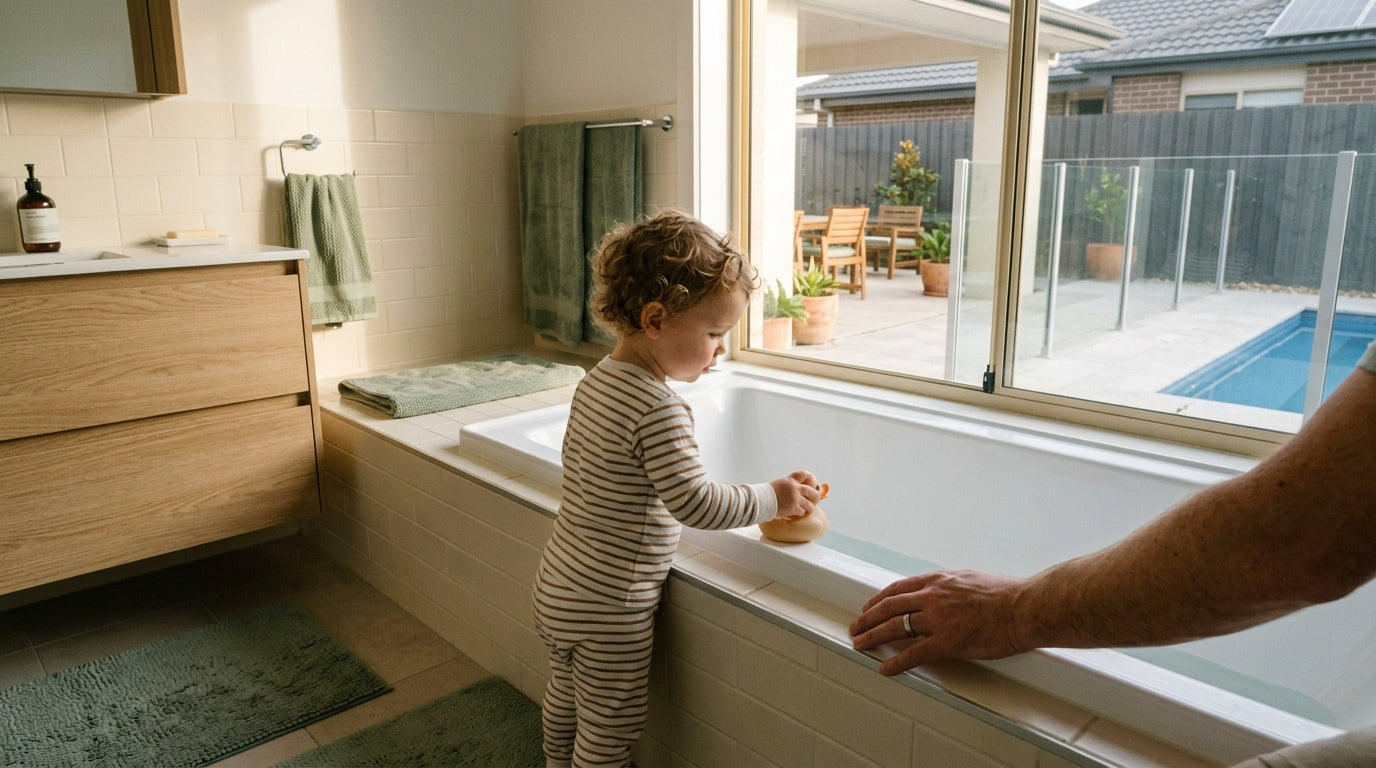
Drowning risk in the bathroom is real and underappreciated. Young children can drown in very shallow water, and a toddler who falls headfirst into a toilet cannot always right themselves. Toilet seat locks require pressing two points simultaneously to open, which is beyond most toddlers’ coordination. They’re not glamorous, but they work.
Bathroom door locks, mounted high or requiring a key, keep unsupervised children out of the bathroom entirely. This is the simpler solution if you can reliably keep the door closed. The toilet lock is a backup for the times you can’t.
Cord and Blind Safety
A cord is a tripping hazard, and a strangulation risk for infants and toddlers. Per AAP guidance, looped cords should be cut, secured with a breakaway device, or replaced entirely with cordless window coverings. This is one of the few baby proofing categories where replacement is often the right answer rather than an add-on product.
Cord wind-ups and wall-mount cleats keep cords out of reach temporarily, but they’re only as reliable as the last time you used them. Cordless blinds and shades have come down significantly in price and are available on Amazon across most standard window sizes. If you’re replacing window coverings anyway, cordless is the right default.
Appliance cords, including those from lamps, fans, and countertop appliances, should be routed behind furniture or secured with cord clips. A cord running across an open floor is a pull hazard as much as a strangulation hazard.
How to Prioritize When You Can’t Do Everything at Once
Most parents can’t baby proof the entire house in a single weekend. If you’re working through this in stages, start with the rooms where your child spends the most time and the hazards with the highest consequence.
Stairs and windows first. A fall from either can cause serious injury. Hardware-mounted gates at the top of stairs and window stops on upper-floor windows are the highest-priority installs.
Cabinets with chemicals second. Under-sink kitchen and bathroom cabinets, medicine cabinets, and utility closets. Magnetic locks on all of them.
Furniture anchors third, especially in the bedroom. A dresser tip-over can happen in seconds.
Everything else, including outlet covers, corner guards, and door locks, can follow in the order that matches your child’s current mobility and curiosity. A child who isn’t walking yet doesn’t need stove guards. A child who has just started pulling to stand needs furniture anchors immediately.
The CPSC’s baby safety resources and the JPMA’s certification program are both worth bookmarking. JPMA certification on a product means it has been independently tested against the relevant ASTM standard, which is a meaningful quality signal when you’re sorting through hundreds of Amazon listings. When in doubt, filter for JPMA-certified products and check that the listing names the specific ASTM standard it meets.
Baby proofing is not a one-time project. Revisit your setup every few months as your child’s height, strength, and problem-solving skills change. The lock that stopped a 14-month-old may not stop a 26-month-old.