How to Baby Proof a Lazy Susan Cabinet

Most cabinet locks work on one assumption: the door opens from one spot. A Lazy Susan breaks that assumption entirely.
The rotating tray inside means your child can push the door open at any angle, reach around the edge, and spin hazardous items directly toward them without ever fully opening the cabinet. Standard single-latch designs were built for fixed shelves. They were not built for this.
Why a Lazy Susan Is a Different Kind of Problem
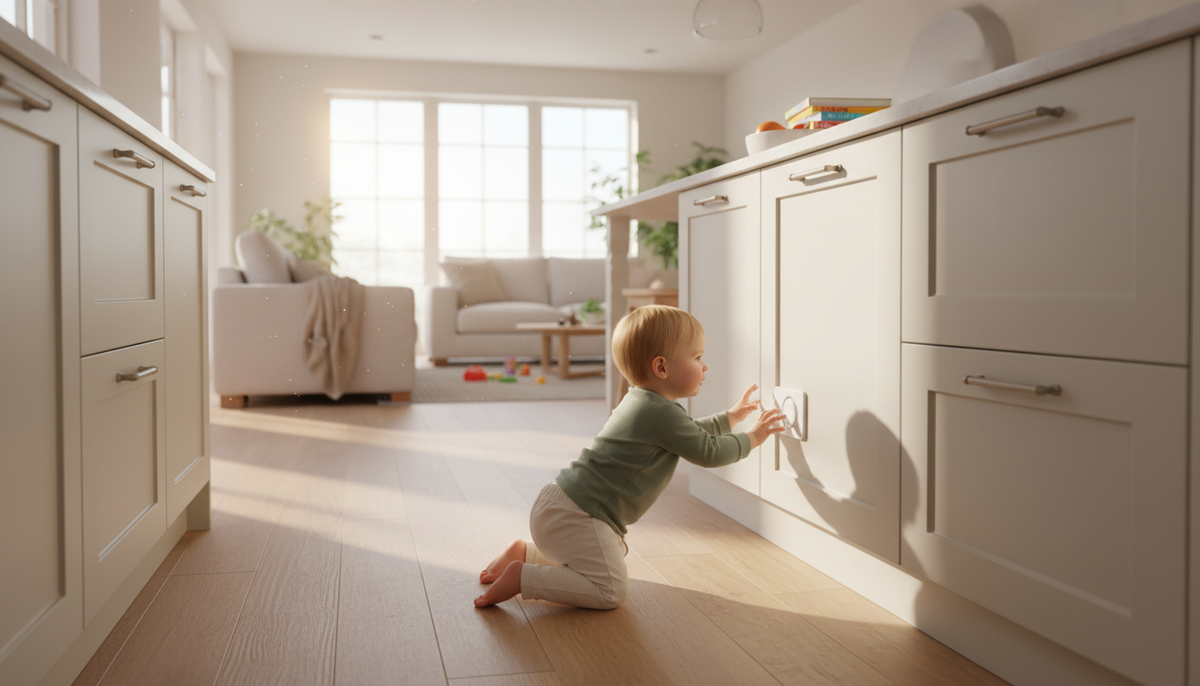
A regular cabinet has one door, one opening, one point of entry. A Lazy Susan has a rotating interior that can bring any item on the tray within reach of a small hand, regardless of where the door is sitting. My older daughter figured out that she could push the door open just a few inches, hook her fingers around the edge, and spin the tray. She got into a bag of rice that way at around 22 months. It was rice. It could have been something worse.
The rotating mechanism also means a child gets multiple attempts at any latch. They push, the tray moves, the door shifts slightly, and they try again from a new angle. A simple magnetic or adhesive lock that works perfectly on a standard cabinet can be defeated on a Lazy Susan just by persistence and geometry.
In 2024, household cleaning substances topped the list of substances kids under 6 got into, accounting for roughly 1 in 10 (10.1%) of all pediatric poison center cases, according to America’s Poison Centers. Many of those products live under kitchen sinks, often on a Lazy Susan.
The Lock Types That Work Here
Single-latch magnetic locks are not sufficient on their own for a Lazy Susan. The door flex and rotation give children too many angles of attack. What you need is a multi-point solution.
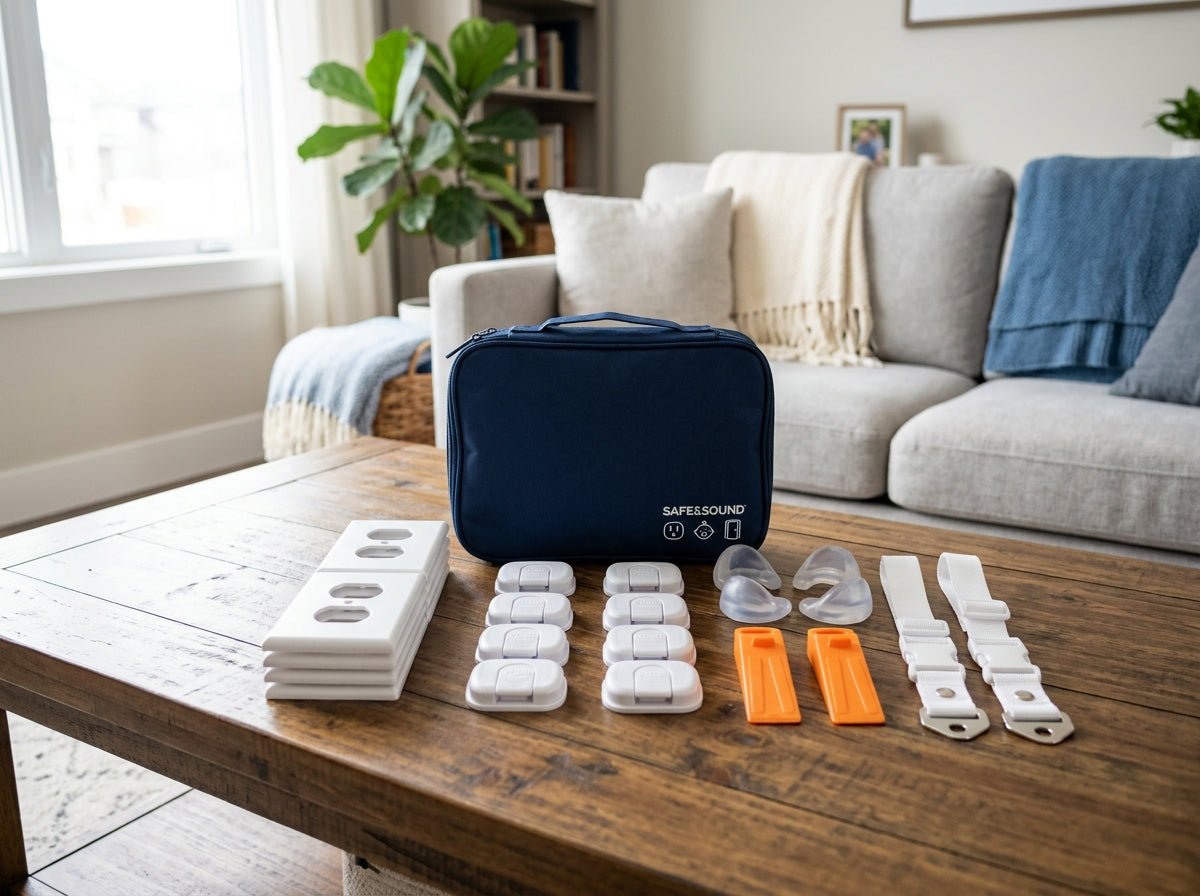
Multi-door spanning locks are the most effective option. These run across the full width of the cabinet opening and secure both doors simultaneously. Because they span the gap rather than latching at a single point, they prevent the partial-open manipulation that makes Lazy Susans vulnerable.
Key-operated or combination locks add a second layer of security. The rotating interior gives a child more opportunities to fiddle with a simple push-button latch from different positions. A keyed lock eliminates that variable entirely.
Two-point locking systems are worth the extra installation time. If your Lazy Susan’s design allows access to the central post or base, install a secondary lock there in addition to the door lock. Even if a child compromises one, the second point holds.
ASTM F3492–21 is the voluntary consumer safety standard that applies to cabinet locks and latches in the U.S. Locks that meet this standard must withstand an average breaking force of at least 45.3 lbs across a 30-sample test. Check product packaging for this certification before you buy.
A 2012 CPSC recall pulled 900,000 Safety 1st Push 'N Snap cabinet locks after reports of children as young as 9 months opening them. Three of those children reached toxic cleaning products. Simple push-button designs have a documented failure history. This is not theoretical.


Measure Before You Buy
Lazy Susans vary more than most people realize. A full-circle rotating tray has a different clearance radius than a kidney-shaped or half-moon tray. Some mechanisms sit close to the door frame; others have significant depth between the door and the first rotation point.
Before ordering any lock, measure the width of your cabinet opening, the depth from door to tray edge, and the clearance on each side of the door frame. Some spanning locks require a minimum frame width to mount properly. Some rotating mechanisms will jam against a lock housing that sits too far inside the opening.
Check the rotation radius specifically. If a lock housing protrudes into the interior space, it can catch on the tray mid-spin and prevent the cabinet from functioning at all. Adjustable hardware solves this, but only if you know your measurements going in.
Anchor the Cabinet
A Lazy Susan cabinet under a kitchen counter is usually toe-kicked in and relatively stable. A freestanding Lazy Susan unit, or a corner cabinet with less structural support, is a different situation.
If cleaning supplies, medications, or sharp objects live on your Lazy Susan, anchor the cabinet to the wall or floor. A child who cannot open the door may try climbing or pulling. According to the CPSC 2023 Annual Tip-Over Report, 64 of 79 chest, bureau, and dresser tip-over deaths between January 2013 and July 2023 involved children. The instinct to pull and climb does not discriminate by furniture type.
Wall anchoring is straightforward with a furniture strap rated for the cabinet’s weight. If the cabinet is built into cabinetry, confirm that the surrounding structure is secured to wall studs, not just drywall.
What Goes on the Tray Matters Too
No lock is a permanent solution. Children get older, locks wear out, and caregivers make mistakes. Relocating hazardous items is the backup layer that makes everything else more resilient.
According to the AAP, about 3 million people are exposed to a poisonous substance every year, and many are children under 5. Moving cleaning products to a high shelf or a separately locked drawer removes the hazard from the equation entirely, regardless of whether the Lazy Susan lock holds.
Reserve the Lazy Susan for bulky, non-toxic items: large pots, baking sheets, bags of dry goods. Anything with a warning label belongs somewhere a child cannot reach even if every lock fails.
Lazy Susan Safety Checklist
Test Weekly and Brief Your Caregivers
Lazy Susan cabinets experience more mechanical wear than standard cabinets. The tray spins constantly, the door flexes, and any lock spanning that opening absorbs friction and movement that a fixed-shelf lock never sees. Test your locking mechanism weekly. Pull on the door at multiple angles, not just straight on. If the lock feels loose or the mechanism has shifted, replace it.
Brief every caregiver who spends time in your home. A babysitter unfamiliar with a spanning lock may leave it unlatched after getting something out, or may not re-engage it correctly. Show them the mechanism in person. A two-second demonstration prevents the scenario where the lock is technically installed but functionally useless.
When to Consider Replacing the Cabinet
If you have multiple young children, frequent visitors with kids, or a Lazy Susan that stores hazardous materials and cannot be easily anchored or retrofitted, replacing it with a standard fixed cabinet is worth considering. The rotating mechanism adds complexity to childproofing that a fixed shelf simply does not have. A standard cabinet with a single reliable lock, anchored to the wall, storing only non-toxic items, is easier to secure and easier for caregivers to manage consistently.
The Lazy Susan is a convenience feature. Weigh that convenience against the specific configuration of your household and the ages of the children in it. For some families, the retrofit is straightforward. For others, the simpler solution is a simpler cabinet.