How to Baby Proof Your Home for a Foster Care Inspection

Inspection day for a foster care license is not the moment to discover your outlet covers don’t meet code. Inspectors arrive with a checklist, a flashlight, and the authority to delay placement. Getting ahead of their requirements protects both your license and the children you’re preparing to welcome.
Foster care safety standards pull from two main sources: your state’s licensing regulations and the AAP’s injury prevention guidelines. The overlap is substantial. Falls, poisoning, drowning, and suffocation account for the majority of unintentional injuries in young children, and inspectors are trained to look for exactly those hazards.
What varies by state is the specific product standard, the minimum height for locked storage, and whether certain items (pool fencing, window guards) are mandatory or just recommended. Pull your state’s foster care licensing checklist before you buy a single cabinet lock. That document is your real rubric.
Everything below maps to the hazard categories inspectors prioritize. Work through it room by room.
Furniture Stability and Tip-Over Prevention
Inspectors will physically push your furniture. Not gently. They test dressers, bookcases, wardrobes, and television stands by applying lateral pressure at the top. If a piece rocks, it fails.
Secure anything taller than your child’s height to wall studs using anti-tip straps or L-brackets. Adhesive-only straps are unreliable. In my experience, a toddler can defeat an adhesive strap lock in under a minute. Hardware into studs is the only method inspectors consistently accept. Use a stud finder, not your knuckles.
Televisions require separate attention. Flat-screen sets on entertainment units should be anchored with a strap rated for the TV’s weight. The strap packaging will list a maximum weight. Choose a strap rated for at least twice your set’s weight.
Remove any furniture that cannot be anchored safely, including decorative ladder shelves and freestanding coat racks, before inspection day.
Stair Gates and Fall Prevention
About 93,000 children under 5 are treated in U.S. emergency rooms each year for stair-related injuries, per a Nationwide Children’s Hospital analysis of CPSC NEISS data. That number is why inspectors treat stair gates as non-negotiable.
At the top of stairs, use only hardware-mounted gates. These bolt directly into wall studs or a banister adapter kit and cannot be dislodged by a child pushing against them. At the bottom, pressure-mounted gates are acceptable and preferred because they don’t create a fixed trip hazard for adults carrying laundry or a sleeping child.
All gates must meet ASTM F1004, the federal safety standard for expansion gates and expandable enclosures, made mandatory under 16 CFR Part 1239 (effective 2021). Check the gate packaging for the ASTM F1004 certification mark. Older gates bought before 2021 may not comply. Replace them if you’re uncertain. Inspectors know the standard and will ask.
Check that gates latch fully on their own. Walk through each one, let it swing closed, and confirm the latch engages without you pressing it shut. Gates that require a deliberate push-to-latch step will fail the test.
Electrical Safety
Every accessible outlet gets a cover. Inspectors check outlets at floor level, behind furniture, and in garages and utility rooms. Tamper-resistant outlet covers, the kind with internal shutters that require simultaneous pressure from both prongs to open, are the current standard. Simple plug-in caps are still acceptable in most states but are easier for toddlers to remove. If your outlets are older and lack built-in tamper resistance, tamper-resistant covers or full plate replacements are worth the upgrade.
Cord management matters as much as outlet covers. Bundle power strips and charging cables with cable ties or cord organizers and route them behind furniture or through cord channels. Blind cords are a separate category. Cut looped cords, install cord stops, or replace horizontal blinds with cordless versions. A looped blind cord at a child’s neck height is a strangulation risk and an immediate inspection failure.


Locked Storage for Medications and Chemicals
Everything toxic goes in a locked cabinet. That means prescription and over-the-counter medications, cleaning supplies, pesticides, laundry pods, dishwasher tabs, and any product with a poison warning label. Inspectors will open under-sink cabinets, check bathroom vanities, and look in the garage.
In my experience, an 18-month-old can empty an entire under-sink cabinet in the time it takes to answer the doorbell. Spring latches are often insufficient for foster inspections. Many states require a true lock, meaning a mechanism that requires a key or combination.
Store medications in their original labeled bottles. Keep a current list of all prescriptions in the home, including dosages and the name of the prescribing provider. Some inspectors will ask to see this list. Keep it in a consistent location.
Separate toxic substances from food storage. Under the kitchen sink and the pantry should not share a cabinet.
Window Safety
Windows above the first floor require guards or stops that prevent a child from falling through. Window screens do not count as fall protection. A screen is designed to keep insects out, not to support a child’s weight.
Window guards are metal bars or grilles installed inside the frame. They must have a quick-release mechanism for fire egress. Window stops are simpler: they limit how far a sash can open, typically to 4 inches. Either approach is acceptable in most states. Check your state’s specific requirement because some mandate guards on all second-floor windows regardless of window type, while others accept stops.
Inspect screens for tears or loose frames and replace damaged ones before the inspection. A missing or damaged screen on an upper-floor window is a flag even if guards are present.
Blind cord rules apply here too. Secure all window covering cords above 5 feet or replace with cordless options throughout the home.
Safe Sleep for Infants
If you’re licensed to care for infants, the sleep environment gets its own line items. The AAP recommends that infants sleep on a firm, flat surface with no pillows, loose blankets, bumper pads, or positioners. Room-sharing without bed-sharing is recommended for at least the first six months.
Inspectors will look at the crib or bassinet itself. Slat spacing must be narrow enough that a soda can cannot pass between them. Drop-side cribs are banned. If a crib was manufactured before 2011, it likely does not meet current federal standards and should be replaced. Do not use a secondhand crib unless you can verify its manufacture date and confirm it was never recalled.
Sleep sacks are a practical alternative to blankets for infants and are fully compliant with AAP guidance. Have one available if you’re expecting an infant placement.
Water Safety
Drowning is a leading cause of unintentional injury death in children under 5. Inspectors treat water hazards with corresponding seriousness.
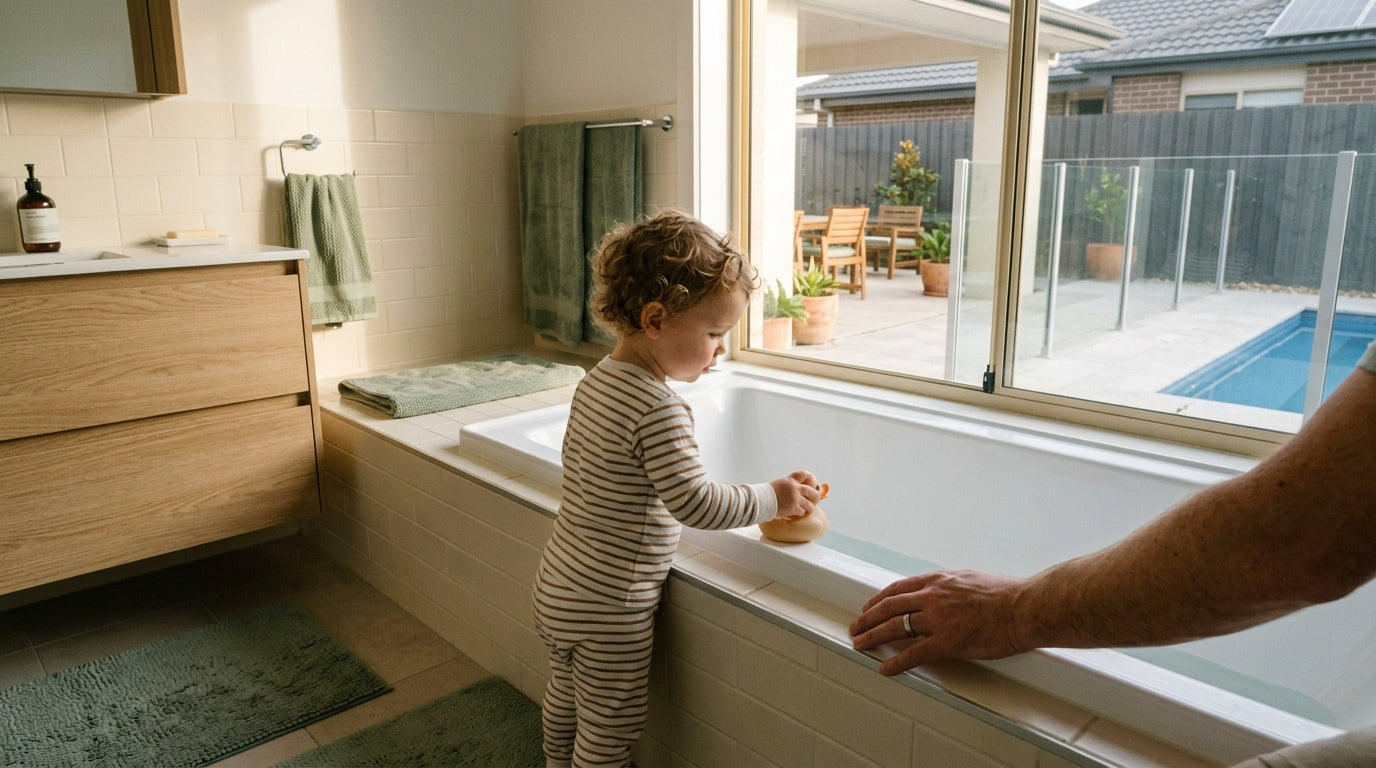
Install toilet locks on every toilet in the home. They look like a small clamp on the seat hinge and require two-step pressure to open. Place non-slip mats in every bathtub and shower. Add a drain cover to the bathtub if one isn’t already present.
If your home has a pool, spa, hot tub, or natural water feature, expect extended scrutiny. Most states require four-sided fencing with a minimum height (often 4 feet), self-closing and self-latching gates, and a latch positioned above a child’s reach. The fence must separate the water from the house. A wall of the house cannot serve as the fourth side in most jurisdictions. Verify your local requirement.
Many states also require at least one caregiver in the home to hold current CPR certification when infants or young children are placed. Schedule that course before your inspection date, not after.
Foster Care Inspection Checklist
Smoke and Carbon Monoxide Detectors
Install a working smoke detector on every level of the home and outside each sleeping area. Carbon monoxide detectors are required near bedrooms in any home with gas appliances, a gas furnace, or an attached garage.
Test every detector the week before your inspection. Press the test button and confirm the alarm sounds. Replace any detector that doesn’t respond. Smoke detectors older than 10 years should be replaced regardless of test results, as the sensor degrades over time.
Keep a log of your monthly tests. Write the date and your initials on a small card taped inside the detector cover, or keep a notebook in a consistent location. Inspectors appreciate documented maintenance. It signals that safety is a habit, not a pre-inspection scramble.
Choking Hazards and Toy Safety
Walk every play area at knee height and look for small toys, coins, button batteries, latex balloons, and plastic bags. Button batteries are particularly dangerous because they cause chemical burns to esophageal tissue within two hours of ingestion. They belong in a locked drawer.
Inspect toy bins for age-inappropriate items. If you have older children in the home, their small Lego pieces, marbles, and game tokens need to be stored separately from areas accessible to younger children. A zip-top bin on a high shelf works. A shared toy box on the floor does not.
Remove latex balloons from the home entirely for inspection. Inspectors consistently flag them, and they’re not worth the argument.
Emergency Planning and Documentation
Post your emergency plan where inspectors can see it. It should include fire escape routes with at least two exits from each bedroom, a designated outdoor meeting point, and emergency contact numbers including Poison Control (1-800-222-1222). Some states require this plan to be laminated or in a protective sleeve.
Walk through the escape routes yourself before inspection day. Confirm that windows designated as secondary exits can be opened fully and that any window guards have functional quick-release mechanisms.
Keep a documentation folder. Include photos of every installed safety device, receipts for major purchases, your monthly detector test log, and copies of any CPR or first aid certifications. This folder does two things. It demonstrates ongoing commitment to safety rather than a one-time effort, and it gives you a paper trail if any installation is questioned.
Inspectors are not adversaries. They’re evaluating whether a child will be safe in your home. A well-documented, consistently maintained home passes more reliably than a home that was assembled the night before. Start the process early, work through each hazard category systematically, and treat your documentation log as a living record you update every month.