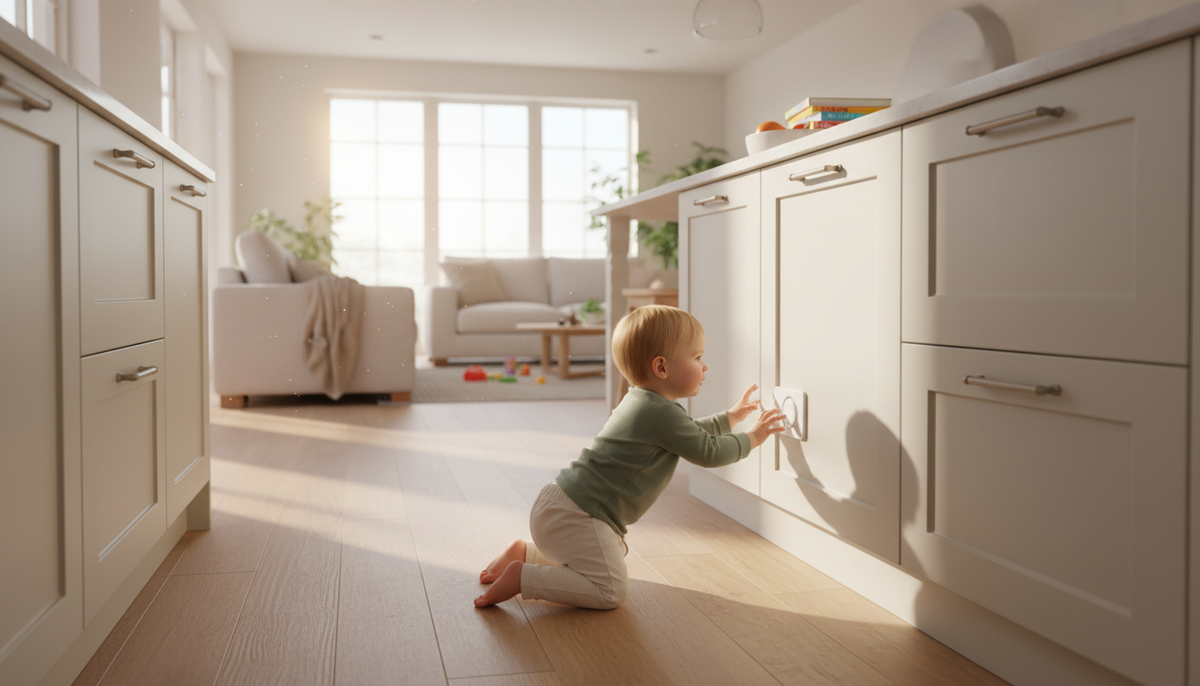
Every year, the CPSC receives reports of thousands of injuries to children under five involving furniture and cabinet hardware. Most happen in kitchens and bathrooms. Most are preventable. And most parents don’t realize the cabinet lock they installed three months ago has already been defeated.
Magnetic drawer locks are different. Not because they’re marketed better, but because the mechanism itself is harder to circumvent. A toddler who has learned to pry, pull, and wiggle a spring-loaded latch can’t apply that same logic to a lock with no visible moving parts.


How Magnetic Drawer Locks Work
The core mechanism is simple. A locking arm or bolt inside the cabinet holds the drawer or door shut. That arm is spring-loaded to stay in the locked position. The only thing that releases it is a magnetic key held against the exterior surface, close enough to attract the internal magnet and pull the arm free.
There are no external buttons, no levers, no gaps to pry. From the outside, the cabinet looks unmodified. From a toddler’s perspective, there is nothing to interact with. That’s the design advantage.
Most systems use rare-earth (neodymium) magnets in the key. These are strong enough to work through cabinet material up to about 1.5–2 inches thick, depending on the brand. The lock body mounts inside the cabinet with screws, and the key is a small disc or wand you keep out of reach. Installation takes about ten minutes per cabinet if you’re comfortable with a drill.
Why Visible Locks Fail Faster Than Parents Expect
My older daughter defeated an adhesive strap lock at 26 months. I watched it happen. She didn’t brute-force it. She figured out the release mechanism by watching me open it twice, then tried it herself. The strap lock was gone by the end of the week.
Spring-loaded and adhesive locks have a fundamental vulnerability: they’re interactive. A curious child can see the latch, touch it, and experiment with it. Given enough time and enough motivation (and toddlers have both), many of them work it out. The AAP notes that children between 18 and 36 months are in a peak phase of cause-and-effect learning. That’s exactly the cognitive stage that makes a visible latch an interesting puzzle.
Magnetic locks remove the puzzle. There’s no latch to find, no button to press, no mechanism to reverse-engineer. The drawer simply doesn’t open. In my experience, children who encounter magnetic locks tend to pull once or twice and move on. There’s no feedback loop to exploit.


Where to Install Them: Room by Room
Kitchen. This is the highest-priority room. Under-sink cabinets often hold dishwasher pods, drain cleaner, and other chemicals that are acutely toxic to small children. The CDC reports that poisoning is the leading cause of injury death in the United States, and household cleaners are among the most common culprits in pediatric cases. Knife drawers are the other obvious target. Magnetic locks work well on both because they’re invisible and don’t require any change to how you use the space.
Bathroom. Medications, razors, and cleaning supplies all live here. The bathroom is also a room where parents are often distracted or occupied. My younger daughter emptied the under-sink cabinet in the time it took me to answer the doorbell. I had a spring latch on that cabinet. She’d learned to compress it. After that, every bathroom cabinet in our house got magnetic locks within the week.
Home office. Scissors, letter openers, batteries, and small electronic components are all hazards. Desk drawers are often overlooked in a room-by-room safety audit because they don’t feel like "kitchen cabinet" territory. They should be locked.
Laundry room. Laundry pods are one of the most dangerous household items for young children. Their bright colors and soft texture make them appealing. The CPSC has issued multiple warnings about pediatric laundry pod ingestion. If your detergent lives in a low cabinet or drawer, lock it.
Bedrooms. Less urgent than kitchens and bathrooms, but worth considering for any drawer holding medications, cosmetics with small parts, or anything with button batteries. Button batteries can cause severe internal burns if swallowed, and the AAP treats them as a medical emergency.

- Under-sink chemicals and dishwasher pods
- Knife drawer within toddler reach
- Low pantry cabinet with small hazards
- Countertop items outside lock protection
-
Dry fit the lock body
Mount the lock loosely inside the cabinet, close the drawer slowly, and confirm the arm engages cleanly before tightening. -
Drill a pilot hole
Use a bit slightly smaller than your screw diameter to prevent splitting, especially on thin particleboard cabinet interiors. -
Secure the lock body
Tighten screws firmly but do not overtighten on particleboard. Add an adapter plate for frameless European-style cabinets. -
Find and mark the key release point
Hold the key against the exterior, locate the exact release spot, and mark it lightly with a pencil for quick daily access. -
Store keys at adult height
Place one key on a high hook in each room and one in a central location, out of reach of children at all times.
Choosing a System: What the Specs Mean
Not all magnetic lock systems are equal. Here’s what to evaluate.
Magnet strength and range. The spec you want is the maximum cabinet thickness the key works through. Most quality systems work through 1–1.5 inches of wood. If you have thicker cabinet faces or plan to install on particleboard with a veneer overlay, measure first. A lock that can’t reliably release from the outside is just a lock you’ll be frustrated by.
Locking force. This is listed in pounds of holding force. For kitchen drawers and cabinet doors, look for at least 40 lbs. Some systems rate higher. Higher holding force matters more for drawers than doors, because drawers get pulled directly outward rather than swung.
Screw vs. adhesive mounting. Screw-mounted locks are significantly more reliable. In my experience, adhesive systems fail on painted MDF, which is common in kitchen cabinetry. If you’re renting and can’t drill, adhesive is your only option. Know that it’s a compromise.
Key management. Most systems come with two keys. Some come with three. Keep one in a consistent high location in each room and one in a central spot. Losing the key is inconvenient. Some brands sell replacement keys; confirm this before you buy.
Universal vs. proprietary keys. Some magnetic lock systems use a standardized key that works across brands. Others use proprietary keys that only work with their own locks. Proprietary systems offer a slight security advantage (a child who finds a key from one brand can’t use it on another brand’s locks), but they mean you can’t mix and match if you expand your system later.


Installation: What Goes Wrong and How to Avoid It
The most common installation mistake is misaligning the lock body with the strike plate or the door frame. Magnetic locks need the internal arm to seat correctly when the door closes. If the lock body is even a quarter-inch off, the arm won’t catch, and the drawer will feel loose without locking.
The fix is to do a dry fit first. Mount the lock body loosely, close the drawer or door slowly, and check that the arm engages cleanly. Then tighten the screws. On frameless cabinets (common in European-style kitchens), you may need a small adapter plate. Most quality systems include one.
Drilling tip: Use a drill bit slightly smaller than your screw diameter. Cabinet interiors are often thin, and a pilot hole prevents splitting. On particleboard specifically, stripped screws are a real risk if you overtighten.
One more thing: test the key position before you commit. Hold the key against the exterior and find the exact spot where the lock releases. Mark it lightly with a pencil. That’s where you’ll reach every time. It sounds obvious, but in a hurry, fumbling for the release point with a toddler on your hip is annoying if you haven’t internalized the location.
Room-by-Room Lock Audit
The Limits of Magnetic Locks
Magnetic locks are not appropriate for every application. They don’t work on metal cabinets because the key’s magnetic field is disrupted by the cabinet material itself. They’re also not suitable for drawers or doors that need to be accessed by older children or other adults who won’t have access to the key. In a multi-generational household, this can create real friction.
There’s also the question of emergency access. If a child is locked inside a cabinet (rare, but worth thinking through), you need the key to open it from the outside. Keep keys accessible to adults but out of reach for children. A hook at adult eye level works. A drawer in the same room does not.
And magnetic locks won’t solve every hazard in a room. They secure the specific drawers and cabinets you install them on. Open shelving, freestanding furniture, and items left on countertops are outside their scope. A magnetic lock on the under-sink cabinet doesn’t help if the dish soap lives on the edge of the counter.
Integrating Magnetic Locks Into a Broader Safety Plan
The CPSC recommends a layered approach to home safety. Locks are one layer. Supervision is another. Environmental design (keeping hazardous items out of low spaces entirely) is a third. Magnetic locks work best when they’re part of that layered approach, not a substitute for it.
In practice, this means doing a room-by-room audit before you buy anything. Identify every cabinet and drawer that holds something hazardous. Prioritize by severity: cleaning chemicals and medications first, then sharp objects, then small parts and batteries. Install locks on the highest-risk locations first, then expand.
It also means revisiting your setup as your children grow. A four-year-old is more likely to find and experiment with the magnetic key than a two-year-old. The lock itself remains effective, but key storage strategy may need to evolve. Keeping keys in a consistent, high location helps. So does explaining to older children why certain cabinets are locked, which builds awareness without advertising the key’s location.
Magnetic locks are one of the more durable child safety investments you can make. The mechanism doesn’t wear out the way adhesive does, and there’s nothing external to break or defeat. Installed correctly on the right cabinets, they’ll stay effective well into the preschool years, which is exactly the window when you need them most.