Every first-time parent I know has a version of the same list. The cute stuff gets ordered in the first trimester. The safety stuff gets added in a panic during the third. And then, somewhere between the swaddle blankets and the white noise machine, the items that prevent the worst outcomes get skipped entirely.
I’ve been through this twice. And I’ve spent years reviewing safety products professionally. The gaps I see in "newborn essentials" lists are almost always the same gaps.
This is the list I wish someone had handed me before my older daughter came home.
Why Safety Items Get Skipped on Most Lists
Baby registries are built around moments. The first bath. The first outing. The first night home. Products that photograph well and feel celebratory get recommended. Products that prevent invisible emergencies do not.
There’s also a timing problem. Most parents don’t think about furniture anchoring until a toddler tries to climb a bookshelf. They don’t think about carbon monoxide until they read a news story. But by then, the baby is already home. The window to do this calmly, before sleep deprivation sets in, has closed.
The items below are not optional accessories. They are the infrastructure your home needs before a newborn arrives. Some of them take under ten minutes to install. Some of them require a weekend. None of them should be left until after the birth.
Sleep Safety: The Foundation Before Everything Else
About 3,500 infants die each year from sleep-related causes in the United States (CDC SUID data). That number includes SIDS, accidental suffocation, and deaths from unsafe sleep environments. Unintentional suffocation kills roughly 1,000 infants under age 1 each year in the United States (CDC).
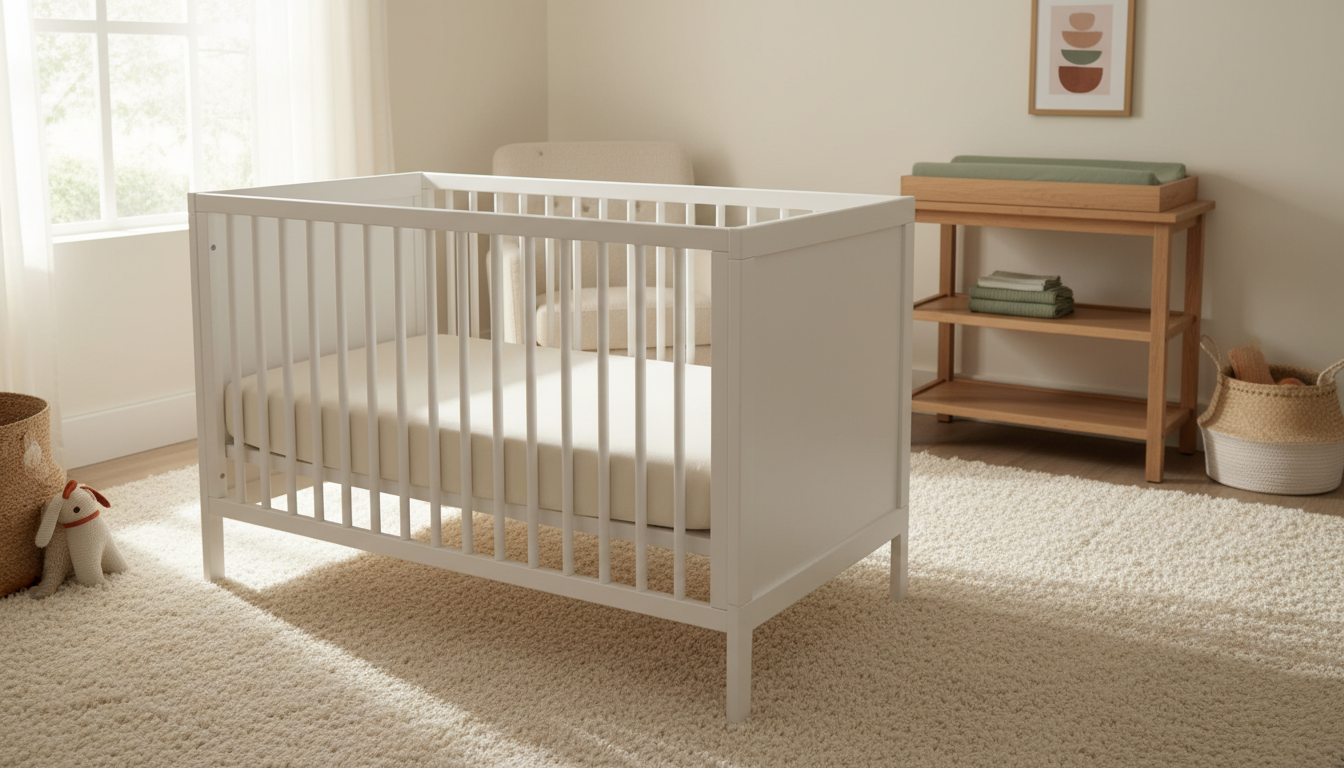
The product you need is simple: a firm, flat sleep surface with no incline, no padding, and no extras. A crib, bassinet, or play yard that meets current CPSC standards. Nothing in the sleep space. No positioners, no wedges, no bumpers, no loose blankets.
What parents forget is that the sleep surface they already own may not meet current standards. Products sold before 2022 may predate the Safe Sleep for Babies Act, which banned inclined sleepers and crib bumpers from the market. If someone is gifting you a hand-me-down bassinet, check the model number against CPSC recalls before it enters your home.
The other thing parents skip: a firm mattress cover. The mattress that comes with a crib is not always the right firmness. Press your palm flat against the center. It should not compress more than an inch. If it does, replace it.
Smoke and Carbon Monoxide Alarms
Three out of five home fire deaths occur in homes with no smoke alarms or non-functioning ones (NFPA). That statistic never stops being jarring.
And yet I’ve walked through homes with newborns where the only smoke alarm is the one that came with the house in 2009, still running on its original battery.
CO poisoning kills more than 400 people each year and sends more than 100,000 to U.S. emergency rooms (CDC). Carbon monoxide is colorless and odorless.
Infants are more vulnerable to it than adults because their respiratory rates are higher. They will not wake up and cry. You will not smell anything.
Before your baby comes home, do three things. First, test every existing smoke alarm. Replace any that are more than ten years old. Second, install a combination smoke and CO alarm on every level of your home and within ten feet of every sleeping area. Third, check the batteries. Not "they’re probably fine." Check them.
I replaced two smoke alarms in my home when I was pregnant with my older daughter and found one that had been silenced with a piece of tape over the sensor. Someone, at some point, had gotten annoyed by a false alarm and done the worst possible fix. That tape had been there for years.


Furniture Anchoring: Do It Before the Nursery Is Finished
CPSC reports one child death every two weeks from tip-overs. Those deaths are not limited to toddlers. Dressers fall on infants who are placed on top of them for diaper changes. Bookshelves fall when older siblings climb them in rooms where newborns are sleeping.
The nursery dresser is the most commonly skipped item. Parents buy it, assemble it, fill it with tiny onesies, and never anchor it to the wall. The anti-tip strap takes about five minutes to install and costs less than ten dollars. It requires finding a wall stud. That’s the whole job.
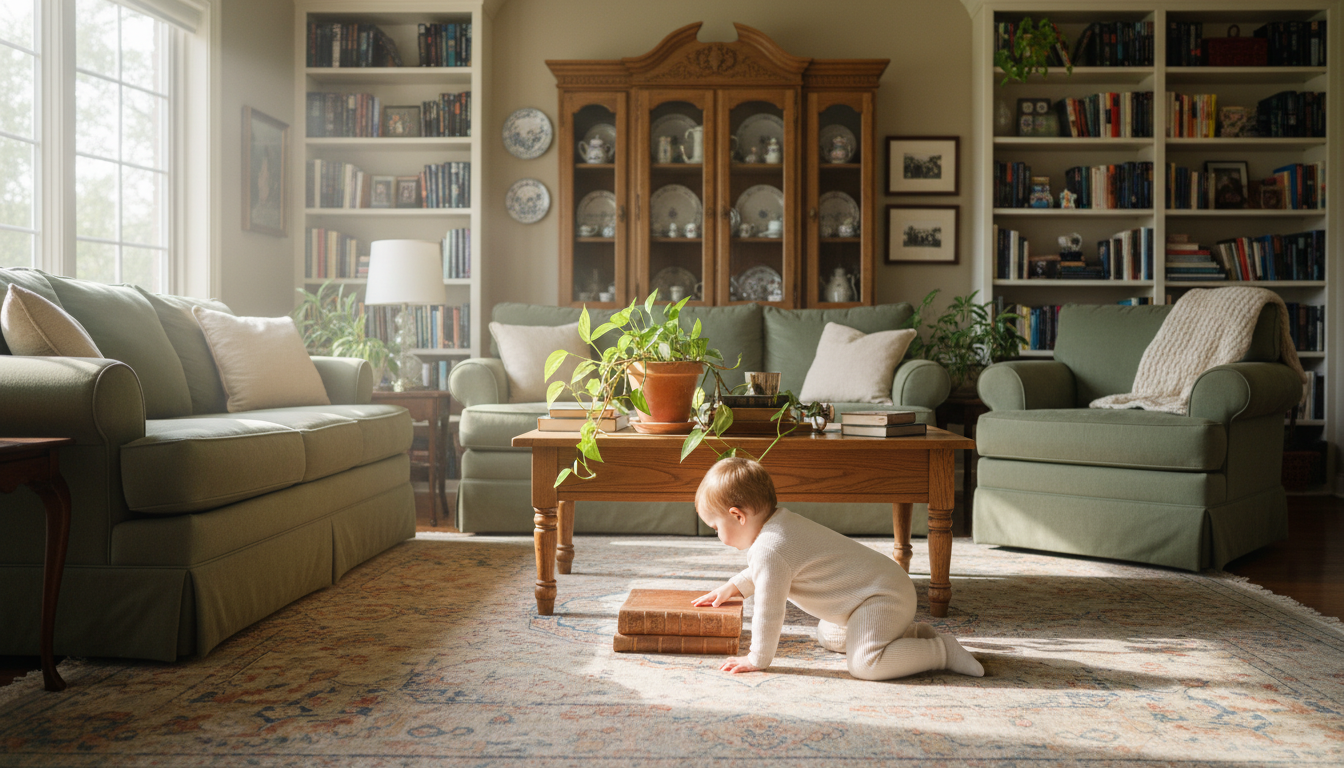
Anchor every piece of furniture taller than 30 inches in any room your baby will spend time in. That includes the living room bookshelf, the TV console, and the wardrobe in your bedroom if your baby will sleep there. Do it before the baby arrives. You will not have time or energy to do it after.
Use anti-tip straps rated for the weight of the furniture plus the weight of anything stored in it. For a dresser loaded with clothes, that number is higher than most people assume. L-brackets into studs are more secure than strap kits for very heavy pieces. If you’re not sure, use both.

- Unanchored dresser, tip-over risk
- Bookshelf needs wall anchor
- Outlet requires sliding plate cover
- Blind cord must be secured 5 ft up
- Crib mattress firmness needs testing
Baby Gates: Not All of Them Are Legal
About 93,000 children under 5 are treated in U.S. emergency rooms each year for stair-related injuries (Nationwide Children’s analysis of CPSC NEISS data, 1999–2008).
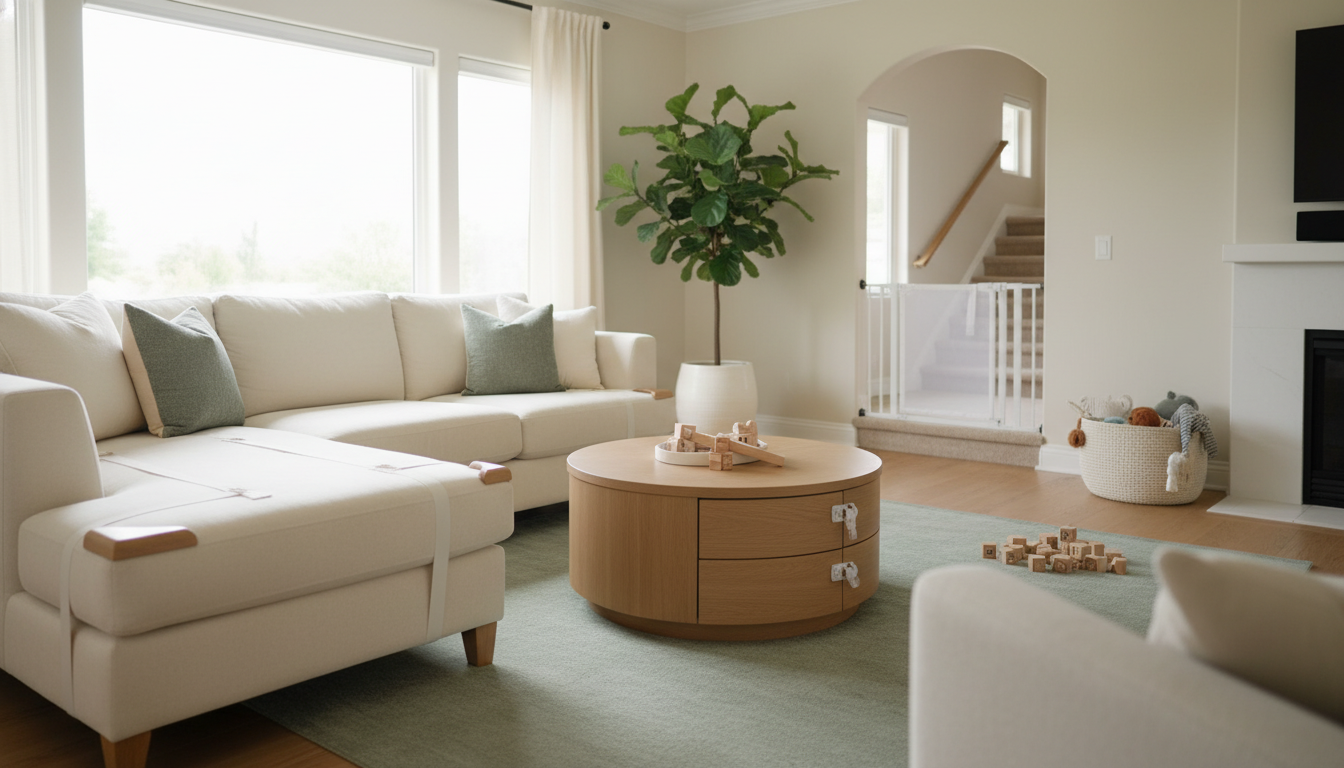
For top-of-stair installations, you need a hardware-mounted gate. Pressure-mounted gates are for doorways and room dividers only.
A pressure-mounted gate at the top of stairs will give way under the weight of a falling child. This is not a design flaw. It is a use-case mismatch. The packaging will tell you. Read it.
Look for ASTM F1004 certification on the box when shopping for gates. If a gate doesn’t list it, skip the gate.
My younger daughter was about 14 months old when she figured out how to push through a pressure-mounted gate I had incorrectly installed at the top of our back staircase. I had read the instructions and still made the wrong call because the gate fit the opening and felt solid. It was not solid. Hardware-mounted only, at the top of any stairs.
Buy the gates before the baby comes home. Install them before the baby comes home. You will not have time to do it when you’re running on three hours of sleep and the baby has learned to roll.


Cabinet and Drawer Locks: The Under-Sink Cabinet Is the Priority
The cabinet under your kitchen sink contains dish soap, drain cleaner, dishwasher pods, and possibly bleach. These are among the most toxic substances in a home. Unsupervised exposures to household chemicals send children to emergency departments regularly.
You do not need to lock every cabinet before a newborn arrives. Newborns cannot open cabinets. But you have about nine months before your baby becomes mobile, and that window passes faster than you think. Install locks on the under-sink cabinet, any cabinet containing cleaning products, and any drawer containing knives or sharp tools before the baby comes home. Do the rest when your baby starts pulling up to stand.
The under-sink cabinet is the one I always tell parents to do first. My younger daughter emptied ours in the time it took me to answer the front door. She was 11 months old. The cabinet had a magnetic lock that I had not yet installed because I thought I had more time. I did not have more time.
For under-sink cabinets, magnetic locks or sliding locks are more reliable than adhesive strap locks. Adhesive locks work fine on upper cabinets and drawers. On lower cabinets that get opened frequently, the adhesive weakens over time. My older daughter defeated an adhesive strap lock at 26 months by pulling steadily on the door rather than yanking it. She had figured out the mechanism.
Outlet Covers and Cord Management
Standard outlet covers are the item most parents do buy, and often the item they buy wrong. Plug-in caps are the most common choice. They are also the easiest for young children to remove, and a removed cap becomes a choking hazard.
Sliding plate covers, which replace the existing outlet cover and require an adult-style two-step motion to open, are more effective. They cannot be pulled out and swallowed. Install them in any room your baby will spend time in before the baby comes home.
Cords are a separate issue. A cord is a tripping hazard and a strangulation risk for infants. Window blind cords are the specific concern here. Corded window blinds have been phased out of new production, but older homes still have them. Any corded blind in a room where your baby will sleep should be replaced or have the cord wound and secured at least 5 feet off the floor before the baby arrives.
Power strips should be covered or placed behind furniture. Charging cables should not be left on the floor or hanging from surfaces where a baby could reach them.
Before Baby Comes Home
Car Seat: The Standard Is Changing in 2026
You cannot leave the hospital without a car seat. Most parents know this. What fewer parents know is that FMVSS 213a, the new federal child restraint side-impact standard, takes effect December 5, 2026. If you are buying a car seat this year, look for models that already meet 213a. Manufacturers are beginning to label compliance now, ahead of the mandatory date. A seat that meets the new standard has been tested for side-impact crashes in a way that previous seats were not required to be.
Install the seat before your due date. Have it inspected by a certified Child Passenger Safety Technician. Many fire stations and hospitals offer free inspections. The NHTSA website has a locator. A correctly installed seat and a seat that feels correctly installed are not always the same thing. Get the inspection.
The Items That Complete the List
A few more items belong on this list that rarely appear on registry guides.
- A first aid kit designed for infants, with a nasal aspirator, infant thermometer (rectal for newborns), and saline drops. Not the general-purpose kit from the drugstore.
- A baby monitor with video, positioned so you can see the full sleep surface. This is not a luxury. It is how you verify safe sleep positioning without entering the room every twenty minutes.
- A door pinch guard on any door your baby could be near when it swings. Finger amputations from door hinges are more common than most parents realize.
- A non-contact thermometer for room temperature. The AAP recommends keeping a baby’s sleep environment between 68°F and 72°F. Most parents guess at this. A thermometer tells you.
Before the Baby Comes Home
The single most useful thing I can tell you is this: the week before your due date is too late to start on most of this. Furniture anchoring requires finding studs. Gate installation requires measuring and sometimes patching. Smoke alarm replacement requires a trip to the hardware store.
Start the safety checklist at 32 weeks. Finish it at 36. Give yourself the last month to focus on the things that cannot be done in advance.
The cute items on your registry will make the first weeks warmer and easier. The safety items on this list are what make those first weeks possible.