The moment your baby pulls up on the coffee table and takes three shaky steps toward you, something shifts. It’s thrilling. And it’s the moment your home stops being a place you live and becomes a place you manage.
Developmental motor milestones don’t arrive on a schedule you control. They arrive on your child’s schedule, which is usually faster than you expected and always faster than you’ve prepared for. Understanding what’s coming, and when, is the only way to stay ahead of the hazards each new skill unlocks.
The Crawling-to-Walking Window: What’s Typical
Most children take their first independent steps somewhere between 9 and 12 months, though the range stretches well past that. Cruising along furniture, pulling to stand, and standing briefly without support are the precursors. You’ll see those for weeks before independent steps appear. AAP recommends consulting your pediatrician if your child is not walking independently by 18 months, so if you’re watching a 16-month-old still crawling exclusively, there’s no cause for alarm yet, but it’s worth flagging at the next well visit.
What matters for safety planning is that cruising and pulling-to-stand arrive before walking. Your child can reach the top of the coffee table, the second shelf of a bookcase, and the edge of the stove before they can walk across the room. Height access expands before mobility does. That’s the window parents most often miss.
Running, Climbing, and the Acceleration Phase
Walking becomes running within weeks of those first independent steps, not months. By 18 months, most toddlers can run, though with limited ability to stop or turn quickly. By 24 months, they’re climbing. Not just the couch. Bookshelves. Dresser drawers used as ladder rungs. The outside of the stair railing.
My older daughter was 26 months when I watched her drag a step stool to the kitchen counter, climb onto the counter, and reach the top of the refrigerator. She wasn’t looking for anything specific. She was just testing what was possible. That’s developmentally normal. It’s also the moment I understood that height-based storage is not a safety strategy.
The climbing phase is also when furniture tip-overs become a serious threat. According to CPSC data, one child dies every two weeks from tip-overs involving furniture, TVs, or appliances. The mechanism is almost always the same: a child climbs a drawer front or pulls on a shelf, and the piece comes down on top of them. Knowing that your child will attempt this, even if they never have before, is the baseline assumption you need to operate from by 18 months.


Stairs: The Injury Category Parents Underestimate
Stairs are one of the earliest hazard categories that demands a physical barrier, not just supervision. About 93,000 children under 5 are treated in U.S. emergency rooms each year for stair-related injuries, according to Nationwide Children’s Hospital analysis of CPSC NEISS data from 1999 to 2008. That works out to roughly one child every six minutes.
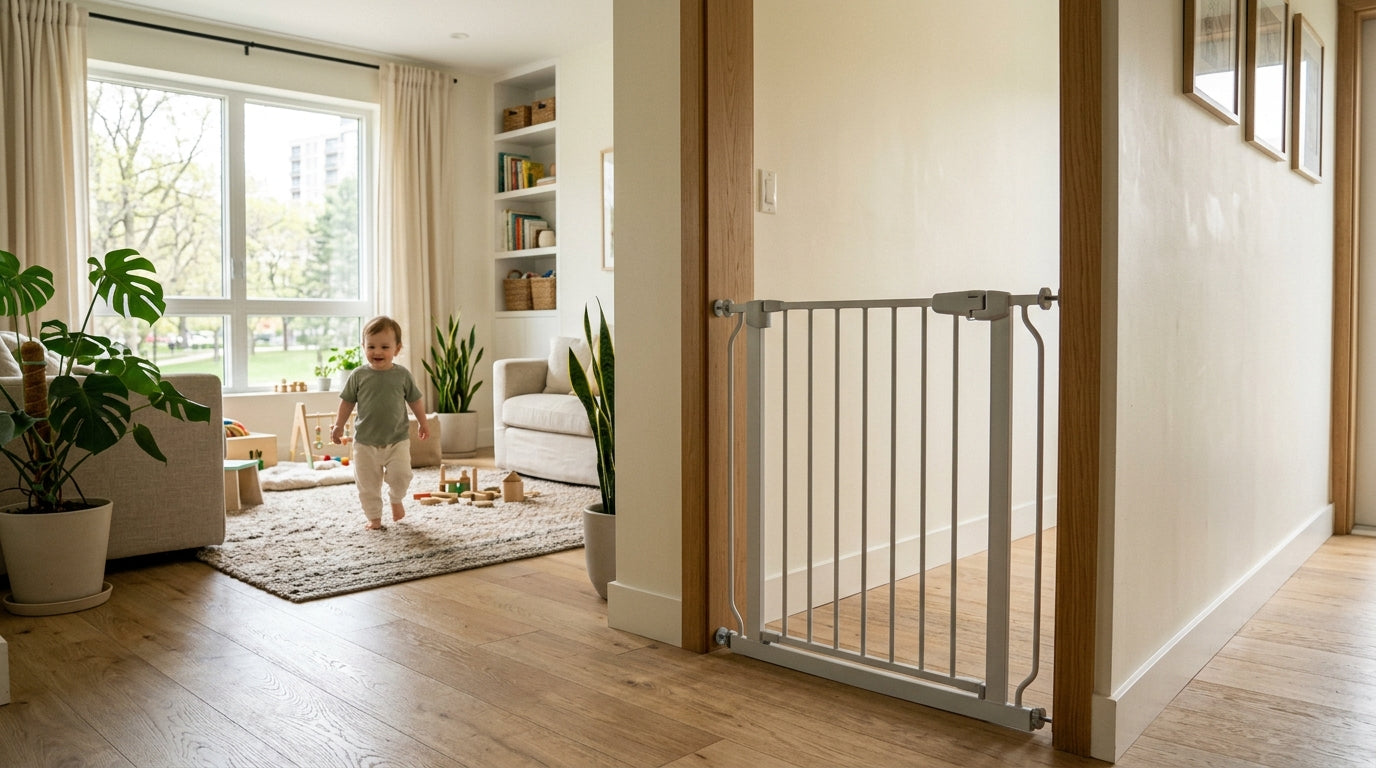
The stair gate conversation usually focuses on the bottom of the stairs, but the top is where the serious falls happen. A fall from the top of a staircase is a fall from height, with no soft landing. ASTM F1004 is the federal safety standard for expansion gates and expandable enclosures, made mandatory under 16 CFR Part 1239 (effective 2021). For top-of-stair installation, you need a gate that hardware-mounts to the wall, not a pressure-mounted gate. Pressure-mounted gates are appropriate for doorways and room dividers. They are not appropriate for the top of stairs, where a child leaning on the gate can push it free.
I’ve installed both types in two houses. The difference in how they feel under pressure is immediate. A hardware-mounted gate doesn’t flex. A pressure-mounted gate does. At the top of a staircase, that flex is the problem.

- Toilet: drowning risk for under-36-month-olds
- Under-sink cabinet: cleaning products inside
- Door: add high hook-and-eye latch to block entry
- Bathtub: never leave standing water unattended
What Climbing Means for Furniture and Storage
Once your child is climbing, the concept of "out of reach" has to be retired. Anything a child can reach by stacking, dragging, or climbing is within reach. This changes how you think about every room.
Dressers and bookshelves need to be anchored to the wall. Full stop. Anti-tip straps are inexpensive, and most furniture manufacturers include them or sell them as accessories. The strap goes through the back of the furniture into a wall stud. Two anchor points are better than one. The goal is that if a child climbs the drawer fronts, the piece doesn’t move.
TVs are a separate problem. A flat-screen mounted to the wall is safer than one sitting on a stand, because it removes the tipping mechanism entirely. If your TV is on a stand, the stand needs to be anchored, and the TV needs to be secured to the stand with a strap or bracket rated to hold at least several times the TV’s weight.
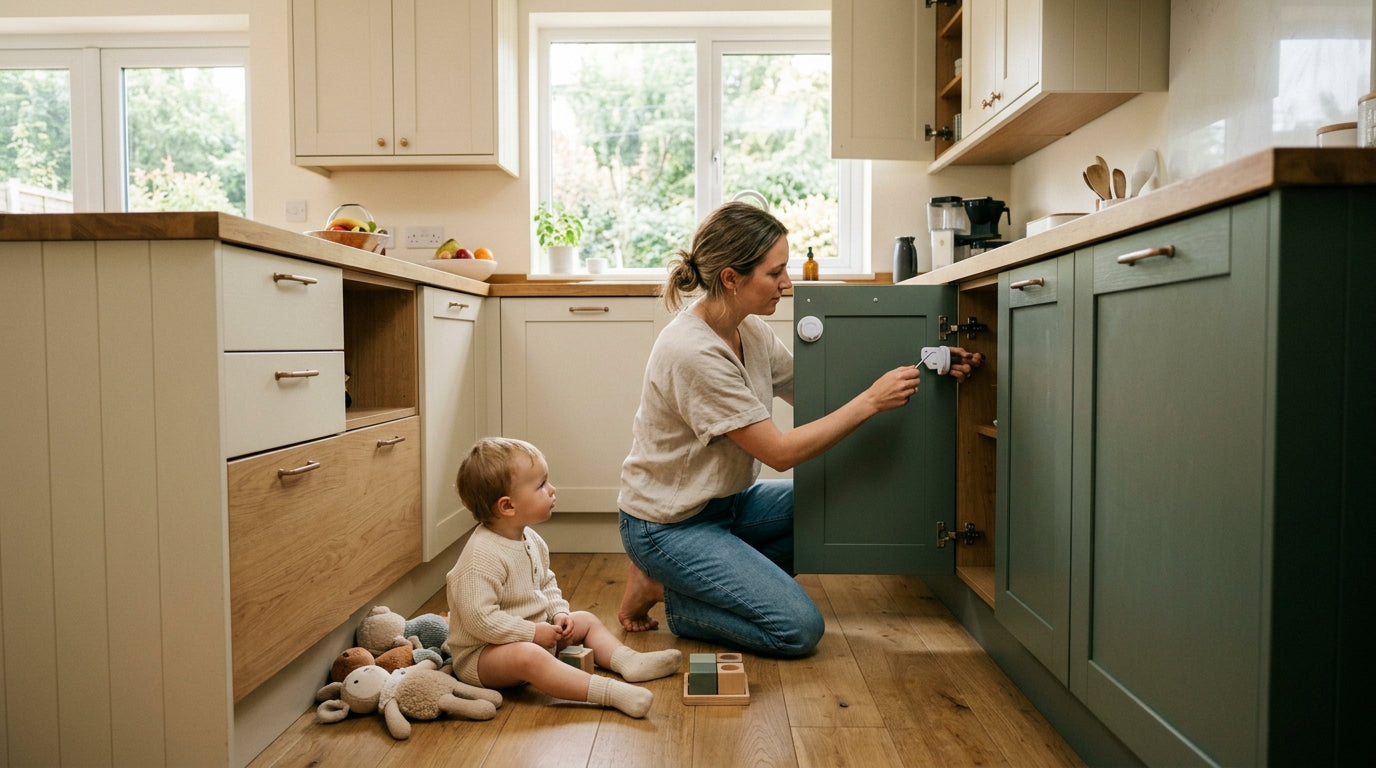
My younger daughter once emptied the entire under-sink cabinet in the time it took me to answer the doorbell. I was gone maybe 90 seconds. She wasn’t climbing in that instance, just pulling, but it reminded me that speed and curiosity scale together as children develop. The cabinet was relocked that afternoon with a magnetic lock, which requires a magnetic key held to the cabinet face to release. She has not opened it since.


Cabinet Locks: Which Hazards Demand Them
Not every cabinet needs a lock. But some absolutely do, and the developmental window for installing them is before your child can walk, not after they’ve already gotten in.
The categories that require locks:
- Under-sink cabinets in kitchens and bathrooms. These typically hold cleaning products, drain chemicals, and dishwasher pods. Many of these products are required by 16 CFR 1700.14 to ship in child-resistant packaging, but child-resistant packaging is not childproof. Under 16 CFR 1700.15, packaging passes the child-resistant bar if at least 85% of tested children (ages 42–51 months) can’t open it within 10 minutes, or 80% after an adult demonstrates how. That means roughly 15–20% of children in the test age range can still get in.
- Medicine storage. According to CDC PROTECT data, unsupervised medication exposures send roughly 100 children under five to U.S. emergency departments every day. According to CPSC data, 90 U.S. children under 5 died from unintentional poisonings in 2023, with deaths from narcotics and psychodysleptics doubling from 33 in 2021 to 66 in 2023. Medications belong in a locked cabinet or a locked box, not a high shelf.
- Any cabinet containing sharp tools, batteries, or hardware. Button batteries are a swallowing hazard. Sharp tools are obvious. These don’t need to be accessible to children at any age.
ASTM F3492–21 is the voluntary consumer safety standard that applies to cabinet locks and latches in the U.S. When shopping, look for products that reference this standard. It doesn’t guarantee a specific product is good, but it means the manufacturer is working within a tested framework.
Water Access and the Running Toddler
Running changes water hazards. A toddler who can run can reach a bathroom, a toilet, a bucket of mop water, or a backyard kiddie pool faster than a walking child. Drowning is the leading cause of unintentional injury death in children ages 1–4 (CDC), and a child can drown in as little as one to two inches of water (AAP).
Toilet locks are underused. Most parents think of them as optional. They’re not optional if you have a child between 12 and 36 months who can open a bathroom door. The toilet is a drowning risk, and it’s also a hand-washing and splashing destination that children find endlessly interesting.
Bathroom doors should have a handle lock or a hook-and-eye latch mounted high on the door frame, out of reach, to prevent unsupervised access entirely. This is more reliable than any toilet lock, because it removes the opportunity before the child reaches the hazard. But if the bathroom is accessible, the toilet lock is your backup.
Kiddie pools and water tables empty when you’re done with them. Every time. A few inches of standing water left overnight is enough.
Door Pinch Points: The Hazard Nobody Talks About
Running toddlers and doors are a bad combination, and not just because of falls. Finger pinch injuries from doors are common: roughly 4 in 10 pediatric door-injury emergency department visits involve children age 4 or younger. The hinge side of a door is the worst offender. A child’s fingers on the hinge side of a swinging door can be caught and crushed as the door closes.
Pinch guards, which are foam or silicone sleeves that wrap around the door edge and hinge side, are cheap and effective. Door stoppers that prevent doors from closing are another option in rooms where full closure isn’t needed. The back of a bedroom door, the bathroom door, the pantry door: these are all worth addressing once your child is mobile enough to follow you through doorways.
A Developmental Checklist by Milestone
Rather than a room-by-room audit, here’s a milestone-triggered list. When your child hits each stage, these are the corresponding safety actions.
Staying Ahead of the Curve
The hard truth about toddler safety is that each milestone arrives before you’ve fully processed the last one. Your child walks before you’ve finished babyproofing for crawling. They climb before you’ve locked down for walking. The only way to manage this is to install for the next stage, not the current one.
If your child is cruising furniture today, install the cabinet locks and stair gates now, before the first independent steps. If your child is walking today, add the toilet lock and door pinch guards before running starts. You will not have time to do it after. The milestone and the hazard arrive together.