How Much Force Can a Baby Gate Take? Standards vs. Real Use

About 93,000 children under 5 are treated in U.S. emergency rooms each year for stair-related injuries, according to a Nationwide Children’s Hospital analysis of CPSC NEISS data from 1999 through 2008. That works out to roughly one child every six minutes. A baby gate is supposed to prevent that. But a gate is only as good as the force it can withstand, and most parents have no idea what that number is, or whether their installation achieves it.
What the Federal Gate Standard Requires
The standard for baby gates sold in the United States is ASTM F1004, made mandatory by the CPSC under 16 CFR Part 1239. Among other tests, it requires every gate, including pressure-mounted ones, to resist an average push-out force of more than 30 pounds at five test locations without opening or dislodging. That’s the floor, not the ceiling. The standard also presses down on the top rail with a 45-pound force, a test the CPSC says is intended to check that gates “retain child occupants, even when children hang from or attempt to climb up the gates.” Neither lab test is a running toddler throwing their shoulder into the gate.
ASTM F1004 (16 CFR 1239) is the one to look for: parents shopping for stair gates should confirm the packaging or product specifications state compliance with it.
The lab threshold is a starting point. Real children apply force in ways that no single lab number fully captures.
Instantaneous vs. Sustained Force: Why Both Matter
The federal standard loads a gate in two directions. Its push-out test pushes horizontally at five spots, the four corners and the center, and the gate must hold an average of more than 30 pounds at each. Its vertical strength test presses down on the top rail with 45 pounds. Both are controlled lab loads, applied five times at set points. A toddler who runs at a gate, or a child who hangs on the top rail for several seconds and shifts their weight, loads it less predictably.
In my experience, children who climb gates and hang from them redistribute their weight slowly until something gives. A gate at the top of stairs may hold under this stress, while one at a kitchen doorway develops a visible lean over weeks of repeated contact and eventually requires replacement.
This is why watching how your specific child interacts with a gate matters as much as the product’s rated specifications. A child who leans and hangs creates sustained lateral and downward force simultaneously. That combination stresses hinges and mounting brackets in ways that a standard push test doesn’t replicate.


Hardware-Mounted vs. Pressure-Mounted: The Force Tolerance Gap
Wall-mounted gates distribute force across their mounting points and into wall studs. Pressure-mounted gates rely entirely on friction and tension between the gate frame and the doorway. They hold their position through compression, not mechanical attachment.
CPSC guidance is unambiguous on this: gates installed at the top of stairs must be hardware-mounted. A pressure-mounted gate can dislodge under sustained force from a climbing or falling child. At the top of a staircase, that failure has catastrophic consequences. Pressure gates belong in doorways between rooms, where a fall through the gate means landing on a flat floor, not down a flight of stairs.
The force tolerance gap between the two types is real. A properly anchored hardware-mounted gate can absorb the weight of a child hanging from the top rail without shifting. A pressure gate under the same load may walk outward incrementally until it pops free of the doorway. The mechanism of failure is different, and so is the outcome.
How Installation Quality Affects Load Tolerance
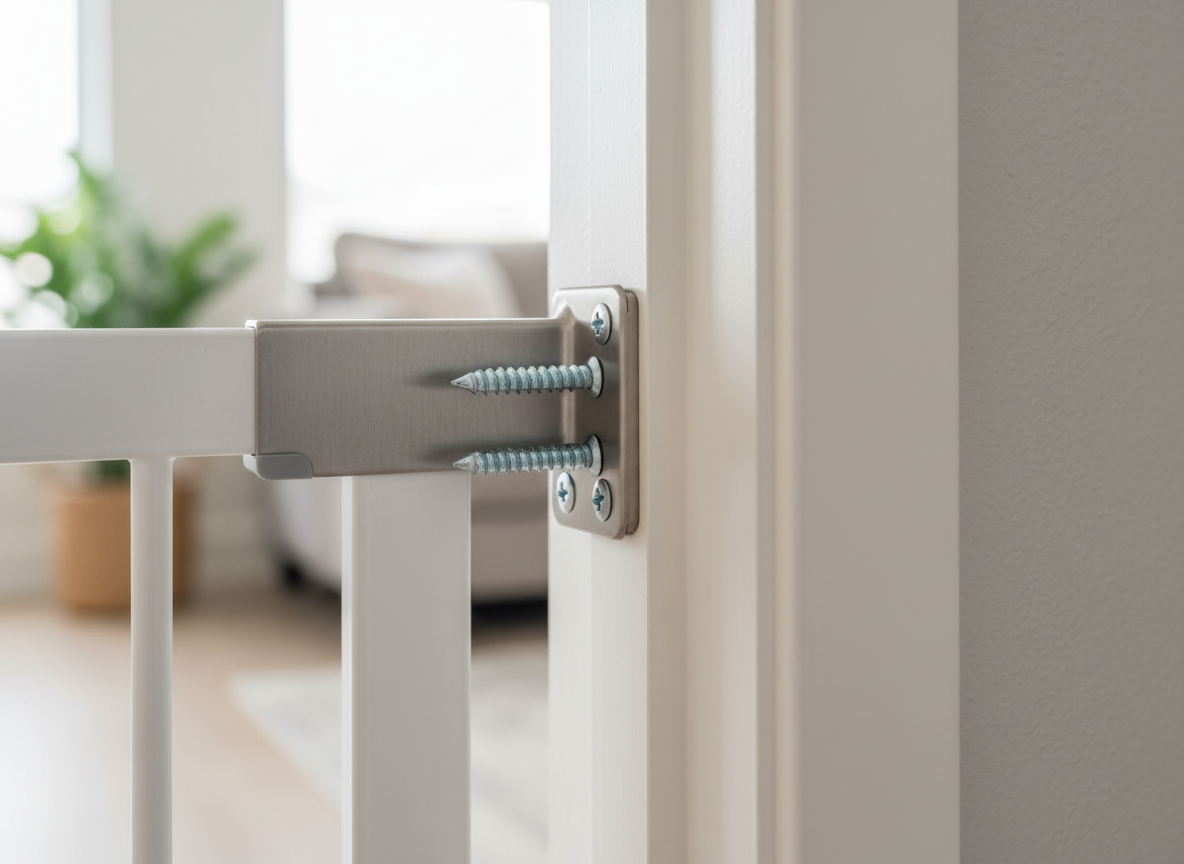
The gate frame can meet every standard and still fail if the installation is wrong. Brackets mounted in drywall alone, without hitting a stud, are the most common installation error I see when parents reach out about gate failures. Drywall anchors can hold light static loads, but they are not designed for the dynamic, repeated lateral force a toddler applies to a gate every day.
Standard stud spacing in U.S. residential construction is 16 inches on center. When studs are spaced further apart, finding two solid mounting points within the gate’s adjustable width range becomes difficult. Some parents compensate by mounting one bracket in a stud and one in drywall. That asymmetry means one side of the gate is anchored and one side is not. Under load, the gate pivots around the solid anchor point, and the drywall side fails.
Installation errors, including brackets placed in drywall instead of studs or gates installed at an angle, undercut whatever strength the gate was built with. The federal push-out test is run with the gate in a test fixture, not in your wall, so a lab pass assumes a sound installation. A gate that passed in the lab can still turn marginal when half its anchors are in drywall.
Proper installation, using a stud finder, pre-drilling pilot holes, and checking bracket alignment with a level, takes longer than eyeballing it. That’s not excessive for something standing between a toddler and a staircase.
Hardware Quality and the Weak-Link Problem
A gate is a system. The frame, the hinges, the latch mechanism, and the mounting brackets all contribute to overall force tolerance. The weakest component sets the ceiling for the whole assembly.
Inexpensive gates frequently use thinner gauge metal for hinges and lighter fasteners at bracket attachment points. These components can fail in daily use even when the gate as a whole passed the standard’s tests when new. The frame passes the test. The hinge bends. The gate opens.
Price alone doesn’t tell you how strong a gate is. In my experience, gates in the $40 range can feel solid while gates over $100 show visible hinge flex under moderate hand pressure. Read hardware specs, not just marketing copy. Look for gates that specify hinge material and bracket construction, not just compliance with ASTM standards.
Material Fatigue and the Lifespan Problem
A gate that passed load testing at the time of purchase may not be the same gate six months later. Material fatigue is real. Repeated stress from daily opening, closing, and child contact weakens joints and hinges over time. Metal fatigues at stress points. Plastic components crack at weld lines. Latch mechanisms wear and develop play.
In my experience, gates can degrade without visible failure. A gate may develop a rattle at the hinge or a latch that requires noticeably less force to open than it once did. Both conditions indicate the gate is past its safe service life even though it hasn’t broken.
The inspection protocol matters. Check your gates periodically for bent frames, cracked welds, loose fasteners, and worn hinges. A gate with a bent frame has already absorbed a load event it wasn’t designed to handle repeatedly. Loose fasteners at the mounting bracket mean the anchor is degrading. Any of these defects reduces the gate’s ability to withstand force, and the degradation accelerates once it starts.
Gate Height, Center of Gravity, and Climbing Force
Taller gates have a higher center of gravity. When a child climbs a tall gate and applies force at the top rail, the leverage on the mounting points is greater than the same force applied at mid-height. Physics doesn’t care about ASTM ratings.
Gates marketed as "extra tall" for climbing-prone children are a good idea in principle. But they need to be installed with particular attention to bracket placement and stud anchoring, because the mechanical advantage a climbing child gains increases with gate height. A 36-inch gate with solid hardware installation handles a climbing toddler better than a 42-inch gate with marginal anchors.
Gate design also affects how force distributes across the frame. Gates with horizontal bars or rails give children natural footholds and handholds. Mesh or vertical-bar designs offer fewer purchase points and tend to discourage climbing more effectively. If you have a child who climbs everything, gate design is part of the load equation.
Gate Installation and Inspection Checklist
What to Do Before You Trust Your Gate
Walk through this before you consider the gate installed and functional.
The Bottom Line on Force and Failure
The ASTM F1004 minimum is a starting point, not a safety guarantee. A gate’s real-world force tolerance depends on hardware quality, installation accuracy, wall composition, how your child interacts with it, and how long it’s been in service. Hardware-mounted gates at the top of stairs are non-negotiable. Pressure gates belong only in low-consequence locations. And no gate, regardless of price or certification, performs better than its weakest component or its worst anchor point.
Inspect your gates. Know how your child uses them. Replace them when the hardware shows wear. The gate you installed 18 months ago may not be the gate you think it is today.